You’ve picked a destination. Maybe even your dates. Then the planning spiral starts. One tab says a neighborhood is unmissable, another says it’s overcrowded, a forum thread from years ago recommends a hotel that no longer fits your trip, and a glossy roundup gives you inspiration but almost no logistics.
That’s the problem with travel destination guides in 2026. There isn’t a single “best” one. There’s a best one for the kind of trip you’re taking, the planning stage you’re in, and the level of detail you need right now.
That distinction matters more than ever because guide formats have shifted sharply toward digital access. Online platforms now account for 56.67% of tourism guidance service access globally, while mobile apps are the fastest-growing segment, projected to expand at a 9.58% CAGR, according to Roots Analysis on tourism guidance services. In practice, that means the strongest planning stack often mixes a classic editorial guide with a mobile-friendly companion you can effectively use on the move.
Travel destination guides themselves have always evolved with traveler behavior. Travel guides emerged as a distinct commercial genre in American publishing during the 1820s and 1830s, when publishers began packaging practical information and curated travel narratives for broader audiences, as described by Encyclopedia.com’s history of travel guides and accounts. The best modern guides still follow that template. They combine logistics, editorial judgment, and a point of view.
This list treats them as a planner’s toolkit, not a popularity contest. Each pick earns its place because it solves a different planning problem well, whether that’s building a first international itinerary, tightening a city break, adding unusual stops, or finding a more polished luxury short list.
1. Lonely Planet
If you want one travel destination guide that can carry most of a trip from idea stage to airport departure, Lonely Planet is still the easiest default.
Its core strength is range. You can start with broad destination inspiration, move into country or city pages, then drill into practical basics like transport, money, and safety without changing editorial voice. That consistency matters when you’re planning a trip with multiple stops and don’t want to reconstruct your assumptions every time you open a new guide.
Best for first-time international planners
Lonely Planet works best for travelers who need a generalist. Not a hyper-local nightlife editor, not a luxury specialist, and not a pure hidden-gems archive. It’s strongest when you want balanced coverage of general information for a new destination.
That makes it especially useful if you’re building your first overseas itinerary and need a framework before you optimize details. If you’re still sorting flights, pacing, and country-to-country basics, pairing it with a practical primer like this guide on how to plan a trip abroad makes sense.
Practical rule: Use Lonely Planet to shape the skeleton of the trip. Then use narrower guides to improve individual days.
Its downloadable chapters and app also fit the broader shift toward mobile trip support. That doesn’t make every Lonely Planet entry equally deep, but it does make the platform easier to use as an active planning tool rather than a one-time read.
Where it wins and where it slips
Lonely Planet’s biggest advantage is that it rarely leaves you without a starting point. For mainstream destinations, that breadth is reassuring. For less-covered places, the trade-off is uneven depth.
A few strengths stand out:
- Broad format coverage: You can move between web content, print, chapters, and app access without relearning the product.
- Good planning basics: It usually answers the early questions that stall planning, especially around movement and trip setup.
- Strong for repeatable workflows: Travelers who plan often can use the same approach across many destinations.
Its weakness is subtle but important. Because Lonely Planet aims to cover so much, some entries feel sharper than others. If your trip depends on deep neighborhood knowledge, fast-changing restaurant scenes, or highly current event planning, you’ll often need a second source.
That doesn’t lower its value. It clarifies its role. Lonely Planet is the toolkit’s anchor guide, not always the final word.
2. Fodor’s Travel
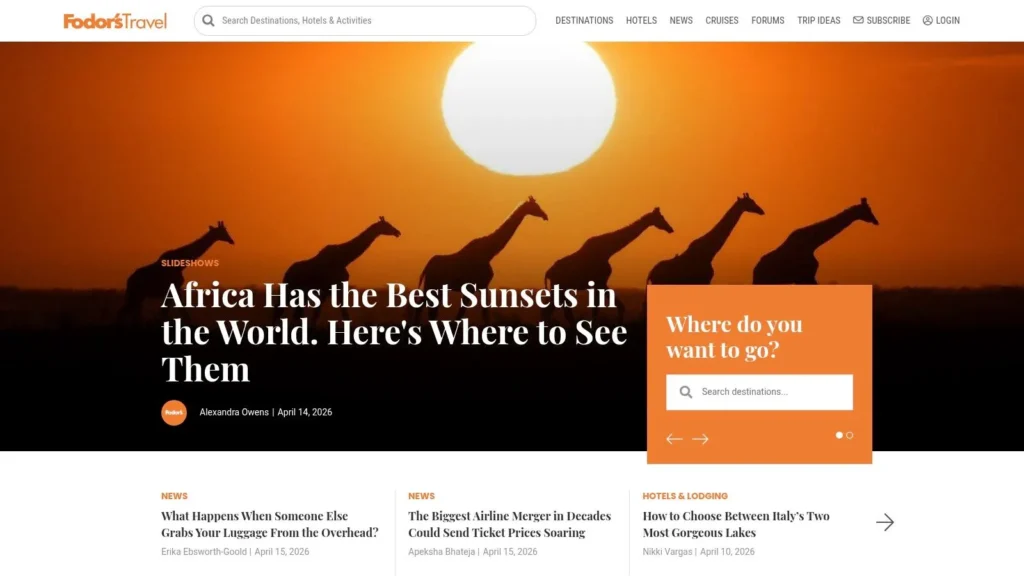
Fodor’s Travel is the guide I’d hand to someone who doesn’t want to browse for hours. It gets to recommendations quickly, and it usually does so with enough editorial confidence that you can make decisions instead of collecting possibilities forever.
That difference matters because too many travel destination guides confuse abundance with usefulness. Fodor’s tends to avoid that trap. Its country and city destination hubs, best-of lists, and itinerary content are built for narrowing choices, not multiplying them.
Best for fast planning and classic editorial curation
Fodor’s works best when your planning window is short. Maybe you already know the city, country, or region and just need a clear editorial short list of where to stay, eat, and spend limited time.
Its tone is more concise than sprawling. That makes it especially useful for travelers who value editorial selection over exhaustive cataloging. If you’re in the “just tell me the strongest options” phase, it’s efficient.
For broader idea generation before you commit, a destination roundup like these places to travel in the world pairs well with Fodor’s more decision-oriented destination pages.
Fodor’s is strongest when indecision is the main problem.
The trade-off for that speed
The same concision that makes Fodor’s easy to scan can also make it feel lighter in less-visited regions. You’re not always getting deep cultural layering or unusually broad place coverage. You’re getting edited judgment.
That’s often a good deal. Especially for trips where time is constrained and the cost of overresearch is missing reservations, overbuilding the itinerary, or wasting half a day comparing similar neighborhoods.
A practical way to think about Fodor’s:
- Best for city-and-country triage: It helps you decide what matters most, fast.
- Best for travelers who like a familiar voice: The brand’s long editorial tradition is part of the appeal.
- Less ideal for edge-case trips: If you’re heading somewhere remote or niche, another guide may cover more ground.
Fodor’s also sits in an interesting middle position in the toolkit. It’s more curated than broad travel databases, but less niche than a city specialist like Time Out or an experience specialist like Atlas Obscura. That makes it useful when you want a dependable editorial baseline before adding more specific layers.
3. Rough Guides
A common planning problem starts after the destination is chosen. You know you do not want a generic checklist, but you also do not want to coordinate every transfer, hotel stop, and local decision from scratch. Rough Guides is one of the few tools in this lineup built for that middle ground.
Its editorial voice assumes the reader wants agency. The writing is practical, but it usually gives enough cultural and on-the-ground context to help you make better choices, not just faster ones. That makes Rough Guides a useful part of a planner’s toolkit for trips that need both judgment and flexibility.
Best for independent trips with selective planning support
Rough Guides is strongest for travelers who like building their own trip framework, then want help with the parts that become time-consuming or fragile. Its tailor-made trips service is the differentiator. Few guide brands combine destination editorial with a direct path to local planning support in the same ecosystem.
That matters for a specific kind of traveler. Someone planning a self-directed itinerary through multiple regions may enjoy choosing the route, pace, and priorities, but still want a specialist to handle the hotel sequence, transfers, or hard-to-verify local logistics. Rough Guides serves that use case better than a guide built only for inspiration or only for booking.
It also pairs well with trips that have an activity layer. If the itinerary includes trekking, remote transport, or multi-stop outdoor travel, this overview of different styles of adventure travel helps clarify whether you need pure DIY planning or some local support.
What Rough Guides does well
Its strength is not speed. It is useful judgment.
Several traits make it stand out:
- Independent-travel orientation: The content generally respects readers who want control over routing, budget, and daily decisions.
- Context that affects choices: Rough Guides often explains neighborhoods, regional differences, and cultural patterns well enough to change where you stay or how long you allocate.
- Hybrid planning model: The tailor-made option is valuable once research stops being interesting and starts becoming administrative work.
This gives Rough Guides a distinct role in the toolkit. Fodor’s is often better for fast narrowing. National Geographic Travel is often better for meaning, nature, and destination appeal. Rough Guides is often better when the actual question is how to turn a self-directed idea into a workable trip without handing over the whole process.
The trade-off
Coverage consistency on the website can vary. Some destination pages feel richer than others, and the web experience does not always match the depth people associate with the brand’s print reputation. Travelers looking for highly standardized destination pages may notice that unevenness.
Even so, Rough Guides remains a strong choice for readers who want a trip to feel researched and shaped, not just booked. For independent travelers who want backup only where it counts, that is a specific advantage, not a minor feature.
4. National Geographic Travel
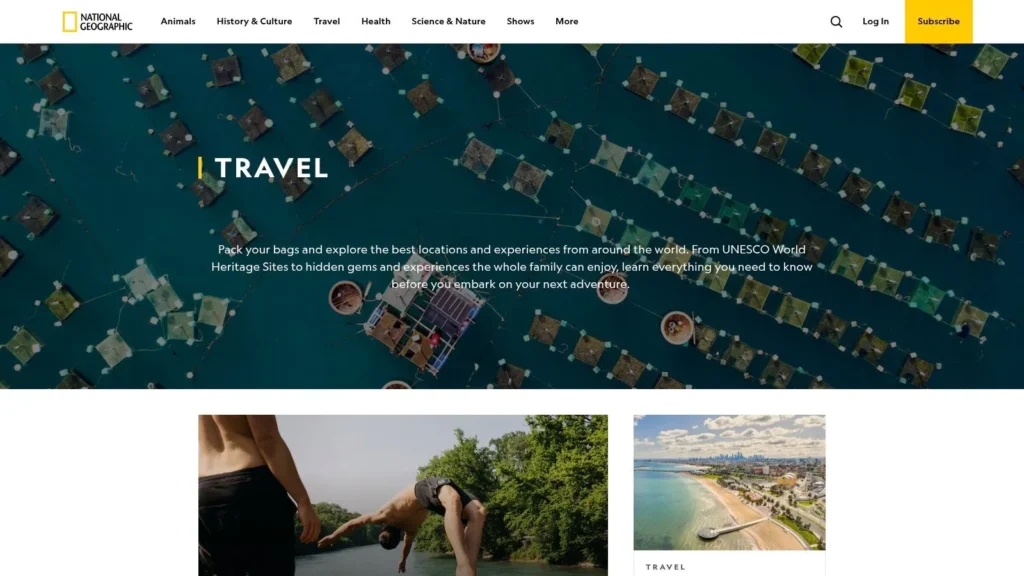
You have a week to plan a trip and too many plausible options. One guide shows hotel grids and top attractions. National Geographic Travel helps with the earlier decision. Which places carry enough ecological, historical, or cultural weight to justify the trip at all?
That makes it one of the more distinct tools in this planner’s toolkit. National Geographic Travel is strongest at the point where inspiration needs evidence. Its destination coverage focuses on scenery, wildlife, heritage, photography, and conservation, so it often clarifies what makes a place distinctive before you start comparing routes or room rates.
Best for nature, culture, and meaning-rich trip design
This is the guide to reach for when the trip centers on national parks, historic places, cultural sites, or wildlife-focused travel. It works especially well for travelers who want the destination’s significance explained, not just listed. A park, archaeological site, or river route becomes easier to prioritize when the guide explains why it matters and what kind of experience it offers.
It is also useful early in the planning process, when the bigger question is what type of trip you are building. Travelers shaping a hiking, wildlife, expedition, or conservation-focused itinerary may also find this overview of what adventure travel includes helpful as a separate planning reference.
Heritage-driven travel has grown well beyond a niche interest, as noted earlier in the article. That shift increases the value of a guide brand that treats history, preservation, and sense of place as core trip-planning inputs rather than decorative background.
Where it outperforms more logistics-first guides
National Geographic Travel usually does its best work on trip intent. It helps answer questions that influence the entire itinerary: why this region instead of another one, why this season, and what you are likely to remember once the trip is over.
That strength has practical value. Better context often leads to better allocation of time. Travelers are less likely to rush through a heritage site, underestimate a scenic route, or treat a culturally significant stop as filler if the guide has already explained its relevance.
The limitation is clear. National Geographic Travel is not built to be your only planning source. It is less useful for side-by-side hotel comparison, dense transport detail, or highly tactical urban scheduling, and some articles may sit behind access controls depending on format.
Used correctly, that is not a weakness. It is role clarity. In a planner’s toolkit, National Geographic Travel is the best for trips where meaning shapes the itinerary. Use it to choose the right destination and define the trip’s purpose, then pair it with a more tactical guide to handle execution.
5. Time Out
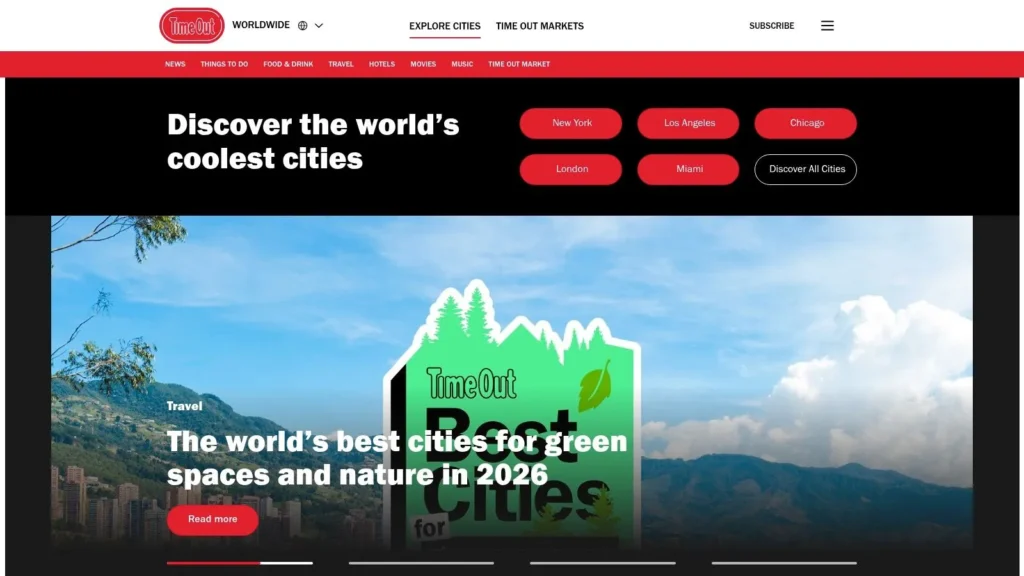
If your trip lives or dies by where you eat tonight, what neighborhood you walk through after dark, and which current exhibition or opening is worth your limited time, Time Out is the right tool.
Its city bias is not a limitation to apologize for. It’s the whole point. Time Out is one of the clearest examples of why travel destination guides work better as a toolkit than as a single-source religion. For major metros, it often knows what feels current in a way broader guide brands can’t match.
Best for city breaks and right-now culture
Time Out is strongest in places where “up to date” matters more than completeness. Restaurants change. Bars peak and fade. Neighborhoods shift. Event calendars move fast. A city guide that can’t handle that tempo becomes background noise.
That makes Time Out especially useful for short trips. Weekend breaks. Add-on city stops. Food-led urban itineraries. If you already know the canonical landmarks, Time Out helps answer the more valuable question: what’s happening in the city while you’re there?
Its neighborhood guides and local-editor curation are what make it practical. Rather than forcing you to build a city from top attractions outward, it often lets you plan from vibe, district, and interest.
Where it stops being enough
Time Out’s weakness is the mirror image of its strength. It’s not built for rural planning, nature-heavy trips, or broad country logistics. If your itinerary includes mountains, drives, ferries, border crossings, or regional hopping, another guide has to carry that load.
That’s fine. It isn’t trying to be universal. It’s trying to make urban time sharper.
A few situations where it shines:
- Short city trips: You can build a compact, current itinerary quickly.
- Food and nightlife planning: It’s stronger than classic guidebooks on what feels alive now.
- Neighborhood selection: It helps you decide where to stay based on the trip’s mood, not just map centrality.
Time Out also solves a common planning mistake. Travelers often overinvest in monuments and underinvest in city texture. The memorable parts of many urban trips aren’t only landmarks. They’re the street you walked before dinner, the market you found because an editor flagged the area, or the event you would’ve missed in a static guide.
For city breaks, that’s a real competitive edge.
6. Condé Nast Traveler
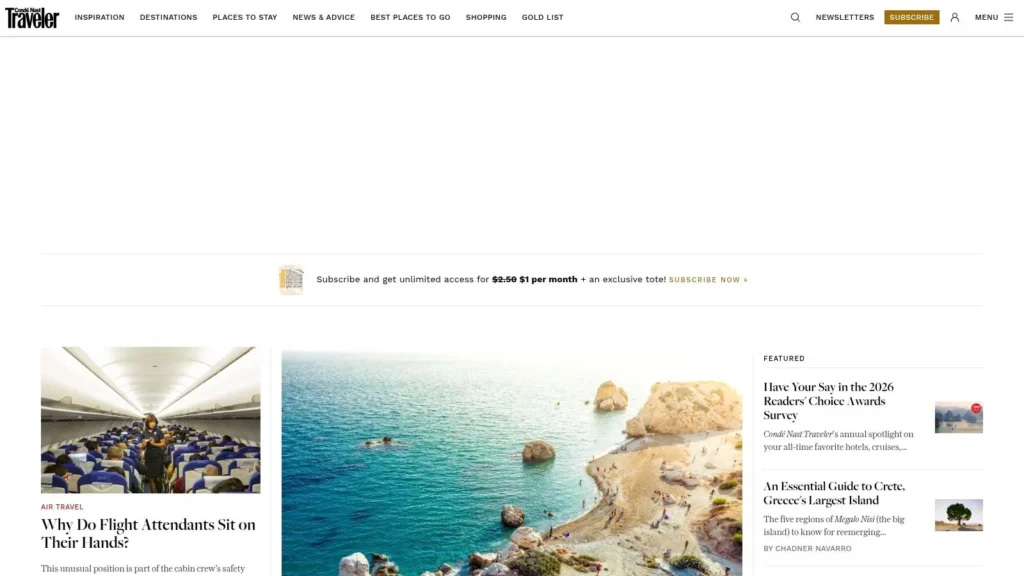
Condé Nast Traveler is the guide to use when the quality of the stay is part of the destination. Not just a bed between activities, but a defining part of the trip.
That makes it a very different instrument from a broad guidebook brand. Its value is concentrated in curation, presentation, and hotel-and-restaurant shortlisting. If you care about experience design, not just destination coverage, Condé Nast Traveler earns a spot in the stack.
Best for polished stays and aspirational shortlists
Condé Nast Traveler is strongest when you want to compare high-standard options quickly. Its city and country guide hubs, editorial picks, and accommodation roundups can compress a lot of premium-market browsing into a manageable set of choices.
That’s useful even if you don’t book the most expensive option on the page. A polished editorial list can still help you understand the top end of a market, identify which neighborhoods attract stronger hospitality design, and spot where a trip’s money is best spent.
Its photography and editorial finish also make it one of the better inspiration tools for travelers who respond to atmosphere. Some guides are excellent at facts but poor at helping you imagine the trip. Condé Nast Traveler rarely has that problem.
The bias you need to account for
The brand’s taste level is also its filtering mechanism. You’re getting a skew toward mid-range to high-end experiences, and budget coverage is lighter.
Use Condé Nast Traveler when you want to raise the quality bar, not when you need the broadest price spectrum.
That doesn’t make it elitist by default. It makes it selective. If your trip depends on identifying standout hotels, restaurants, and polished experiences with minimal noise, the bias is helpful. If you’re backpacking, trying to compare every transport scenario, or hunting for the cheapest workable plan, it’s the wrong lead guide.
A practical way to use it is as a standards check. Run your shortlist through Condé Nast Traveler after you’ve done broader planning elsewhere. If a neighborhood, hotel category, or dining scene repeatedly appears in its editorial ecosystem, that often tells you where quality has clustered.
For design-conscious travelers and special-occasion trips, that signal is valuable.
7. Atlas Obscura
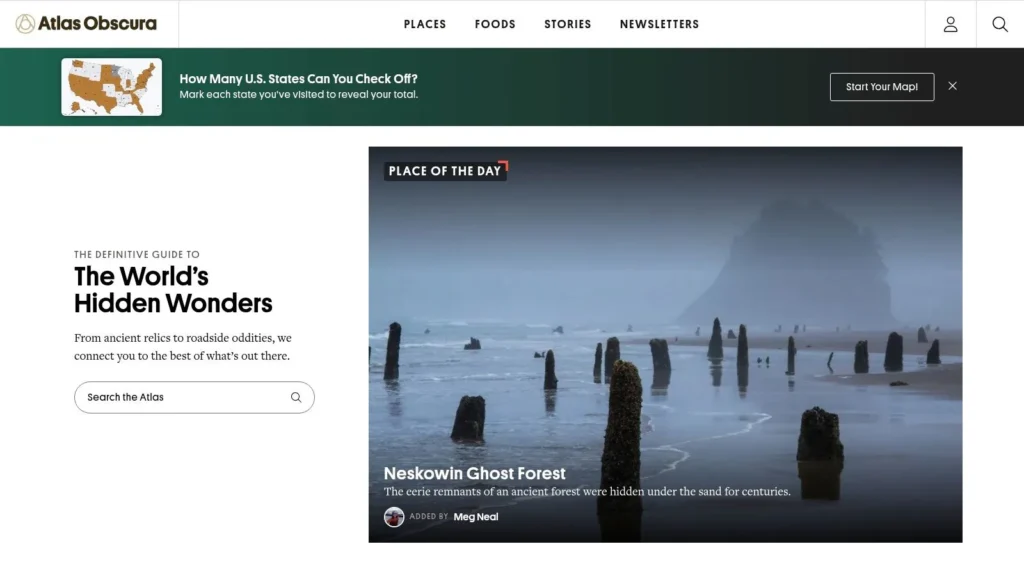
Atlas Obscura is not the guide you use to build a whole trip from scratch. It’s the guide you use to save a trip from becoming generic.
That distinction is important because “hidden gems” content has become one of the weakest categories in travel media. Static lists age badly. Places change. Access changes. Visibility changes. Some formerly under-the-radar places become crowded as soon as enough roundups repeat them.
Best for off-the-beaten-path additions
Atlas Obscura excels at finding the strange, specific, and memorable stop that broad guide brands miss. Odd museums, overlooked architecture, unusual local history, intriguing natural features, and place-based stories are its territory.
For planners, that makes it a high-value secondary source. Build the main route elsewhere. Then use Atlas Obscura to insert one or two stops that alter the tone of the trip.
That matters more than it seems. A standard itinerary often fails not because it lacks quality, but because every stop is too expected. Atlas Obscura widens the trip’s emotional range.
Why it works better as a layer than a lead guide
There’s also a caution embedded in this category. A recent analysis of hidden-gem travel content argued that many guides still treat underrated destinations as static discoveries rather than places affected by climate shifts, changing accessibility, and emerging overtourism, as discussed in this analysis of hidden gems and climate-related travel planning. That criticism applies to the genre more broadly, not only to Atlas Obscura, but it’s useful context.
Atlas Obscura’s own role is clearer when you don’t ask it to solve logistics. It’s not your hotel engine, your transport planner, or your all-purpose destination brief. It’s your originality engine.
A smart way to use it:
- Add one unusual stop per day: Enough to diversify the trip without derailing it.
- Use the app in transit: It’s especially useful when you’ve got an open afternoon.
- Pair it with a logistics-heavy guide: That keeps curiosity from turning into friction.
Its paid trips and thematic guides can also appeal to travelers who want unusual experiences without independently stitching together every oddball stop. But even if you never buy a trip, Atlas Obscura is one of the few travel destination guides that consistently improves surprise.
Top 7 Travel Destination Guides Comparison
| Guide | Implementation complexity | Resource requirements | Expected outcomes | Ideal use cases | Key advantages |
|---|---|---|---|---|---|
| Lonely Planet | Low, easy to use via web, app or print | Minimal, free web content; optional paid guides/downloads | Broad itinerary ideas and practical basics; depth varies by place | First‑time and repeat travelers wanting wide coverage | Extensive global coverage, versatile formats, inspirational lists |
| Fodor’s Travel | Low, concise, quick‑scan editorial guidance | Minimal, web access; optional print guidebooks | Clear, curated recommendations for where to stay/eat/do | Quick trip planning and travelers who want trusted picks | Familiar editorial voice and easy‑to‑scan planning pages |
| Rough Guides | Moderate, self‑planning plus optional tailor‑made service | Moderate, web/print use; paid custom trip service available | Detailed practical info and cultural context; bespoke itineraries if used | Independent travelers seeking depth or personalized itineraries | Balanced practical/cultural content and vetted local specialists |
| National Geographic Travel | Low, inspirational storytelling, not step‑by‑step logistics | Minimal to moderate, web access; some paywalled content | Inspiring ideas, nature/culture insight and travel essentials | Travelers focused on nature, culture and responsible travel | High‑quality photography and authoritative contextual reporting |
| Time Out | Low, highly focused, timely city info | Minimal, online access to local editorials and event listings | Up‑to‑date dining, events and neighborhood recommendations | Urban travelers and short city breaks wanting current picks | Timely, trend‑aware local expertise in major metros |
| Condé Nast Traveler | Low, polished, curated editorial content | Moderate, web access; some content/subscriptions may be required | High‑quality recommendations and hotel/restaurant comparisons | Travelers preferring premium, photo‑driven guidance and top picks | Strong editorial standards, photography and mid‑to‑high‑end coverage |
| Atlas Obscura | Low to moderate, discovery‑oriented, not full logistics | Minimal, free searchable database; paid small‑group trips optional | Unique, offbeat stops and themed discovery to enrich itineraries | Travelers seeking unusual attractions and niche experiences | Massive database of curiosities, thematic guides and an app |
How to Build Your Perfect Itinerary
Three browser tabs become ten fast. One source is good at rail routes, another is better at hotels, and a third keeps surfacing places that never appear on standard top-10 lists. The planning problem is usually not information scarcity. It is tool selection.
The most reliable itineraries come from using destination guides as a planner’s toolkit, with each guide assigned to a specific job. One source should handle trip structure. Another should improve the parts that matter most for that trip, such as food, context, or unusual stops. A third should help once plans start changing on the ground.
Start by choosing the guide that fits the trip type, not the guide with the biggest name. Lonely Planet works well as a base for multi-stop trips because it is strong on transport, route planning, and practical sequencing. Fodor’s is more useful when the main task is reducing options quickly through tighter editorial selection. Rough Guides tends to suit travelers who want stronger cultural background during research and may later add custom planning support. On a short city break, Time Out often deserves the lead role because restaurant turnover, neighborhood energy, and event timing shape the trip more than long-haul logistics.
Then fill the gap your lead guide leaves behind.
National Geographic Travel is a strong second source for travelers who care about history, natural scenery, and cultural meaning. Condé Nast Traveler is a better add-on when hotel quality, design, and dining standards will influence satisfaction more than museum coverage or route efficiency. Atlas Obscura works best as a targeted supplement for travelers who want a few memorable deviations from the standard circuit, not a full trip framework.
This method also reflects how people plan. Research often starts on a laptop, shifts to saved maps and phone notes, and continues during the trip itself. A print-oriented guide can still provide structure, but it usually performs better when paired with a source built for current openings, changing hours, and local developments.
Editorial perspective matters here. Every guide filters the same destination through a different priority set. Lonely Planet tends to emphasize practicality. Time Out prioritizes what feels current in a city. Condé Nast Traveler applies a more taste-driven lens. Atlas Obscura searches for novelty. Rely on only one source and that editorial bias shapes the whole trip, including what gets omitted.
A stronger approach is simpler than it sounds. Match each planning decision to the guide built for it. Use one source for route logic, one for the travel style you care about most, and one for live relevance after arrival. If you want another planning reference point, maxijournal.com can serve as a general travel reading source, but the smarter move is still to assign each guide a narrow role instead of asking one publication to do everything.
For most trips, three guides are enough. Pick a foundation. Add a specialist. Add a current-use source.
That is how travel destination guides become a working toolkit rather than a stack of overlapping recommendations.
Discover more from Maxi Journal
Subscribe to get the latest posts sent to your email.