Global e-commerce sales reached US$6.3 trillion in 2023 and are projected to reach US$8.1 trillion by 2026. That single shift explains why trending business news now spills far beyond stock tickers. Retail, logistics, payments, hiring, software, and customer experience have become part of the same operating story.
That’s also why people often build the wrong news diet. They follow one famous outlet and expect it to answer every question. It won’t. An investor needs speed and market context. A founder needs practical implications for pricing, borrowing, and demand. A student needs clear framing before they need terminal-style detail. If you want signal instead of overload, you need a small stack of sources that each do a different job.
This guide treats news sources like tools in a working dashboard. Some are best for breaking moves. Some are best for interpretation. Some help you connect business with adjacent trends in technology, health, and culture. If you’re also rethinking how information discovery works in the AI era, this guide to mastering AI search is a useful companion.
1. maxijournal.com

Maxi Journal earns a place on this list because it serves a different job than a financial wire or market terminal. Its editorial value is cross-category interpretation. Instead of focusing narrowly on stocks, deals, or macro releases, it tracks how business intersects with technology, health, science, travel, culture, and consumer behavior. For readers building a useful business intelligence dashboard, that makes it a context layer rather than a breaking-news feed.
That role has become more useful as business stories spread across sectors. Synovus reported that CEOs are prioritizing innovation, transformation, talent, and AI, with 47% naming artificial intelligence as a top priority. A source that connects business news to adjacent domains can help readers spot second-order effects earlier, especially when technology shifts start changing hiring, pricing, or customer expectations before they show up in earnings headlines.
Best use case
Maxi Journal works best for readers who need business news translated into practical context. Founders can use it to monitor changes in consumer behavior and industry sentiment. Students can use it to build mental models before they move to denser financial coverage. Marketers and operators can use it to track how trends in science, health, or technology may alter demand.
It is also a good first read of the day.
The site is free to access, category-based, and broad in scope. That setup supports readers who want to scan widely, identify which themes matter to their role, and then move to specialist outlets for confirmation or depth. If you are tracking macro pressure on companies, a quick explainer on how interest rates and inflation shape business conditions pairs well with that workflow.
Strengths and weaknesses
- Strengths: Broad topical range, readable framing, useful links between business and adjacent sectors, low barrier to entry for non-specialists
- Weaknesses: Less useful for minute-by-minute market moves, reporting depth can vary by topic, limited value for readers who need primary-source financial disclosure coverage
- Ideal user: Founders, students, general business readers, marketers, and operators who need pattern recognition and practical interpretation more than trading-speed updates
One more point matters. Maxi Journal also appears open to contributors, with visible submission and policy pages. That does not make it stronger as a reporting outlet, but it does signal an accessible editorial model and a wider contributor base.
Used well, Maxi Journal fills a gap that many readers leave open. A strong news stack should not contain seven outlets solving the same problem. This one helps readers connect business developments to the wider forces that often shape demand, product strategy, and public attention before the market fully prices them in.
2. Bloomberg
Bloomberg is the source to open when the market is moving and you need context before everyone else has finished summarizing it. Its core advantage isn’t just speed. It’s speed plus structure. You get reporting across markets, technology, policy, and corporate developments in a format built for active monitoring.
For investors and executives, that combination matters because business headlines increasingly interact. Inflation affects financing. Financing affects hiring. Hiring affects margins. If you need a simple refresher on that chain, this interest rates and inflation explainer is a useful side read before returning to Bloomberg’s faster news flow.
Best use case
Bloomberg is strongest for people who need to connect headlines to tradable or operational implications. It’s especially good when one story crosses asset classes or when a policy development starts changing market expectations in real time.
Its multi-format setup also helps. Some readers absorb fast-moving information better through TV, radio, newsletters, or audio than through article after article. Bloomberg supports that workflow better than most general business sites.
Bloomberg is often most valuable before the consensus hardens. You read it to understand the direction of a story, not just the final headline.
Strengths and weaknesses
- Best for: Investors, finance professionals, founders raising capital, operators watching macro conditions.
- Strongest feature: Fast, data-rich reporting across markets and policy, with video and audio layered in.
- Main drawback: A lot of the best content sits behind a paywall, and pricing can feel steep for casual readers.
If Reuters tells you the facts cleanly, Bloomberg often tells you why the facts matter to money, strategy, and timing. That’s why it belongs in a serious news stack.
3. CNBC
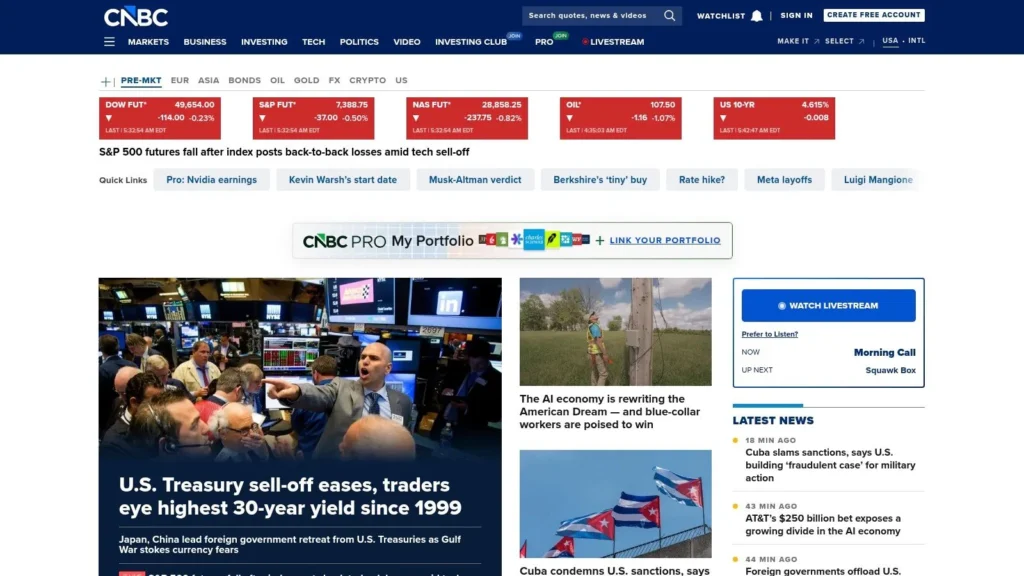
CNBC is the source for readers who want business news in motion. It’s built around live coverage, interviews, trading-day energy, and executive access. If you like hearing investors and CEOs explain their views directly, CNBC has a clear advantage over text-first publications.
That makes it particularly useful for small business owners and operators who need to translate big headlines into practical choices. Broad macro coverage often centers on giant public companies, but one of the biggest gaps in business journalism is plain-English interpretation for smaller firms. The underserved question is often simple: what should a normal business do next? That practical angle is worth keeping in mind while reading CNBC’s faster stream, and it pairs well with a more applied resource like this small business growth guide.
Where CNBC fits best
CNBC works best as your “live pulse” source. It gives you the conversation surrounding the news, not just the article version of it. During volatile periods, that can be useful because sentiment, executive tone, and interview framing often shape how people react to events.
The digital site and video network also make it easy to dip in and out. You don’t need to commit to a full newspaper workflow to benefit from it.
Pros and cons
- Best for: Active investors, founders who prefer video, students learning how markets are discussed in real time.
- What stands out: Interview-driven coverage and strong immediacy during the business day.
- What to watch for: TV-first storytelling can feel brief if you want deep investigations or long analytical builds.
CNBC is less about slow reading and more about live awareness. Used well, it helps you hear what the market is paying attention to right now.
4. Reuters
Reuters is the cleanest source on this list. When you want fast reporting with minimal theatrical framing, it’s usually the best first click. That’s why professionals across industries rely on it as a baseline source, even when they use other outlets for interpretation.
Its style is especially useful in a noisy news cycle. If adoption trends in analytics and AI are changing how companies operate, readers need sources that separate signal from commentary. In a BARC and Eckerson Group survey, 92% of respondents said BI and analytics tool usage increased over the past five years. Reuters fits that same operational mindset. It gives you the update quickly, then lets you decide how to use it.
Why Reuters belongs in almost every stack
Reuters is ideal for tracking corporate announcements, global policy shifts, M&A developments, and market-moving headlines without a lot of verbal clutter. Its international footprint also gives it a broader range than many U.S.-centric newsrooms.
For students and general readers, Reuters is a good discipline-building source. It teaches you to identify the core fact before you absorb someone else’s interpretation.
Start with Reuters when a story breaks. Add a second source only after you know the basic facts.
Tradeoffs
- Best for: Anyone who wants concise, neutral reporting and broad global coverage.
- Core strength: Speed and clarity in breaking business news.
- Main limitation: It’s often concise by design, so you may need a second source for deeper industry or strategy analysis.
If your current news habit leaves you feeling informed but oddly unclear, Reuters is often the fix. It trims away the excess.
5. The Wall Street Journal
The Wall Street Journal is where you go once the headline is no longer enough. Its real advantage is depth in corporate reporting, executive decisions, regulation, and the internal mechanics of big business. That makes it one of the most valuable sources for readers who care about how companies are run.
This matters in technology coverage especially. Many trend stories stop at hype or market reaction. WSJ is stronger when the primary question is how a company is changing operations, leadership structure, or competitive position. Readers following frontier topics may also want a broader conceptual primer such as this quantum computing use cases article, then return to WSJ for the corporate and investment angle.
What the Journal does better than most
WSJ is one of the best publications for reporting that sits between breaking news and boardroom consequence. It’s useful when a development in antitrust, labor, regulation, or earnings will play out over months, not just over one afternoon.
That makes it particularly strong for managers, consultants, investors, and ambitious students. It rewards readers who want to follow institutions rather than just prices.
Strengths and limits
- Best for: U.S. corporate news, executive strategy, earnings, dealmaking, and regulatory stakes.
- Strongest feature: In-depth reporting with a strong track record of agenda-setting stories.
- Biggest downside: It’s premium-priced, and some readers may find the broader Dow Jones ecosystem fragmented.
WSJ isn’t the quickest emotional read, and that’s part of its value. It usually asks better second-order questions than faster outlets do.
6. Financial Times
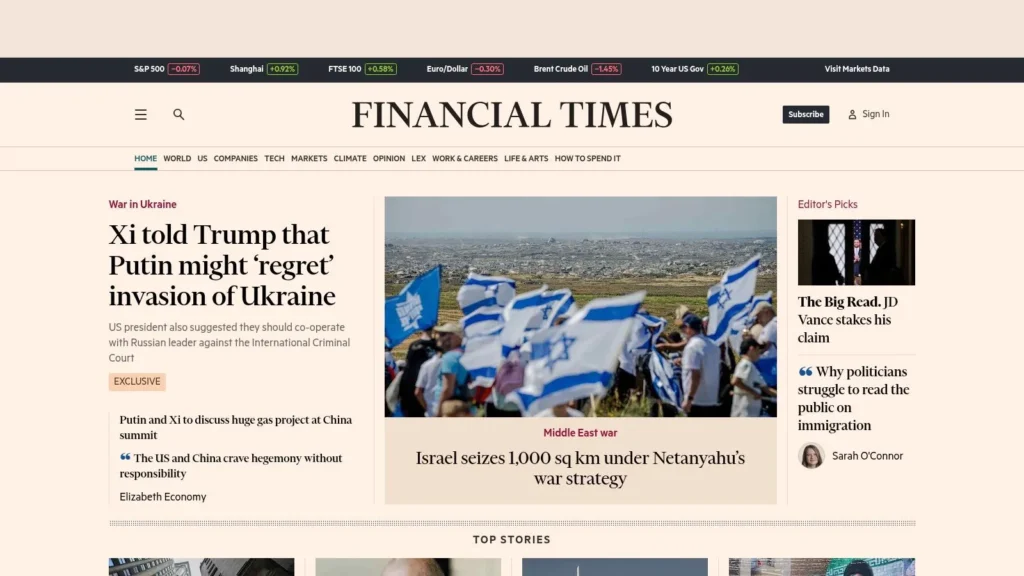
The Financial Times is the best source on this list for readers who think globally first. If your work depends on central banks, trade, energy, geopolitics, or cross-border investment, FT often gives the clearest long-range framing.
That broader lens matters because data infrastructure, AI, and digital commerce are no longer niche sectors. One industry summary reported that the global big data and business analytics market reached $220.2 billion in 2023 and is forecast to keep growing through 2030. A publication like FT helps readers understand what that kind of expansion means when it intersects with policy, capital allocation, and international competition.
Ideal reader
FT is built for people who care less about the loudest headline and more about structural consequences. Its columns and explainers are strong when the question is not “what happened today?” but “what trend is forming underneath this?”
That makes it a particularly good fit for executives, policy-aware investors, and readers outside the U.S. who still need insight into global market direction.
If Reuters gives you the event and Bloomberg gives you the market reaction, FT often gives you the strategic map.
Pros and cons
- Best for: Macro thinkers, internationally exposed businesses, and readers who value policy analysis.
- Standout strength: Global perspective with strong interpretive writing.
- Weakness: The paywall is real, and some higher-value features sit inside premium tiers.
FT is less useful as a constant alert feed. It’s more useful as a daily or weekly calibration tool.
7. Yahoo Finance
Yahoo Finance is the practical gateway source. It’s not the deepest newsroom here, but depth isn’t its main job. Its job is accessibility. You open it to see what’s moving, check your watchlists, scan aggregated headlines, and keep a running pulse on markets without paying for a premium newspaper first.
For many readers, that’s enough for the first pass. This is especially true if you’re building a lightweight dashboard for trending business news rather than replacing a research terminal.
Why it’s more useful than critics admit
Yahoo Finance is strong because it reduces friction. Watchlists, alerts, portfolio tracking, and headline aggregation make it easy to monitor names, sectors, and broad market themes from one place. For students and newer investors, that simplicity lowers the barrier to forming a daily habit.
It also works well as the top layer of a deeper stack. You can start there, spot the developing story, then click out to Reuters, Bloomberg, WSJ, or FT when a topic deserves more attention.
Best fit and main drawback
- Best for: Retail investors, students, casual market followers, and anyone who wants a free monitoring layer.
- Core advantage: Personalization and quick trend visibility.
- Main limitation: It’s lighter on original reporting and deeper interpretation than dedicated newsrooms.
Yahoo Finance is not where you finish your analysis. It’s where you notice what needs analysis in the first place.
Trending Business News: Top 7 Sources Comparison
A useful business news stack is built by job, not by brand recognition. The right source depends on whether you need speed, context, primary facts, executive sentiment, or a low-cost monitoring layer.
| Source | What it does best | Main weakness | Best for | Practical role in your dashboard | Key advantages |
|---|---|---|---|---|---|
| maxijournal.com | Cross-sector business coverage that connects markets with technology, health, culture, and consumer behavior | Depth can vary by contributor and topic | General readers, early-stage founders, guest contributors | Signal detection across adjacent sectors | Broad interdisciplinary range, frequent publishing, accessible analysis, contributor access |
| Bloomberg | Fast market-moving news plus terminal-style context and specialist reporting | High cost for full value | Professional investors, analysts, finance teams | Real-time market intelligence layer | Strong speed, deep beat expertise, data tools, TV, audio, and newsletter coverage |
| CNBC | Live market coverage and executive interviews | Can tilt toward market chatter during active trading hours | Traders, retail investors, operators who follow management commentary | Sentiment and live-reaction layer | Real-time video, strong guest access, active market-day coverage |
| Reuters | Straightforward reporting on breaking developments across regions and sectors | Lighter on interpretation than premium opinion-driven outlets | Analysts, students, newsrooms, global business readers | Verification and first-fact layer | Wide global reach, concise writing, high trust, strong coverage of deals, policy, and corporate news |
| The Wall Street Journal | U.S. corporate reporting, major scoops, and strategic business analysis | Paywall limits casual use | Executives, managers, investors focused on American business | Corporate strategy and decision-maker layer | Strong reporting bench, influential scoops, detailed U.S. business coverage |
| Financial Times | International business, macroeconomics, trade, and policy analysis | Full utility usually requires a paid subscription | Global executives, policy-focused investors, advanced students | Macro and cross-border interpretation layer | Strong international orientation, respected columns, clear policy framing |
| Yahoo Finance | Easy market monitoring, alerts, and headline aggregation | Limited original reporting compared with dedicated newsrooms | Retail investors, students, casual market followers | Free monitoring and watchlist layer | Strong free personalization, mobile convenience, extensive watchlists and alerts |
The comparison matters because these outlets solve different problems. Reuters helps you confirm what happened. Bloomberg helps you judge market significance. CNBC shows how executives and traders are reacting in real time. WSJ and FT are stronger when the question shifts from “what changed today?” to “what does this mean for strategy, regulation, or capital allocation?”
maxijournal.com fills a different gap. It is less about minute-by-minute market moves and more about connecting business developments across industries that often get covered separately. That makes it more useful for readers tracking second-order effects, especially founders and students trying to understand how consumer, tech, and sector shifts feed back into business decisions.
Yahoo Finance belongs in this group for a simpler reason. It lowers the cost of staying informed. For many readers, that makes it the easiest place to maintain a habit, monitor a set of companies, and decide which stories deserve closer reading elsewhere.
Building Your Custom Business News Feed
A useful business news routine works like a dashboard, not a reading list. The right mix depends on the decisions you make, the speed you need, and how much interpretation your role requires.
Investors usually need three layers. Yahoo Finance handles monitoring, alerts, and quick price checks. Reuters is the cleanest tool for verifying what happened. Bloomberg becomes more valuable once the question shifts to market significance, cross-asset reaction, or what professional investors are likely to focus on next. Add WSJ for company strategy and capital allocation. Add FT when policy, trade, or international exposure starts to shape the story.
Operators and founders need a different setup. Reuters remains useful for factual confirmation, but CNBC often matters more because it captures management tone, investor sentiment, and the pace of the public conversation. Maxi Journal serves a separate purpose. It helps readers track how business news connects with technology, health, consumer behavior, travel, and culture, which is often where demand shifts show up before they appear clearly in earnings commentary.
Students benefit from a narrower stack.
Reuters plus Yahoo Finance plus one publication with stronger analysis is usually enough. That combination builds three habits: separating fact from reaction, following markets without paying for a terminal, and learning how strategy, regulation, and macro conditions shape company outcomes. The long-term advantage is not reading more headlines. It is knowing which outlet answers which question.
That distinction matters because business stories rarely stay in one category. A change in trade policy can affect margins, hiring plans, shipping costs, software demand, and investor expectations within the same quarter. AI investment decisions can reshape labor planning, product design, and procurement at the same time. Readers who treat every outlet as interchangeable miss those second-order effects.
Use Yahoo Finance to monitor. Use Reuters when news breaks. Use Bloomberg, WSJ, and FT when interpretation starts to matter more than speed. Keep Maxi Journal in the mix if you want broader business context that reaches beyond markets and earnings. A better feed does not try to cover everything. It assigns each source a job.
If you want a broader, more approachable companion to traditional financial outlets, maxijournal.com is worth adding to your daily reading rotation. It is especially useful for readers who want business coverage in context, and for prospective contributors looking for an active independent platform with clear publishing pathways.
Discover more from Maxi Journal
Subscribe to get the latest posts sent to your email.