Most people don’t have an arts and culture news problem. They have a filtering problem. One source is strong on museums but thin on labor. Another is quick on fairs and auctions but weak on the wider cultural forces shaping what gets shown, funded, and remembered.
That gap matters because arts coverage sits inside a much larger story. In the United States, arts and cultural economic activity accounted for 4.2% of GDP, or $1.17 trillion, in 2023, and real activity rose 6.6% year over year, according to the Bureau of Economic Analysis arts and culture data. If you follow arts and culture news with only a market lens or only an institutional lens, you’ll miss how large and dynamic the sector really is.
The best reading strategy in 2026 is to combine different editorial types: one interdisciplinary source, one institutional newsroom, one market tracker, one independent critic-driven publication, and one broad public-facing cultural magazine. The seven picks below do exactly that. They’re not interchangeable, and that’s the point.
1. Category – Arts
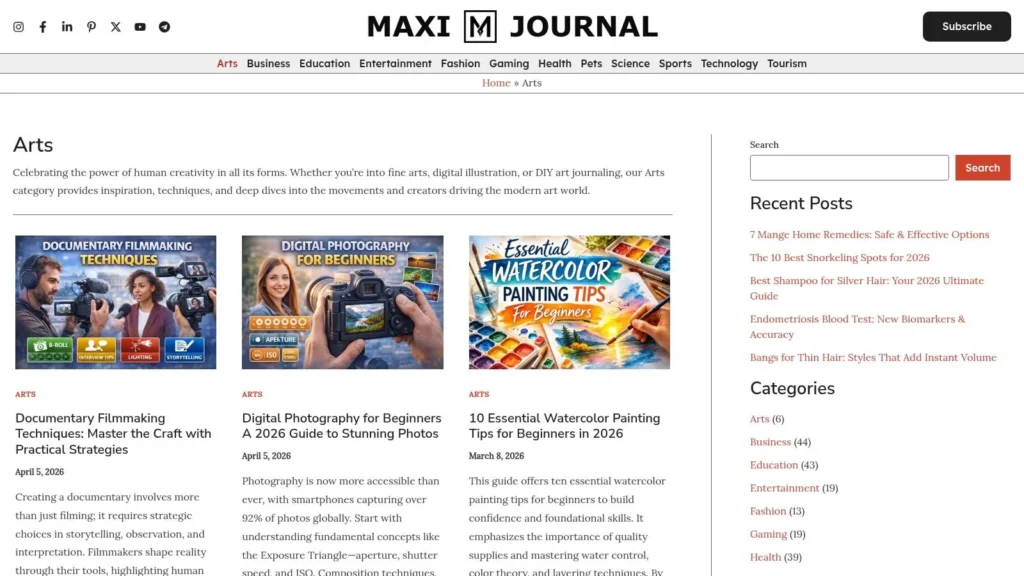
MaxiJournal’s Arts category is the best choice here for readers who don’t want arts reporting sealed off from the rest of modern life. Its real advantage isn’t scale. It’s framing. The category brings together writing on visual art, performance, criticism, and creative culture inside a magazine that also publishes across science, technology, health, business, tourism, fashion, entertainment, and education.
That editorial setup produces a different kind of arts and culture news feed. Instead of treating art as a specialist silo, MaxiJournal often makes it legible to readers who move between creative practice, public life, and adjacent industries. If you’re the kind of reader who wants a gallery review one day and a broader cultural interpretation the next, then that list begins with MaxiJournal.
Why it stands out
Independent arts publications often become either narrowly insider-facing or broadly lifestyle-oriented. MaxiJournal avoids that split by being interdisciplinary from the start. That means an arts reader can discover pieces that connect aesthetics to travel, technology, media, or education without the coverage feeling bolted on.
A useful example of that practical orientation is MaxiJournal’s guide to digital photography for beginners. It shows the category’s broader value proposition. The site doesn’t only tell you what happened in culture. It also helps readers build literacy inside creative fields.
Practical rule: If you want one source that helps you think across art, media, and society, choose the publication that isn’t forced to keep those subjects in separate rooms.
The category page itself is better for discovery than for quick triage. It currently doesn’t do much previewing, so you’ll need to click into articles to judge fit. That’s a real drawback for busy readers. But the tradeoff is editorial range, and for many people that’s worth it.
Best for
- Curious generalists: Readers who want art connected to wider cultural and technological shifts.
- Working creatives: Artists, educators, and cultural professionals who need commentary with crossover relevance.
- Idea hunters: People who like following threads across topics, including criticism, craft, and cultural context.
Its other strength is independence. MaxiJournal isn’t tied to a major museum system or a market platform, so its editorial voice can be more exploratory and less bound by art-world hierarchy. If your reading list already includes more formal outlets, this category works well as the place where you find the unexpected. For readers interested in historical design context alongside contemporary cultural reading, Striped Circle’s Art Nouveau guide is a useful complementary resource.
2. The Art Newspaper
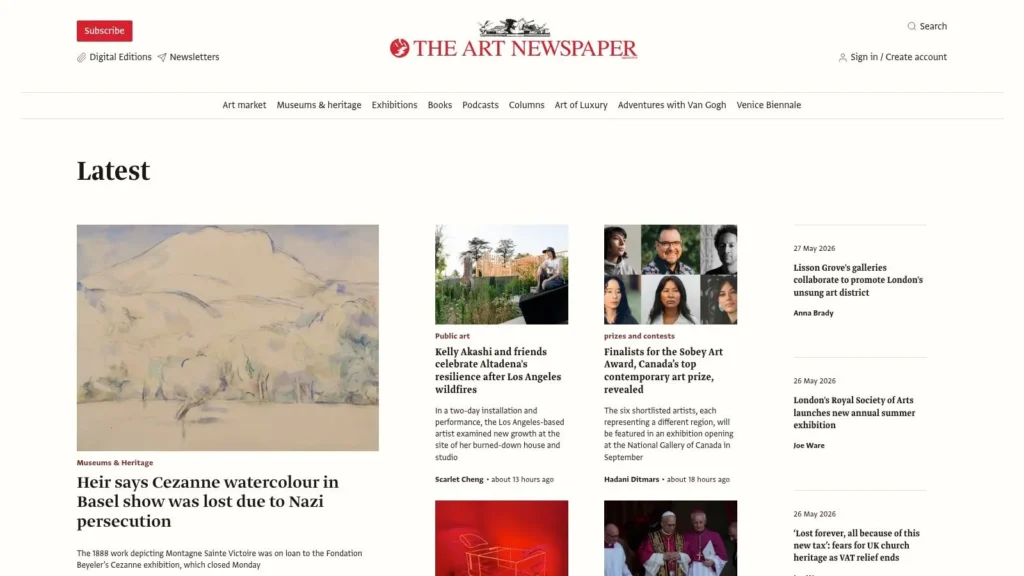
The Art Newspaper remains one of the strongest institutional newsrooms in the field. If your main question is what museums, biennials, public agencies, and large art organizations are doing, few outlets cover that terrain with comparable consistency. Its reporting on policy, restitution, funding, and museum leadership gives readers a serious map of power in the art world.
That’s especially valuable in a period when funding shifts are becoming a core arts story, not a side issue. Recent reporting has underscored an underserved angle in arts coverage: how funding cuts translate into local economic harm, worker disruption, and losses beyond headline institutions, as discussed in The Art Newspaper’s reporting on the current U.S. culture-war pressure on institutions and artists. The publication is well positioned to keep following that thread because it already treats policy as news, not background noise.
Who should read it
Collectors and museum professionals will get the most immediate value. So will arts administrators who need to monitor governance, philanthropy, repatriation, and fair-driven institutional strategy.
It’s the outlet to read when an exhibition isn’t just an exhibition, but part of a larger institutional or legal story.
The main limitation is scope. The Art Newspaper is strongest in visual art and adjacent policy beats, not in broader entertainment or general cultural coverage. And if you want full depth rather than occasional free access, you’ll likely run into the subscription wall.
3. ARTnews
ARTnews is a strong pick for readers who want a fast U.S.-centric rhythm without giving up global awareness. Its digital-first model makes it one of the easier habit-forming stops on this list. You check it because something probably happened today, and ARTnews is likely on it.
That immediacy matters in a sector where the line between culture and commerce keeps tightening. Research and Markets projects the global arts market at USD 583.42 billion in 2026 and USD 739.99 billion by 2030, while identifying digitization, digital art marketplaces, immersive experiences, and technology-enabled promotion as major drivers in its arts market forecast. ARTnews is useful because it tends to catch those shifts at the newsroom level before they calcify into industry consensus.
Where it fits best
Its audience is broad but not vague. ARTnews works especially well for U.S. readers who want breaking headlines, collecting coverage, gallery news, and museum developments in one place. The annual collectors issue also gives it a distinct long-view identity, even though its everyday utility comes from web publishing and newsletters.
For readers who like to move between visual art and adjacent screen culture, MaxiJournal’s independent film reviews make a smart pairing. ARTnews handles the art-world current. MaxiJournal can widen the frame.
A fair caution: ARTnews is still predominantly visual-arts focused. If your idea of arts and culture news includes substantial music, television, or literature coverage, you’ll need another source beside it.
4. Artnet News (including Artnet PRO)
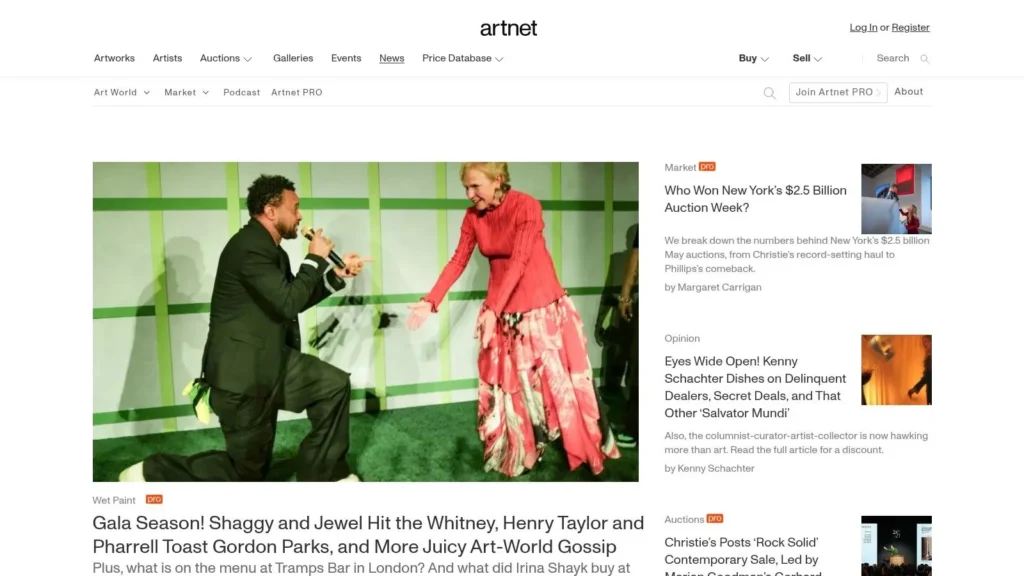
Artnet News is the most clearly tiered source on this list. At the free level, it’s a sharp daily art newsroom with strong instincts around auctions, galleries, and fairs. At the PRO level, it becomes something closer to a specialist intelligence product for readers who care about business context as much as cultural interpretation.
That distinction makes Artnet unusually useful for professionals. Dealers, advisors, collectors, and artists who need to understand how a headline might affect sales conditions or institutional positioning will appreciate the publication’s market discipline. The writing often answers a different question from criticism-led magazines: not only what matters culturally, but what matters operationally.
Best use case
Read Artnet when timing matters. It’s often most valuable during market-moving events, major sales cycles, and fair seasons, when speed and sourcing count for more than literary tone.
- Best for collectors: Strong auction and market orientation.
- Best for advisors and dealers: Clear upgrade path through PRO.
- Best for artists tracking the market: Useful for understanding the commercial environment around exhibitions and fairs.
The downside is equally clear. Some of the most actionable material sits behind the PRO wall, and the publication’s center of gravity is still the visual-art market. If you want a wider civic or historical view of culture, Artnet shouldn’t be your only read.
5. Hyperallergic
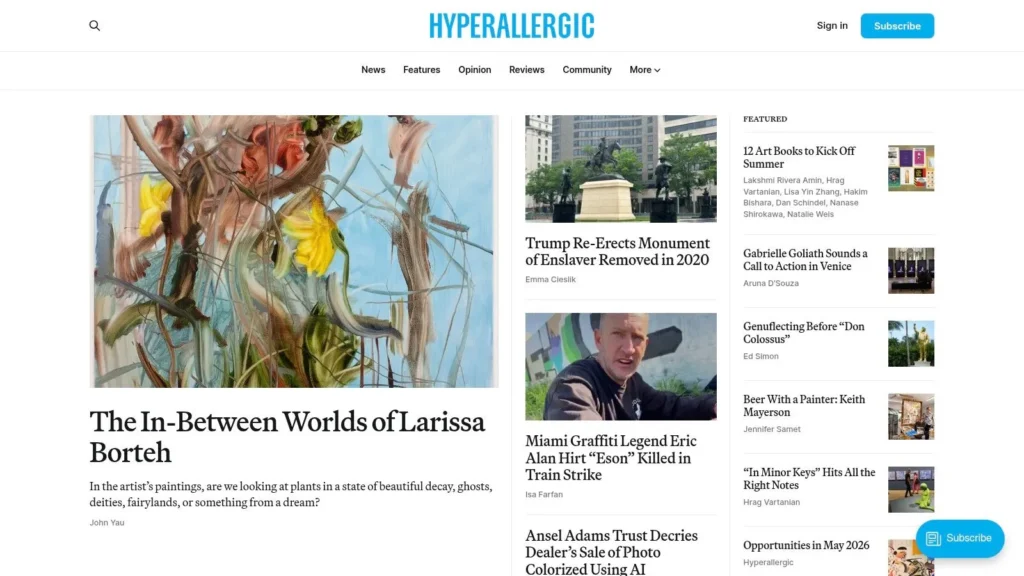
Hyperallergic is the independent voice on this list that most consistently challenges the assumptions of mainstream art coverage. It’s approachable without flattening complexity, and it has become especially useful for readers who care about museum accountability, labor, public art, censorship, and the social meaning of cultural institutions.
That editorial stance matters because arts sectors don’t only grow. They also fracture under pressure. In 2020, U.S. arts and cultural production fell by 6.4% after inflation adjustment, compared with a 3.4% decline in the overall economy, and the sector lost 604,000 jobs between 2019 and 2020, according to the Arts Action Fund summary of federal pandemic-era arts data. A publication like Hyperallergic is useful precisely because it treats labor precarity and institutional vulnerability as central arts stories, not secondary ones.
Editorial personality
Hyperallergic has a recognizably independent tone. Some readers will find that energizing. Others may prefer a more detached register. But even when you don’t agree with every framing choice, the publication often surfaces stories that larger outlets either miss or underplay.
Editorial test: If a newsroom regularly covers working artists, governance disputes, and community fallout, it’s usually seeing more of the field than a publication that only tracks openings and sales.
Its resource sections, calls, and contributor-facing opportunities also make it more useful to practicing artists than many prestige outlets. That practical edge is part of its appeal.
6. Frieze
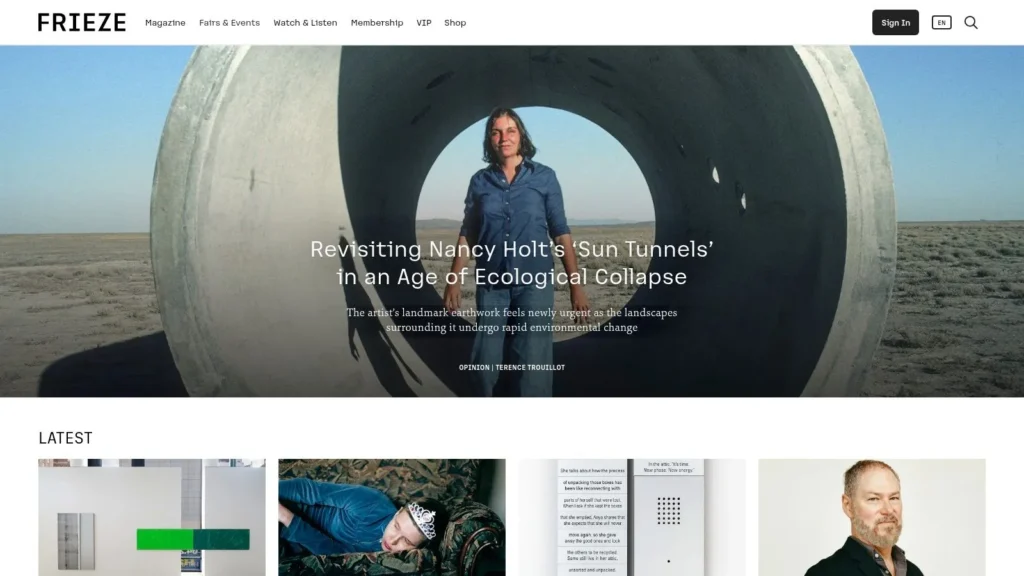
Frieze is where you go when the news itself isn’t enough. Its strength is criticism, essays, and artist-centered features that give contemporary art intellectual depth and aesthetic context. If Artnet often asks what happened in the market, Frieze is more likely to ask how a work, exhibition, or movement should be understood.
That makes it especially valuable for readers who don’t want to confuse speed with insight. Frieze’s ties to major fairs also give it proximity to current art-world activity, but the publication’s best work usually slows the conversation down rather than accelerating it.
Best for serious contemporary readers
This is the publication I’d recommend to curators, advanced enthusiasts, MFA students, and readers who want criticism with authority. It’s also one of the best supplements to a faster newsroom because it interprets the significance of artists and exhibitions after the initial burst of attention.
- Strongest feature: High-level criticism and essays.
- Best audience: Contemporary-art readers who value interpretation over headline volume.
- Main limitation: Less useful if you want broad arts and culture news across film, music, or general culture.
Frieze is not the most democratic entry point on this list. Its voice assumes a degree of familiarity with contemporary art discourse. For the right reader, that’s a feature, not a bug.
7. Smithsonian Magazine – Arts & Culture
Smithsonian Magazine’s Arts & Culture section is the best all-around option for readers who want broad, accessible cultural journalism with strong institutional standards. It covers visual art, literature, photography, history, and popular culture in a way that feels expansive rather than niche.
Not every reader needs insider art-world reporting. Many want context. They want to know why an artist, object, archive, or exhibition matters, and how it fits into a larger American cultural story. Smithsonian is especially good at that interpretive public-service role.
Why it belongs on this list
The best arts and culture news ecosystem needs at least one publication that isn’t dominated by market urgency. Smithsonian fills that role. It’s often more explanatory than competitive, which makes it a strong daily read for educators, students, museumgoers, and general enthusiasts.
The broader case for paying attention to arts coverage is easy to overlook when the headlines feel niche. But in 2023 the U.S. arts and cultural sector generated $1.2 trillion in value added, accounted for 4.2% of U.S. GDP, and supported about 5.4 million jobs, while arts and cultural industries grew at more than twice the rate of the broader U.S. economy between 2022 and 2023, according to the National Endowment for the Arts summary of federal arts and cultural industries data. Smithsonian helps non-specialists understand why a sector of that scale deserves regular attention.
For readers whose cultural interests naturally extend into travel and museum-going, MaxiJournal’s guide to the best museums in Paris is a smart companion read.
7-Outlet Arts & Culture News Comparison
| Item | Access & implementation | Resource requirements | Expected outcomes | Ideal use cases | Key advantages |
|---|---|---|---|---|---|
| Category – Arts (MaxiJournal) | Free, browseable category page; lacks post previews so requires clickthrough | Low (free); time to explore for relevance | Interdisciplinary, discovery-focused art writing linking art to tech, science, business | Curious readers, practitioners, cultural professionals seeking cross-cutting perspectives | Independent editorial voice; daily curation; broad, context-rich coverage |
| The Art Newspaper | Digital and print options; deeper articles often behind paywall | Medium–high (subscription for full access) | Authoritative, institutional reporting on museums, restitution, fairs and policy | Professionals, collectors, institutions tracking global art-world decisions | Widely cited; strong global network and institutional reporting |
| ARTnews | Mostly free digital access with newsletters; occasional paid print | Low–medium (free access; print or premium features limited) | Fast U.S.-centric updates and periodic deep-dive features (e.g., Top 200 Collectors) | U.S. readers wanting frequent headlines and collecting coverage | Rapid coverage with experienced newsroom and useful newsletters |
| Artnet News (incl. Artnet PRO) | Free news available; PRO tier adds paywalled market intelligence | Medium–high (PRO subscription for data and reports) | Timely market and auction coverage; professional-grade market analysis with PRO | Dealers, advisors, collectors and data-driven art professionals | Strong market desk; clear upgrade path to exclusive intelligence |
| Hyperallergic | Free content with reader-supported membership for extras | Low–medium (membership optional for benefits) | Independent, socially conscious criticism and reporting; artist resources | Artists, critics, readers interested in museum accountability and inclusive coverage | Distinct editorial voice; surfaces overlooked or underreported stories |
| Frieze | Subscription or membership often required for full access to essays and archives | Medium–high (subscriptions/memberships for full access and fair benefits) | In-depth criticism and contextual essays on contemporary art and fairs | Readers seeking rigorous criticism, academic context, and fair coverage | Authoritative criticism and strong ties to contemporary-art fairs |
| Smithsonian Magazine – Arts & Culture | Broad free online access; optional print and museum-related memberships | Low (free online; optional paid membership/print) | Research-backed cultural journalism across arts, history, photography | General readers, educators, and those seeking historical/contextual arts coverage | Institutional credibility; wide accessible archive and explanatory features |
Curate Your Own Culture Feed
No single outlet can cover arts and culture news well enough on its own. The field is too fragmented. Museums, public funding, labor conditions, criticism, collecting, digital culture, and place-based community practice all move at different speeds and reward different kinds of reporting.
That’s why the strongest reading stack is mixed by design. Use The Art Newspaper for institutions and policy. Use ARTnews and Artnet News when you need market tempo and art-world developments. Use Hyperallergic when you want accountability and independent reporting. Use Frieze when criticism matters more than velocity. Use Smithsonian Magazine when you want cultural context that stays legible to a broad audience.
There’s also a deeper reason to read across these lenses. The hardest arts stories now sit between beats. One underserved line of reporting concerns which arts programs create durable social cohesion, and which design choices make those efforts more effective. The National Endowment for the Arts has pointed to features such as community ownership, connection across difference, inclusion, consistent presence, and alignment with community change goals in its WE-Making report on arts, social cohesion, and community well-being. That kind of question won’t be answered by market coverage alone, or by criticism alone.
MaxiJournal earns its place in this mix because it connects those overlapping worlds. Its Arts category is useful not as a replacement for every specialist publication above, but as the interdisciplinary layer that helps readers see relationships others leave siloed. If you want art coverage that speaks to technology, science, health, tourism, business, and education as well as aesthetics, it’s a strong home base.
If you’re building your own publication or sharpening your editorial instincts, Outrank’s guide to art blogging offers helpful perspective on how arts writing reaches readers. And if you’ve got a voice of your own, MaxiJournal is also a place to pitch, publish, and join a broader independent conversation.
If you want a smarter daily read on art in context, explore MaxiJournal. It’s an independent magazine built for readers who don’t want culture separated from technology, science, travel, business, entertainment, and education, and it welcomes fresh voices from contributors who have something worth saying.
Discover more from Maxi Journal
Subscribe to get the latest posts sent to your email.