You’re probably in one of two places right now. You love literary magazines, you read contributor bios more closely than many readers read the poems, and you’d happily spend hours talking about sequencing, editorial voice, and what makes a piece feel alive on the page. But when you try to turn that passion into work, the path looks murky.
That confusion is normal. Literary journal jobs rarely follow the neat hiring patterns you see in larger industries. Roles can be part-time, volunteer, stipend-based, seasonal, or folded into broader editorial and communications work. Openings appear in scattered places. Expectations aren’t always written clearly. And a lot of applicants bring passion, which means passion alone won’t separate you.
Charting Your Course in the Literary World
You spend a Saturday reading submissions for a small journal, write careful notes on twenty pieces, spot three that fit the magazine’s voice, and send your comments on time. That kind of work gets remembered. Saying you love literature does not.
A literary journal career usually starts once you can prove you are useful in ways a masthead needs. Strong candidates show editorial judgment, follow-through, clear communication, and some understanding of how a publication reaches readers. At many journals, audience work now sits closer to editorial work than applicants expect. A reader who can also draft newsletter copy, schedule posts, or help with contributor outreach often has a stronger path than someone with vague publishing ambitions.

If you are still getting oriented, the Novelium literary magazine guide gives a solid overview of how literary magazines function and why their structures vary so widely. If you are also curious about the publishing side, not just the hiring side, it helps to study how editors build digital publications from scratch. This guide on how to start an online magazine is useful for seeing the operational work behind the bylines.
What counts as real experience
This is the mistake I see most often. Applicants collect literary activities that sound relevant, but not all experience carries the same weight.
High-impact experience usually includes work where your judgment affected outcomes. Reading submissions under clear editorial criteria. Writing acceptance or rejection notes. Copyediting accepted work. Coordinating contributor deadlines. Building a simple submissions tracker. Running a journal’s Instagram for an issue launch and reporting what performed well. Those tasks show that you can help a publication function.
Resume filler looks different. Attending readings, posting occasionally about books, calling yourself an editor without a masthead role, or doing one-off volunteer tasks with no responsibility attached can still be personally meaningful. It just does not tell an editor much about how you will perform under workload, deadlines, and editorial standards.
A smaller journal can be the better training ground for this reason. You may get broader responsibility faster, even if the title is modest.
The market is real, but the path is uneven
Literary journal work rarely follows a clean ladder, and pay can be inconsistent across roles. The broader category of writers and authors is projected to grow 4 percent from 2024 to 2034, with about 13,400 openings each year on average, according to the U.S. Bureau of Labor Statistics career outlook for writers and authors. That projection points to a steady field, not a booming one.
For aspiring literary professionals, the practical takeaway is straightforward. Expect competition. Expect patchwork experience early on. Expect some jobs to combine editorial tasks with operations, fundraising, events, or marketing.
That last point matters more than it did a few years ago.
Many journals need staff who can help publish strong work and help readers find it. If you can show both editorial care and audience sense, you become easier to hire. I would take a candidate who has read slush well, written sharp editorial notes, and helped grow event attendance over a candidate with a generic publishing internship and no evidence of outcomes.
Practical rule: Build experience that shows decisions, responsibility, and results. Titles matter less than proof that a journal trusted you with work that affected the publication.
Decoding the Roles Inside a Literary Journal
Most aspiring applicants aim at “editor” too early because the title sounds central. The better move is to understand the masthead as a workflow. Journals need people who acquire work, evaluate it, shape it, publish it, and help readers find it. Different publications divide those tasks differently.
A small volunteer-run journal might ask one person to read submissions, draft newsletter copy, and post on Instagram. A larger nonprofit publication might separate those functions across editorial, operations, and audience teams. That’s why applicants get frustrated when their neat assumptions about roles don’t match the listing.
Common Literary Journal Roles at a Glance
| Role | Primary Responsibilities | Typical Experience | Compensation Model |
|---|---|---|---|
| First Reader or Reader | Read submissions, write notes, flag promising work, follow editorial guidelines | Strong close reading, reliability, familiarity with genre | Often volunteer |
| Assistant Editor | Manage slush flow, correspond with contributors, support issue assembly, perform line edits | Prior reading experience, editing samples, communication skill | Volunteer, stipend, or part-time |
| Genre Editor | Shape fiction, poetry, or nonfiction selections, advocate for pieces, edit accepted work | Demonstrated editorial judgment in that genre | Stipend, part-time, or salaried in some organizations |
| Managing Editor | Oversee production calendars, track submissions, coordinate staff, handle workflow | Editorial operations experience, organizational strength | Part-time or salaried |
| Editor in Chief | Set vision, make final editorial calls, oversee staff, represent publication publicly | Deep editorial record, leadership, strategic judgment | Often salaried in established organizations, sometimes volunteer in smaller journals |
| Reviews Editor | Assign and edit reviews, identify relevant books, manage deadlines and critics | Strong criticism, assigning judgment, polished prose | Volunteer, stipend, or freelance |
| Communications or Community Manager | Run social media, newsletters, events, website updates, audience engagement | Writing for audiences, publishing tools, promotion instincts | Often part-time |
The entry-level trap
Many people assume any volunteer role is good experience. It isn’t. If you spend months doing work that never asks for judgment, you may become helpful without becoming hireable.
Useful first-reader work teaches you to explain why a piece succeeds or fails. Weak first-reader work turns you into a yes-or-no machine. One builds editorial muscle. The other fills a line on a CV.
Here’s the difference I’d watch for before accepting a role:
- High-impact volunteer work: You receive editorial criteria, discuss selections, compare your notes with senior editors, and learn how the journal makes decisions.
- Resume filler: You forward pieces with little context, never hear back on your reads, and don’t see how your labor influences publication.
If a journal can’t tell you how readers are trained, how feedback works, or what happens to your notes, ask more questions before you commit.
The overlooked jobs are often the most accessible
A lot of applicants still imagine literary journal jobs as mostly slush reading and copyediting. That picture is dated. Recent postings also call for social media management, newsletter writing, web content updates, brand building, and event promotion, sometimes with 1-3 years of experience and part-time commitments of 8-12 hours per week (Kweli opportunities).
That matters for two reasons.
First, these hybrid roles can be easier entry points than pure editorial jobs because fewer applicants position themselves for them well. Second, they often place you close to the publication’s decision-makers, audience data, and public voice. That proximity can teach you far more about how a journal survives than reading submissions alone.
If you’ve written newsletter copy, run author Q&As, managed a reading series, updated a Submittable queue, or maintained a publication’s site, you’re not “adjacent” to literary work. You’re doing the infrastructure work many journals depend on.
Building a Standout Portfolio and CV
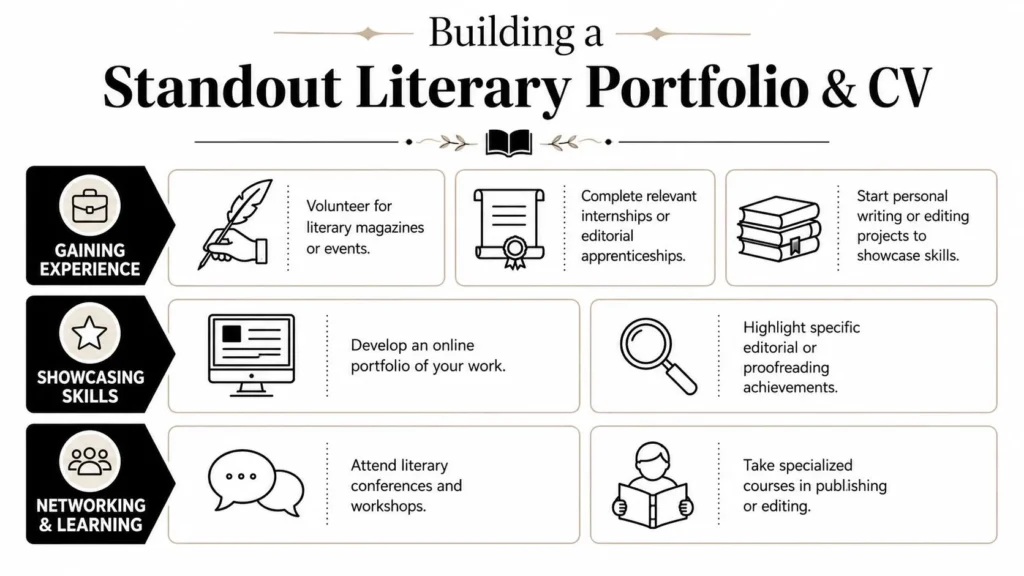
Applicants often hurt themselves by collecting too many disconnected experiences. They say yes to every volunteer call, stack up titles, and end up with a CV that looks busy but not persuasive. Editors don’t need proof that you love literary culture. They need proof that you can do a specific job.
That’s why quality of experience beats quantity.
What strong experience actually looks like
Editorial and writer-facing roles increasingly expect evidence of editorial judgment, audience-specific writing skill, and the ability to collaborate under editorial constraints. Strong applications usually include a CV, a brief targeted cover letter, and role-matched samples that show a public track record of clear writing and comfort working with specialists (Our World in Data hiring process).
That last phrase, role-matched samples, is where many candidates fail.
If you’re applying to be a reviews editor, don’t send three unrelated personal essays. If you want a community role, don’t send only workshop poems. If you’re applying for assistant editor work, give them evidence that you can evaluate, revise, or package writing for readers.
A useful portfolio usually includes some combination of the following:
- Published criticism: Book reviews, essays on contemporary writing, or interviews with authors that show taste and structure.
- Editorial artifacts: Annotated edits, editorial memos, or before-and-after samples, if confidentiality allows.
- Audience-facing writing: Newsletter intros, event copy, reading series blurbs, or web copy for a literary organization.
- Process evidence: Notes that show how you research, draft, revise, and respond to editorial feedback.
Choose work that teaches judgment
Not every volunteer opportunity deserves your time. Before joining a journal, ask what you’ll learn.
High-value opportunities usually include:
- Decision exposure: You see why pieces are accepted or declined.
- Revision practice: You help shape copy, not just pass it along.
- Editorial conversation: Senior staff discuss rationale, not just outcomes.
- Public-facing output: Your work appears somewhere readers can see it.
Low-value opportunities usually leave you with vague claims like “assisted editorial team” or “supported literary programming.” Those phrases signal effort, but not competence.
The best early experience gives you artifacts. A marked-up draft, a published review, a newsletter sequence, a sharp editorial note. If the role leaves you with nothing concrete to show, its value is mostly sentimental.
Build a CV that signals fit
Literary employers often ask for a CV rather than a standard resume, but many applicants use the terms loosely and submit a generic document either way. If you need a quick refresher on format expectations, this guide will help you understand resume vs CV, especially when you’re deciding how much academic, editorial, and publication history to include.
Your document should foreground the experience the role cares about most. For literary journal jobs, that often means moving publications, editorial work, reading roles, event moderation, newsletter writing, and relevant internships above unrelated employment history.
A strong packet also benefits from seeing how other writers present work publicly. Reviewing a range of freelance writing portfolio examples can help you decide how to organize clips, contextualize assignments, and separate your strongest samples by genre or function.
Where to Find Your Next Literary Journal Job
A lot of candidates waste time on generic job boards and then conclude there are no openings. The problem usually isn’t the field. It’s the search method.
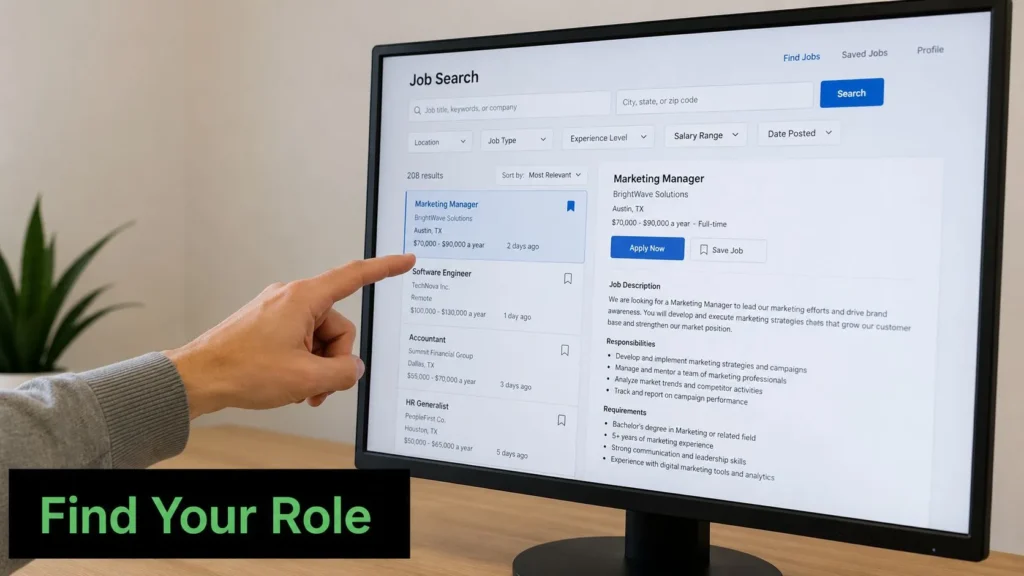
For literary journal jobs, centralized publishing boards tend to surface opportunities faster and in better context than broad platforms do. The practical workflow is simple: scan aggregator boards weekly, then verify each opening on the publisher’s own site and apply there. CLMP’s jobs board and Poets & Writers listings are especially useful starting points because literary roles often appear there before they circulate more widely (CLMP jobs guidance).
Use a repeatable weekly system
What works is consistency and speed. What doesn’t work is checking once a month and assuming good roles will still be open.
A practical routine looks like this:
Scan aggregator boards on a fixed day
Pick one day each week and check CLMP and Poets & Writers. Save anything plausible immediately.Verify on the publisher’s own site
Listings can change. Go to the journal or press website, confirm materials, confirm deadline, and read the publication itself before applying.Submit the same day when possible
Small publications often use short posting windows. If a role fits, don’t sit on it while polishing endlessly.
What to ignore
Generic “content writer” searches can bury the work you want under unrelated listings. For literary journal jobs, broad searches are usually supplemental, not primary.
Avoid three common mistakes:
- Applying from memory: Always re-read the actual posting before sending materials.
- Using one packet for every job: Even small changes in genre, readership, or mission should change your samples.
- Ignoring audience roles: Some of the best entry points now sit in newsletters, digital content, and events rather than traditional editorial titles.
If you contribute to or pitch independent outlets, platforms such as maxijournal.com also accept contributor submissions and draft-based pitches, which can be useful for building public clips while you continue targeting journal openings. That’s not the same as a staff role, but it can strengthen your visible body of work.
Crafting Your Application and Acing the Interview
You find a posting on Tuesday night for a part-time assistant editor role at a journal you frequently read. Deadline is Thursday. The applicants who get serious consideration are rarely the ones with the fanciest language. They are the ones who make an editor’s job easier within the first thirty seconds.
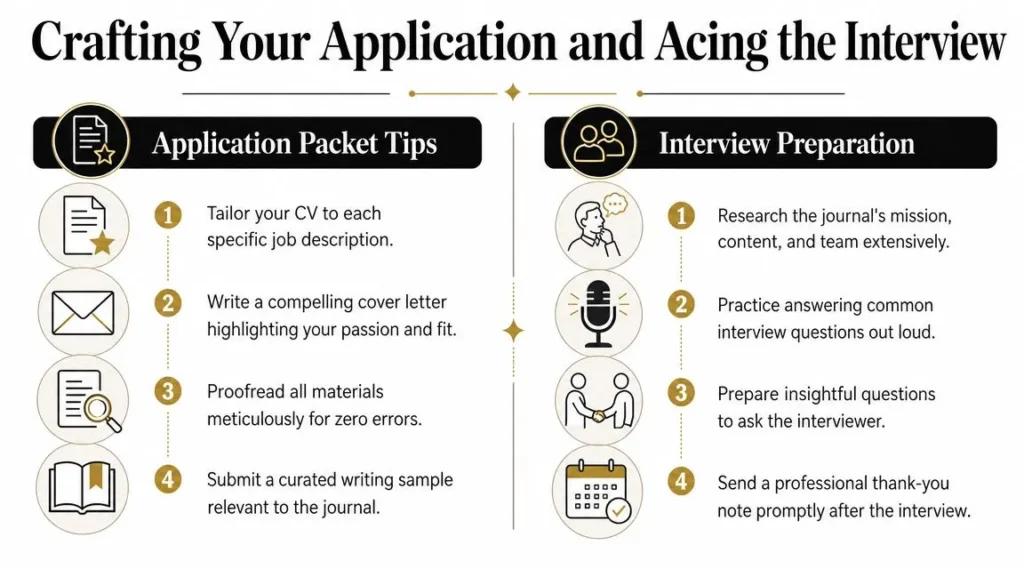
That means a clean packet, relevant samples, and evidence that you understand what this specific publication needs.
Build one modular packet, then customize it
A strong application packet should be fast to tailor because literary journals often hire on short timelines and small teams do not wait around for perfect materials.
Keep these ready:
- A master CV: Full editorial, publication, event, teaching, and administrative history.
- A short bio: Useful for forms, contributor communication, and public-facing roles.
- Three sample groups: editorial assessment, criticism or essays, and audience-facing writing such as newsletters, event copy, or social posts.
- A base cover letter: A working draft you rewrite for each role, not a template you send unchanged.
If you want a practical refresher before drafting, this guide on how to write a cover letter offers a clear checklist for structure, tone, and specificity.
The letter needs to answer three questions quickly:
- Why this journal?
- Why this role?
- What have you already done that suggests you can do it well?
The third question is where applicants often weaken their case. A generic line about loving literature does not help much. A short sentence about managing Submittable queues, writing newsletter copy that increased open-rate attention inside a volunteer publication, or moderating a reading series tells an editor where you can contribute on day one.
Show experience that matters to literary journals
Editors can tell the difference between high-impact experience and resume filler.
High-impact experience usually has one of these qualities:
- You made or supported editorial decisions.
- You handled contributors professionally.
- You shipped public-facing work on a deadline.
- You helped build readership, attendance, or community participation.
Resume filler usually sounds impressive but stays vague. Titles alone do not carry much weight in this field. A volunteer role where you screened fifty submissions a month and wrote acceptance notes is often more persuasive than a grander title with no clear responsibilities.
This matters even more now because many journals are hiring for hybrid work. They may want someone who can read submissions, draft Instagram captions, help with a launch event, and keep a newsletter calendar on track. If you have done that mix of work, say so plainly.
Write like someone who reads the journal
A good literary cover letter shows attention, taste, and judgment.
Stronger approaches:
- Mention a recent issue, feature, or editorial initiative and explain what you noticed about it.
- Match your background to the publication’s actual needs, whether that is poetry editing, reviewer coordination, event support, or audience growth.
- Name concrete skills such as developmental editing, slush reading, copyediting, newsletter writing, interview prep, or contributor management.
Weak approaches:
- “I’ve long admired your publication.”
- “I am passionate about literature.”
- “I believe I would be a great fit.”
Those lines are common because they are easy to write. They also tell an editor almost nothing.
A hiring editor wants to hear your taste at work. Name what the journal publishes well, what kind of writing you can support, and how you handle deadlines, disagreement, and detail.
A useful interview prep resource can help you rehearse your delivery before the conversation:
Prepare for literary-specific interview questions
Literary journal interviews usually test judgment, clarity, and collegiality more than polish.
Expect questions like:
- Which recent piece in our journal stayed with you, and why?
- How do you evaluate a submission that is promising but uneven?
- What makes an author interview feel alive rather than dutiful?
- How would you help promote a new issue to readers who do not know us yet?
- How do you handle disagreement inside an editorial team?
Prepare answers that show how you think, not just what you prefer. If you are asked about a weak but promising submission, talk through the editorial factors. Is the voice distinctive? Is the structure fixable? Does it fit the journal’s taste? That kind of answer shows editorial maturity.
For marketing or community-facing roles, expect practical questions too. An editor may ask how you would publicize a themed issue, improve event turnout, or turn one strong essay into a week of reader outreach. Journals increasingly value candidates who can connect editorial work to audience growth without flattening the publication into generic content.
Come in with a few brief examples ready. One about editorial judgment. One about reliable execution. One about reader or community engagement. That combination makes a stronger case than enthusiasm alone.
Thriving in Your Role Paid or Volunteer
Once you land the role, true career-building starts. People often think getting onto the masthead is the win. It isn’t. The win is turning that role into stronger judgment, stronger relationships, and better future options.
Use each role for a different purpose
Volunteer work is best used to build skills, references, and editorial pattern recognition. If the role teaches you how decisions are made and gives you concrete output, it’s worth more than a flashy title.
Freelance work is best used to diversify your clips and protect your income. It also teaches speed, adaptability, and how to write for different audiences without losing your voice.
Paid staff work is where you should learn systems. Watch how the publication handles calendars, contributor communication, audience development, and conflict. That operational literacy is what moves people from helper to indispensable colleague.
Habits that make editors trust you
Trust is career currency in literary spaces. You build it through ordinary behavior.
- Meet deadlines cleanly: If you’ll be late, say so early.
- Argue with reasons: Editorial disagreement is normal. Back your view with reading, not ego.
- Keep records: Save links, clips, notes, and project outcomes while they’re fresh.
- Notice the unglamorous work: Metadata, scheduling, proofreading, and contributor emails matter because they keep the publication functioning.
The people who advance in literary journal jobs are rarely the loudest. They’re the ones others can rely on when an issue is behind, an author needs attention, or a process breaks.
You don’t need a perfect start. You need useful experience, visible care, and enough patience to keep building from one credible piece of work to the next.
If you’re building clips, testing editorial voice, or looking for a place to pitch thoughtful writing, maxijournal.com is one option to explore. It publishes across a wide range of subjects and accepts contributor pitches and draft submissions, which can help emerging writers create public work while pursuing longer-term literary journal jobs.
Discover more from Maxi Journal
Subscribe to get the latest posts sent to your email.