Every few years, the same cycle kicks off. A fan edit goes viral, a casting thread catches fire, and suddenly the Evangelion live action movie feels one press release away. Then you check the record, and the trail leads back not to a production office, but to old announcements, stalled rights, and a project that has spent longer in limbo than many franchises spend on screen.
The Enduring Dream of a Live Action Evangelion
In the mid-2000s, the idea stopped sounding like fantasy and started sounding like a film package. Reporting described a live-action adaptation as a co-production involving AD Vision and Weta Workshop, with Gainax keeping input and approval privileges, a setup preserved in this archival breakdown of the project’s status. That mattered because it suggested the Evangelion live action movie had moved beyond fan desire and into actual industry conversation.
Why the idea never dies
Evangelion has always carried more adaptation gravity than the average anime property. Neon Genesis Evangelion debuted on Japanese television in 1995 and 1996, and its success made it one of the most visible anime franchises in the world, which helps explain why companies kept circling the idea of an American or international version, as discussed in this historical overview of the project’s long stall.
That history changes how fans should read the silence. A property this famous doesn’t disappear because no one wants it. It disappears because the obstacles are bigger than demand.
The mystery is the story
Most stalled adaptations fade because audiences move on. Evangelion did the opposite. It stayed culturally active enough that the absence of a movie became part of the franchise’s mythology.
Practical rule: If a project keeps resurfacing for years without the normal milestones of filmmaking, the recurring attention is usually cultural momentum, not production momentum.
That’s why the Evangelion live action movie remains such an unusual puzzle. The franchise is famous enough to attract interest, strange enough to tempt ambitious filmmakers, and difficult enough to resist easy translation. Add ownership complications and creator changes, and the missing film starts to make sense.
Fans often treat the question as binary: is it happening or not? The more useful question is why this specific adaptation keeps reappearing even when confirmed movement remains absent. The answer sits at the intersection of franchise scale, unfinished business, and the persistent belief that if any anime deserves a massive live-action treatment, this is the one.
The Long History of a Movie That Never Was
The closest the Evangelion live action movie ever came to feeling real was the moment it acquired recognizable industry markers. ADV Films announced in 2003 that it had acquired live-action rights to the property, and the company presented concept material with Weta Workshop at Cannes in 2006, a step covered by The New York Times’ report on the planned adaptation. That matters because it separates this project from ordinary fan rumor. Rights were discussed publicly. A major effects house was visible. Companies were willing to stand next to the idea.
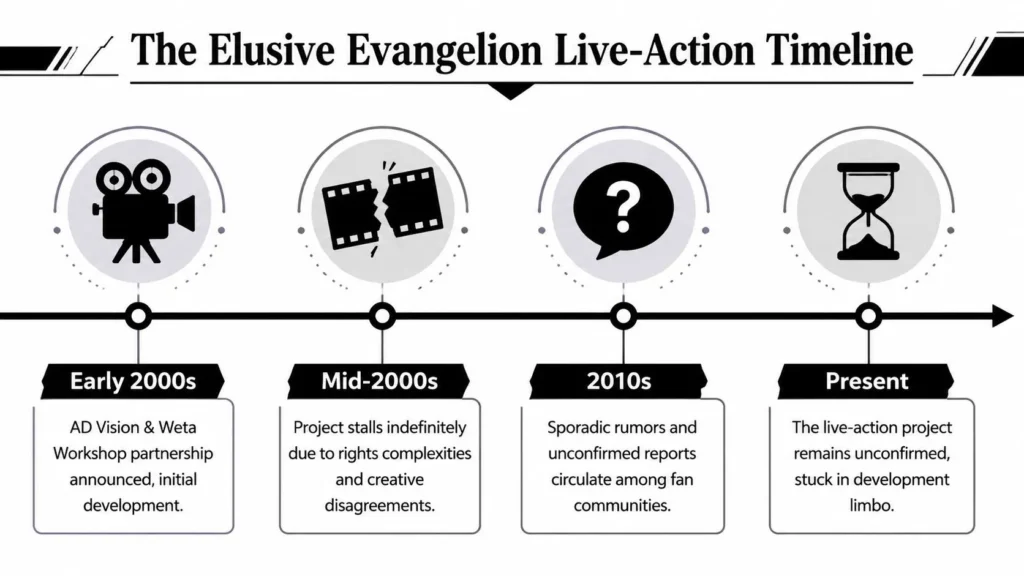
What was announced, and what wasn’t
Those signals were real. The production spine was not.
The strongest way to read that period is by looking for the milestones that usually follow a rights announcement. Trade coverage and convention reporting produced artwork, partner names, and broad ambition. They did not produce a director, cast, start date, or evidence of a finished screenplay. In practical terms, the project had packaging heat without the creative commitments that push a film into pre-production.
That distinction is the filter fans should use whenever the movie resurfaces online. A rights deal shows that someone wanted the option to try. It does not show that the adaptation problem was solved.
Why “on hold” usually means development stalled
The phrase that shadowed Evangelion for years was “on hold.” In studio language, that can describe a temporary pause, but context matters. A film with a director, script drafts, financing strategy, and department heads can recover from a delay. A film missing those pieces is sitting in development limbo.
That appears to be what happened here. The public record showed interest, concept art, and intermittent comments. It did not show the standard chain of escalation from rights acquisition to attached filmmaker to active production planning.
Here is the cleaner way to separate movement from noise:
| Signal | What it usually means |
|---|---|
| Rights are acquired or publicly discussed | The property is available for development |
| A company like Weta Workshop develops concept art | Visual exploration is happening, not filming |
| No director is attached | Nobody is yet accountable for a shootable version |
| No script, cast, or schedule is announced over time | The project is not advancing toward production |
That pattern explains why the adaptation remained famous without becoming tangible. Fans often treat any official mention as proof that a movie exists behind the curtain. Industry history says otherwise. Projects become real when responsibility narrows, usually around a producer with financing, a director, and a screenplay that can be budgeted.
A useful visual summary of that pattern appears below.
The development-hell label fits
By the late 2000s, the reporting had hardened into a familiar picture. The adaptation was still discussed, but the discussion centered on its absence. Anime News Network’s coverage of the rights dispute around Evangelion also showed how legal and business complications continued to surround the franchise in that period, which is the opposite of the clean ownership environment a high-cost film needs.
So the phrase “development hell” fits here for a specific reason. The project did not collapse after cameras were ready to roll. It lingered at the stage where interest was visible but commitment remained diffuse.
That is the key distinction fans should keep in mind. Verified movement looks like rights clarity, an attached filmmaker, and a screenplay heading toward budgeting. Evangelion generated enough of the first category to keep hope alive, but not enough of the second to become a movie.
Why Evangelion Is So Difficult to Adapt
Some projects get trapped by rights. Others get trapped by scale. Evangelion has both problems, and even if the legal side disappeared tomorrow, the adaptation challenge would still be punishing.
Tokyo Otaku Mode framed the concept as combining adult themes with realistic cyborgs alongside real actors, which points to a massive practical-and-digital effects burden rather than a modest genre production, in its description of the live-action concept. That’s the technical side. The creative side is even trickier.
Pillar one: the story resists simplification
A lot of anime can survive compression. Evangelion punishes it.
Strip it down too far, and you don’t have a psychologically invasive story anymore. You have teenagers, monsters, and a military conspiracy. Those elements are present, but they aren’t the reason the franchise lasted. The reason it lasted is that it keeps shifting registers. It can feel like a mecha series, a breakdown diary, a religious fever dream, and a coming-of-age tragedy in the same stretch of narrative.
That creates a harsh adaptation choice. A filmmaker can preserve the weirdness and risk alienating a mainstream audience, or smooth the material into a more conventional blockbuster and lose the property’s identity.
Pillar two: the visuals aren’t just expensive, they’re specific
The Evangelion live action movie wouldn’t just need “good effects.” It would need effects that solve a design problem unique to this franchise. The Evas and Angels don’t work as generic giant creatures. Their shapes, movement, and violence all carry meaning.
A few technical demands stand out:
- Biomechanical design: The mecha can’t look like clean hardware. They need an unsettling body-machine quality.
- Apocalyptic scale: The destruction has to feel operatic, not routine. Evangelion’s world-ending imagery isn’t background spectacle.
- Actor integration: Real performers would need to coexist with designs that are stylized, grotesque, and emotionally loaded.
If any one of those fails, the whole illusion weakens. A mediocre effects scene in another franchise might just be a bad scene. In Evangelion, it can break the concept.
The challenge isn’t only making giant beings look real. It’s making them look real without making them ordinary.
Pillar three: the tone is unstable on purpose
This may be the hardest part. Evangelion changes emotional temperature with very little warning. It can move from adolescent awkwardness to military procedure, then into body horror or abstract despair.
Most studio filmmaking wants tonal consistency. Evangelion’s appeal depends on tonal instability that still feels authored.
A live-action version would have to keep several balances at once:
- Teen intimacy and global catastrophe
- Private trauma and public warfare
- Stylized imagery and believable human behavior
That’s why comparisons to other mecha or sci-fi adaptations usually miss the point. The obstacle isn’t just budget. It’s calibration. Even with perfect rights and a major filmmaker, the Evangelion live action movie would still be one of the narrowest adaptation tightropes in commercial entertainment.
Lessons from Other Anime to Live Action Projects
The easiest way to misread Evangelion’s prospects is to think all anime adaptations fail for the same reasons. They don’t. Some collapse because filmmakers don’t respect the source. Others collapse because the source itself doesn’t survive translation without radical structural choices.
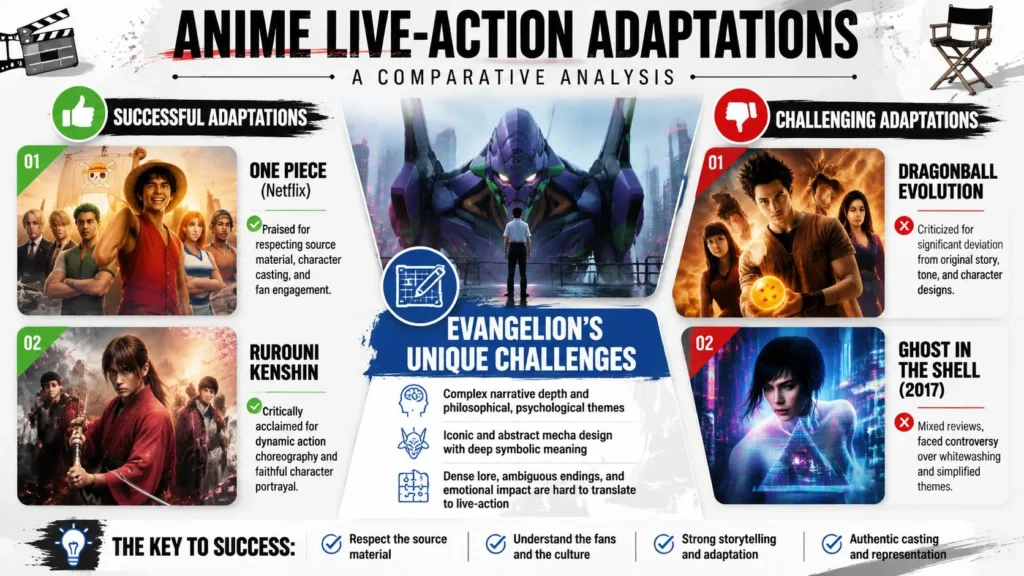
What successful adaptations usually get right
The stronger live-action anime projects tend to make an early decision about what must remain intact. Sometimes that’s character chemistry. Sometimes it’s movement style. Sometimes it’s the world’s emotional tone.
A useful contrast is the broader live-action adaptation realm, where different franchises succeed or fail based on how much they preserve core identity. You can see that same tension in other franchise transitions, including these recent live-action Disney movie discussions, where familiar IP often survives only if filmmakers know which elements are negotiable and which are sacred.
For Evangelion, the sacred elements probably aren’t the ones executives would instinctively prioritize. The action matters, but the emotional abrasion matters more.
A simple scorecard for Evangelion
Here’s where the franchise sits compared with other adaptation types:
| Adaptation factor | Easier anime properties | Evangelion |
|---|---|---|
| Character translation | Often manageable | Difficult because the psychology is the engine |
| World-building | Can be streamlined | Hard to simplify without flattening meaning |
| Effects burden | Variable | Heavy and central to the premise |
| Tone control | Usually one dominant mode | Multiple unstable modes must coexist |
That scorecard points to an awkward conclusion. Evangelion is not the kind of property that benefits from being treated like a standard blockbuster conversion.
The likely fault lines
If a studio approached the Evangelion live action movie with the wrong instincts, the break points would probably look like this:
- Theme reduction: The film becomes a giant-robot spectacle with the inner life drained out.
- Visual overcorrection: The designs become more “realistic” in a way that erases their strangeness.
- Tonal flattening: The adaptation chooses one lane, usually military sci-fi, and leaves the rest behind.
That doesn’t mean a live-action version is impossible. It means the route to success is narrower than fans often admit. Evangelion doesn’t need a generic prestige treatment. It needs filmmakers willing to preserve what’s uncomfortable, disorienting, and difficult to market.
The World of Fan Casts and Director Rumors
A project can stay dead on paper and still feel alive online. Evangelion is one of the clearest examples. Every few months, a new fan cast, director thread, or polished poster set circulates with the tone of breaking news, even though none of it answers the questions that matter in film development.
That gap between visibility and verification is why rumor around a live action Evangelion has lasted so long. Fans are not just debating taste. They are filling in missing industrial facts with images, edits, and plausible sounding names.
Why these rumors keep recurring
Earlier sections covered the stalled history. The more useful point here is how stalled projects behave in public. Once a title has enough cultural weight, speculation starts to imitate pre-production. People discuss actors as if casting sessions are happening. They discuss directors as if meetings have been taken. They treat old reports as active leads rather than expired ones.
Collider has been more careful than many outlets on this point, stressing that recurring interest is not the same thing as a confirmed production in its analysis of why the movie keeps resurfacing. That distinction matters. A property can trend repeatedly without anyone having assembled the legal and financial structure required to shoot it.
The three rumor types fans should separate
Online Evangelion chatter usually falls into a few predictable categories:
- Fan casts. These spread fast because they are visual, easy to repost, and easy to judge.
- Director rumors. These gain traction because a filmmaker’s style can be matched to Evangelion in a single persuasive paragraph.
- Revival claims. These recycle old development history and present it as if dormancy itself were evidence of renewed activity.
Readers who follow daily entertainment reporting and rumor cycles will recognize the pattern. Long dormant franchise talk often creates the appearance of momentum before any company has made a public commitment.
A stronger filter is simple. Ask whether the update includes one of the markers real productions leave behind: rights clarification, a studio or financier on record, or an officially attached filmmaker.
Why director talk gets especially misleading
Director speculation sounds smarter than casting speculation, so it often travels further. It also flatters the fandom. If someone can name a visually ambitious filmmaker and explain why that person understands trauma, religion, or scale, the rumor can feel unusually persuasive.
The problem is that a director name, by itself, proves almost nothing. Serious film development usually leaves a trail before fan communities hear about it. Agencies, trade reporting, producer attachments, and script movement tend to surface first. Even pre-visual planning has to start somewhere practical, because a project this effects-heavy would need early design logic and storyboard beat mapping techniques long before a teaser image ever appeared online.
That is why so many Evangelion rumor waves collapse under scrutiny. They offer aesthetic logic, not production evidence.
Why fan speculation still has value
Fan activity does serve a purpose. It keeps Evangelion in circulation outside the anime press cycle, and it demonstrates that the idea still has commercial heat across generations of viewers.
But it can also blur the line between desire and movement. A convincing mock poster cannot tell you who controls adaptation approvals. A viral casting thread cannot tell you whether anyone has paid for script work. For this property, the smartest reading is often the least exciting one. If the story can be shared without naming a rights holder, financier, or official creative attachment, it belongs in the rumor file, not the production file.
What a Real Evangelion Project Would Look Like
The most useful question fans can ask isn’t whether the Evangelion live action movie is “back.” It’s what kind of evidence would prove that it’s back.
Collider’s framing gets closest to the right standard. The better question is why the idea keeps resurfacing despite no confirmed project, and what signals would count as genuine progress, as noted in this discussion of speculation versus real movement.
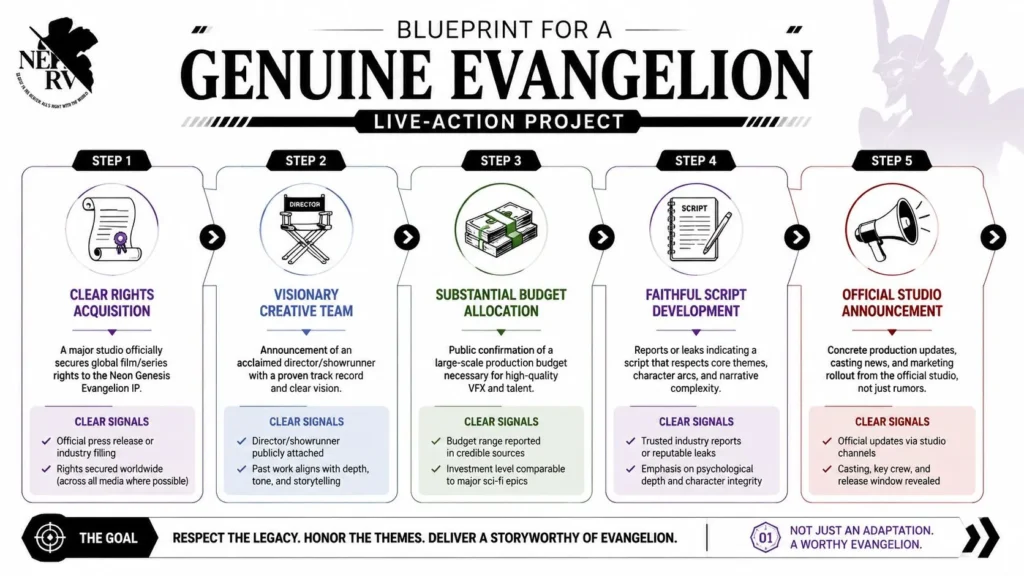
The milestones that would actually matter
Fans should look for a chain of concrete signals, not a single exciting headline.
Official rights clarity
Someone with authority has to state who controls the live-action adaptation path and who has approval power.A named creative lead
A real project needs a director or showrunner, not a fan campaign for one.A script process with intent
Evangelion can’t be improvised into coherence. The adaptation needs a clear structural plan. In practical pre-visualization terms, that means breaking emotional and action sequences into workable visual units. Resources on storyboard beat mapping techniques are useful here because they show how filmmakers translate rhythm, tone shifts, and visual escalation before cameras roll.Studio-level confirmation
Casting, format, and production planning should come from an official studio channel, not a convention anecdote or reposted rumor.
Movie or series
A theatrical film sounds prestigious, but a high-end series may fit the material better. Evangelion needs room for pressure to build. Compress it too hard, and the adaptation risks becoming a summary instead of a drama.
The format decision would also shape sound and pacing. A project that understands the franchise would treat audio identity as core design work, not just support work, much like the films discussed in this guide to the best soundtracks in movies, where music and sound architecture shape memory as much as image.
What counts as progress: a rights announcement, a signed creative lead, and official production communication.
What doesn’t: fan art, recycled rumors, old interviews, or unsourced social posts.
That’s the filter. Until those markers appear, the Evangelion live action movie remains an idea with history, not a production with momentum.
Frequently Asked Questions About the Movie
Is the Evangelion live action movie officially cancelled
There’s no clean public record of a finished production being formally shut down in the way fans usually mean by “cancelled.” The more accurate description is that the project became structurally stalled and stayed there. It had real development history, but it never matured into a conventional production with the normal milestones in place.
Who holds the live-action rights
The public history points to a long period where rights and approvals were part of the problem rather than the solution. Coverage tied the stalled adaptation to legal disputes and rights limbo, which is one reason the project kept resurfacing as an idea without advancing as a film. If fans don’t see a fresh, official rights statement from the current stakeholders, they shouldn’t treat any revival claim as firm.
Would a real adaptation need major creative oversight
Yes. Evangelion is too specific in theme, tone, and visual identity to survive a generic adaptation process. Any genuine project would need visible creative leadership and clear approval structures. Without that, the most likely outcome isn’t a bold reinvention. It’s a flattened version that keeps the brand name and loses the point.
The simplest takeaway is this: the Evangelion live action movie becomes real only when the evidence looks boring. Rights paperwork, attached leadership, official announcements, and sustained production follow-through matter more than exciting rumor cycles ever will.
If you like entertainment analysis that separates hype from verified movement, browse MaxiJournal for more film, TV, music, and pop culture commentary written for readers who want clear answers without the rumor fog.
Discover more from Maxi Journal
Subscribe to get the latest posts sent to your email.