Ghana’s gold industry produced an estimated 4.9 million ounces, about 136 metric tons, in 2024, an 8.5% increase from the previous year, according to the U.S. International Trade Administration’s overview of Ghana’s gold rush. That makes Ghana Africa’s largest gold producer and one of the world’s top 10 producers.
Those figures sound like an uncomplicated success story. They aren’t.
The modern narrative of Ghana gold mining is split between two realities that often appear in different reports, different ministries, and different moral registers. One is the official economy of export earnings, formal concessions, industrial plants, and globally traded bullion. The other is the economy that many Ghanaians know more intimately: pits cut into farmland, muddied rivers, mercury-tainted areas, and informal diggers chasing income in places where the state’s presence is thin or compromised.
The tension goes beyond the distinction between legal and illegal mining. It’s between what gets counted and what gets absorbed. Gold output appears in export tallies and ministerial briefings. The costs of polluted water, lost agricultural land, disrupted schooling, and weakened local institutions are harder to fit into a production table.
An Introduction to Ghana’s Golden Paradox
Ghana isn’t a marginal mining story. It sits at the center of the global gold map. Yet the most revealing question isn’t how much gold the country produces. It’s who benefits from that output, and who pays for the disorder surrounding it.
Two gold economies, one national balance sheet
Officially, Ghana’s mining sector projects strength, scale, and longevity. The country’s position as Africa’s leading producer gives it influence in commodity markets and strategic relevance to investors, refiners, and policymakers. Gold remains one of the clearest ways Ghana earns foreign exchange and attracts international attention.
But the same boom has also sharpened an old contradiction. The more valuable gold becomes, the stronger the incentives for extraction beyond the state’s reach. That matters because the line between formal production and informal activity isn’t a side issue in Ghana. It shapes politics, public finance, rural livelihoods, and environmental damage.
Ghana’s gold story looks straightforward from an export terminal. It looks very different from a riverbank or a cocoa farm.
The paradox is especially stark because Ghana’s relationship with gold isn’t recent. The industry has deep roots, and that historical legitimacy gives mining unusual political resilience. Gold is not treated as a passing windfall. It is treated as part of the country’s identity.
Why the headline number is only the beginning
That’s why Ghana gold mining deserves more than a commodity-market summary. The industry is large enough to matter globally, old enough to shape national memory, and contested enough to expose the limits of regulation.
Several questions sit beneath the production figures:
- Who captures the revenue: Large industrial operators, licensed small miners, traders, local elites, and informal networks all compete for a share.
- Who bears the losses: Rural communities often face the most visible damage when water sources, farmland, or local governance structures weaken.
- What does “growth” mean: Rising output can signal efficiency and investment. It can also mask a widening informal economy and a growing enforcement gap.
This is what makes Ghana such a consequential case. It isn’t just a mining story. It is a test of whether a country rich in a strategic mineral can convert geological fortune into broad-based, durable gains without hollowing out the natural surroundings and communities that sit above the ore.
From the Gold Coast to a Global Player
For centuries, Ghana has sold gold to the world. What changed over time was not the metal’s importance, but the scale of extraction, the structure of ownership, and the distance between export earnings and the communities living on the ore body.
The old name, Gold Coast, was literal. Long before modern licensing regimes, gold from the area fed regional trade and later drew European commercial and colonial interest. As noted earlier, official policy materials describe gold as the dominant source of Ghana’s mineral revenue over the past two decades and place the country at the center of world gold supply in earlier centuries. That long history helps explain why mining debates in Ghana carry unusual political force. They are arguments about revenue and jobs, but also about national inheritance.
Gold before industrial mining
Gold extraction in what is now Ghana long predates excavators, cyanide plants, and foreign-listed mining firms. Archaeological and historical work summarized by the Encyclopaedia Britannica entry on Ghana describes a region shaped for centuries by gold trade, with Akan states building wealth and influence in part through control of mineral resources and trade routes.
That matters for a current argument often framed too narrowly. Small-scale mining is frequently discussed only as a modern governance failure. It also sits within an older tradition of local extraction and exchange, one that existed well before the colonial mine and survived after it. The tension in present-day Ghana is that this historical legitimacy now intersects with a far larger, cash-hungry, machinery-backed informal economy.
Colonial extraction and the modern mine
The late nineteenth century marked a break. Gold mining became more capital-intensive and more closely tied to export infrastructure, concession systems, and outside investors. Obuasi emerged as the best-known symbol of that shift, and with it came a pattern that still shapes the sector: mineral wealth flowing outward through formal channels, while land, labor, and environmental risk stayed local.
Colonial-era mining also changed the politics of territory. Land that communities had used for farming, settlement, and customary authority acquired a second identity as an industrial asset. That legacy still surfaces in disputes over consent, compensation, and who can claim the right to mine.
Continuity after independence
Independence did not reduce gold’s importance. It changed the institutions around it. Successive governments treated the sector as a source of foreign exchange, fiscal support, and international investment, even as public pressure rose over pollution, displacement, and unequal benefit-sharing.
By 2019, Ghana had become Africa’s largest gold producer, overtaking South Africa, according to the World Gold Council’s country production data. The headline was celebrated as evidence of industrial strength and investor confidence.
It was also incomplete.
Official production figures capture what licensed operators report and what the state can count. They say less about the wider political economy that has grown around gold, especially where informal and illegal mining blur into local livelihoods, patronage networks, and cross-border trade. Ghana’s rise as a global producer is real. So is the harder question that follows it: how much of the country’s gold story appears in export statistics, and how much of the cost sits off the books in damaged rivers, lost farmland, and contested authority in mining communities?
The Industrial Giants of Ghanaian Gold
The formal side of Ghana gold mining is dominated by large, mechanized operations. These are the mines that anchor export forecasts, attract foreign capital, and carry the technical burden of processing ore at scale. They are also the operations generally implied when Ghana’s headline production figures are cited.
The geography helps explain why industrial mining clusters where it does. A study in PMC on Ghana’s gold-bearing formations says mapped gold-bearing formations cover about 55,723 km², or 23.34% of the country’s land area. That concentration matters operationally. Companies can align exploration and mine planning with known gold-bearing belts rather than relying only on broad reconnaissance.
Why production is concentrated
Industrial mining in Ghana isn’t spread evenly across the country. It follows geology, infrastructure, and history. Established belts lower discovery risk because operators can build around proven mineralization, historical workings, and existing transport and power connections.
That concentration creates efficiency. It also creates national dependence on a relatively narrow set of major assets.
The basic logic looks like this:
- Geology narrows the search: Gold-bearing formations reduce the uncertainty facing explorers.
- Infrastructure favors established belts: Roads, power, and legacy mining corridors make investment more practical.
- Scale rewards capital: Large processing plants and mechanized extraction require financial depth and technical control.
The formal sector’s strengths and vulnerabilities
Industrial mines offer something the informal sector usually can’t: standardized processing, traceable output, formal export channels, and a clearer route into state revenue systems. That is one reason they dominate official narratives. Policymakers can regulate them more directly, and investors can model their performance with greater confidence.
Yet that doesn’t make the sector immune to fragility. In practice, industrial output depends on operational consistency, not just ore in the ground. Throughput, recovery, plant uptime, and ore grade variability all matter. A production profile can look strong at the national level while remaining vulnerable at the asset level.
A country can be a top producer and still depend heavily on whether a handful of large mines run well, process efficiently, and avoid disruption.
The industrial sector also benefits from path dependence. Mines that sit in long-worked belts inherit geological knowledge, labor pools, and often public familiarity with mining itself. That doesn’t eliminate conflict with surrounding communities, but it does mean formal operators are rarely entering a blank territory. They are entering territories already shaped by decades, sometimes centuries, of extraction.
For investors and officials, this side of Ghana gold mining is the legible one. It has permits, production schedules, disclosed operators, and identifiable assets. For communities living near mining zones, however, the formal sector is only part of the picture. The less legible half of the industry often sits just beyond the fence line.
Galamsey The Unofficial Gold Rush
The most disruptive force in Ghana’s mining debate isn’t the formal mine. It is galamsey, the broad term commonly used for illegal small-scale gold mining. The distinction matters because small-scale mining itself isn’t automatically unlawful. Ghana has licensed artisanal and small-scale mining. Galamsey refers to operations outside that legal framework.
By 2024, about 40% of Ghana’s gold output came from small-scale miners, but an estimated 70 to 80% of those operations were unlicensed, according to Evidencity’s reporting on child labor and illegal gold mining in Ghana. That single set of figures exposes the core reporting problem. A substantial share of production comes from a segment in which legality, traceability, and oversight are often blurred.
Licensed small miners and illegal operators aren’t the same
Public debate often treats artisanal mining as one undifferentiated category. That’s misleading. Some small operators work within licensing rules. Others don’t. Some use basic methods on a limited footprint. Others operate with machinery, political protection, or access to supply chains that look anything but marginal.
The comparison below simplifies a messy reality, but it helps show why the categories shouldn’t be collapsed.
| Characteristic | Industrial Mining (LSM) | Artisanal & Small-Scale Mining (ASM/Galamsey) |
|---|---|---|
| Legal status | Usually formal and licensed | Can be licensed, but galamsey is unlicensed |
| Operations | Mechanized, capital-intensive, structured | Often fragmented, improvised, and less regulated |
| Output visibility | Easier to track through official channels | Harder to verify, especially where unlicensed |
| Environmental controls | Subject to formal compliance requirements | Often weak, absent, or ignored in illegal sites |
| Social footprint | Negotiated through formal concessions and community relations | Can spread rapidly into farms, riverbanks, and settlements |
Why people still enter galamsey
The persistence of galamsey can’t be explained only by criminality. For many participants, it reflects the pull of immediate income in places where alternatives are weak, seasonal, or less profitable. That doesn’t excuse the damage. It does explain why crackdowns often fail to end the practice.
Several incentives keep the system alive:
- Fast cash flow: Gold can produce earnings far more quickly than many rural livelihoods.
- Low trust in enforcement: If rules are enforced unevenly, illegal activity can look survivable.
- Diffused responsibility: Traders, financiers, local brokers, and political intermediaries may all benefit while risk falls on diggers and communities.
Galamsey survives not because the state lacks laws, but because the gold economy keeps rewarding people who can operate between enforcement gaps.
The accounting problem
The official boom narrative is incomplete if a large share of output comes from small-scale mining, and most of that segment operates without licenses. Production growth alone then says little about governance quality. Rising output may reflect stronger mining performance. It may also reflect a wider informal economy that the state doesn’t fully control.
That ambiguity changes the meaning of the headline figures. More gold doesn’t automatically mean more public benefit. It can also mean more unrecorded extraction, more environmental exposure, and more social strain in districts where institutions are already under pressure.
Galamsey is therefore not just a law-and-order problem. It is a parallel system of extraction. It offers work, income, and mobility to some. It also shifts costs outward, onto rivers, farms, schools, and future land use. In Ghana, that unofficial system is now too large to treat as a side note to the formal industry.
The Economic Engine and Its Environmental Scars
Gold dominates Ghana’s mineral economy. As noted earlier in the article, that concentration has brought the state export earnings and fiscal importance. It has also tied a large share of mining’s success to one commodity, while many of the costs sit far from the national accounts.
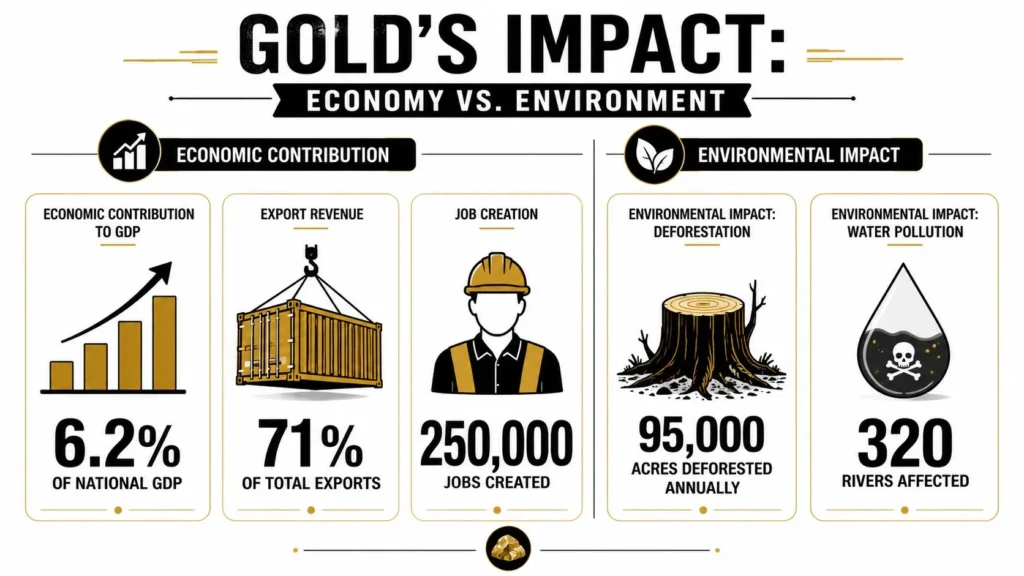
Gold’s official contribution
From Accra’s perspective, the case for gold is easy to see. It brings in foreign exchange, supports tax and royalty flows, and helps keep Ghana visible to international capital. Formal mines also create jobs, contract with local suppliers, and in some districts fund roads, clinics, or other community projects.
Those benefits are real. They are also uneven.
Large operators tend to report output, comply with licensing systems, and fit into a framework investors can evaluate. That makes the formal sector easier to count and easier to defend in policy debates. It also means the official story of mining is built around what can be measured cleanly, exported legally, and booked by the state.
A broader financing lens appears in Expert analysis of African financial governance, which helps explain why resource sectors often attract sustained policy attention even when local trade-offs remain contentious.
A video account of the wider mining impact adds useful context below.
What the revenue story leaves out
The harder question is not whether gold makes money. It is who carries the losses when extraction spreads beyond effective control.
In many mining districts, residents describe a different balance sheet from the one seen in export data. Rivers turn turbid. Farmland becomes harder to use. Mercury and other pollutants enter water and soil. Formal companies can contribute to these pressures, but the problem is especially acute where galamsey operations move quickly, reopen after crackdowns, or operate in places where enforcement is thin.
That gap matters because official production figures can imply order even when conditions on the ground suggest something messier. If a significant share of gold comes from channels that are only partly recorded or poorly regulated, then headline growth does not automatically translate into public benefit. It may also reflect weak control over land use, water quality, and local safety.
Cocoa, land, and the hidden trade-off
The conflict with agriculture is one of the clearest examples. In cocoa areas and other farming zones, mining competes for the same land, labor, and water that rural households depend on for slower, more stable income. A pit can produce cash quickly. A damaged farm can take years to recover, if it recovers at all.
For local families, this is not an abstract policy argument. It is a choice shaped by prices, debt, unemployment, and the credibility of the state. If mining income arrives faster than farm income, and if restoration is uncertain, short-term incentives can overwhelm longer-term planning.
That is why environmental damage in gold districts is also an economic story. Lost topsoil, polluted streams, and degraded cocoa land do not stay confined to one concession or one season. They affect household earnings, food production, and the resilience of communities already exposed to volatile commodity markets. Readers looking for a wider explanation of how climate change and broader ecological stress interact will see why these pressures rarely remain local for long.
The boom’s costs are local
Mining’s gains and losses arrive in different places and on different timetables. Export revenue is counted nationally. Contaminated water is experienced locally.
That split helps explain the intensity of the politics around Ghana gold mining. Officials can point to revenues, investment, and macroeconomic importance. Communities near damaged rivers or abandoned pits often see a thinner version of that prosperity. The result is a sector that looks highly productive in national statistics while leaving many of its heaviest costs off the formal ledger.
That is Ghana’s gold paradox. The country can post strong production numbers and still struggle to answer a basic question: who benefits from the boom once the hidden costs of the galamsey economy are counted?
Navigating Regulations Risks and Investment
For investors, Ghana’s appeal begins with scale. Gold exports are large enough to matter for the cedi, for tax receipts, and for foreign exchange. Yet the official production story captures only part of the risk. In many mining districts, the same boom that attracts capital also fuels conflict over land, water, and authority, especially where legal concessions overlap with entrenched galamsey activity.
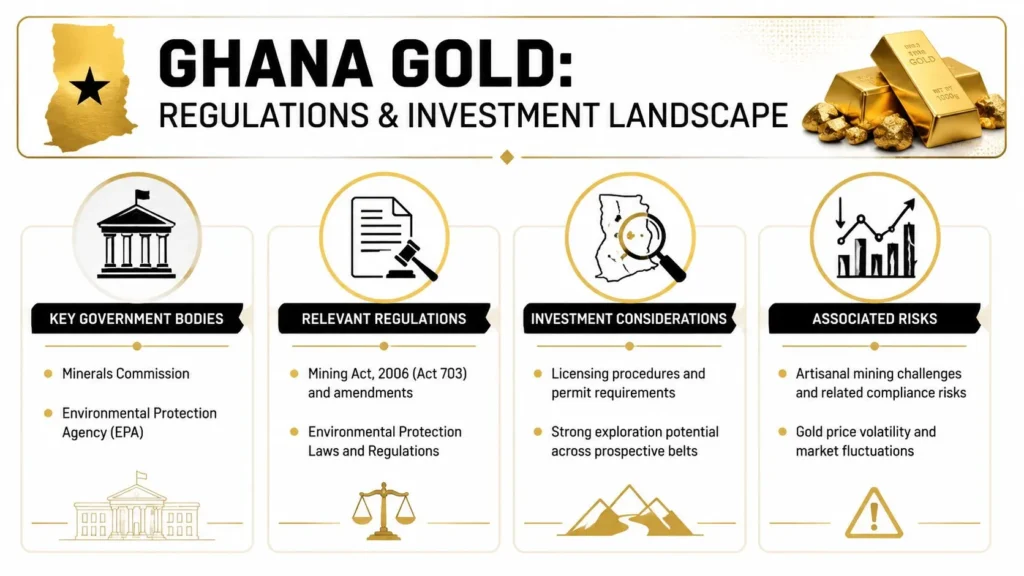
What investors need to understand first
The formal system is clear enough on paper. The Minerals Commission oversees licensing and mining policy. The Environmental Protection Agency handles environmental permitting and compliance. For a large operator, those institutions provide a recognizable framework.
The harder question is how that framework works in practice.
A concession can be valid in Accra and still be contested on the ground if compensation disputes linger, local leaders feel excluded, or informal miners have already occupied part of the area. That gap between legal title and practical control is one of the defining features of Ghana’s gold sector. It matters because investors are not assessing ore bodies alone. They are assessing the state’s ability to enforce rights consistently, and the willingness of communities to accept a project’s presence.
Three checks tend to matter early:
- Licensing and tenure security: Permit boundaries, renewal terms, and local obligations need to be clear enough to withstand dispute.
- Community consent and compensation: Delays often begin with land access, resettlement terms, or distrust over promised benefits.
- Exposure to illegal mining networks: Galamsey activity can create security costs, reputational damage, and operational interruptions even for fully licensed companies.
For readers interested in the broader policy setting around capital, state coordination, and regional investment architecture, this Expert analysis of African financial governance adds useful context beyond the mining sector itself.
Why concentration raises the stakes
The listed end of Ghana’s gold industry is dominated by a relatively small group of large mines. That means national output can look diversified in export data while remaining vulnerable to problems at a handful of sites. A processing setback, a permitting dispute, or a local security incident at one major operation can affect export earnings and government revenue far beyond the fence line.
This concentration also complicates the usual investment narrative. Strong national production figures may signal profitable industrial mining. They can also obscure how much activity, especially in the galamsey economy, sits outside formal reporting while still imposing real costs on rivers, farmland, and nearby communities. Investors who focus only on the counted ounces risk missing the liabilities building around them.
A practical reading of Ghana’s gold market starts there. The headline numbers are real. So are the off-balance-sheet pressures.
A practical framework for reading risk
A useful way to assess Ghana is to separate geological potential from execution risk.
Operational risk
Large mines depend on stable plant performance, reliable power, secure access routes, and steady relations with contractors and host communities.Regulatory and political risk
Enforcement can tighten quickly when pressure rises over illegal mining, polluted waterways, or lost public revenue. Those shifts can affect permitting, inspections, and the broader tone of state intervention.Social and environmental risk
A company may comply with formal requirements and still face opposition if nearby residents associate mining with damaged water sources, lost farmland, or unequal benefit-sharing. In a country where galamsey has blurred the line between legal extraction and environmental harm in the public imagination, licensed operators can still be drawn into wider distrust.
For general readers trying to judge resource-sector opportunity with a cooler head, this guide on how to start investing money is a useful reminder that a growing sector is not automatically a low-risk one.
Ghana remains one of Africa’s most important gold producers. But the investment case is strongest when official output data is read alongside the less visible realities surrounding it: disputed land, weak enforcement in some districts, and environmental losses that national accounts do not fully record.
The Future of Gold in Ghana
The future of Ghana gold mining won’t be decided by geology alone. The ore bodies are important, but the decisive variables now sit above ground: enforcement, formalization, land use, public trust, and whether the state can narrow the gap between counted output and uncounted damage.
The central challenge is not choosing between mining and no mining. Gold is too embedded in Ghana’s economy and history for that to be a serious frame. The challenge is whether Ghana can move more production into legal, traceable channels without only pushing vulnerable people out of one livelihood and into another precarious one.
What reform would actually require
A workable future probably depends on several things happening at once.
- Formalizing small-scale mining: Licensed pathways need to be credible enough that operators have a reason to enter them.
- Enforcing rules consistently: Selective crackdowns signal weakness, not resolve.
- Protecting agricultural land and water: If environmental damage keeps eroding farms and rivers, the country shifts costs into its own future.
- Improving benefit-sharing: Communities near extraction need a stronger reason to believe mining serves more than distant institutions and private intermediaries.
None of that is simple. Formalization can become a slogan if permits are slow, corruption remains entrenched, or legal small miners face barriers that illegal networks can bypass.
Gold’s market appeal will keep pressure on the system
As long as gold remains financially attractive, Ghana will face strong incentives to extract more of it. Anyone trying to understand the market side of that pressure can look at this analysis of understanding gold’s 2026 performance, which offers a broader sense of why the metal continues to command investor attention. Higher prices can support national earnings. They can also intensify the scramble at the informal edge of the sector.
That is why the future debate cannot be limited to output targets. It has to include the quality of growth, the legitimacy of enforcement, and the resilience of communities living with mining’s consequences.
Ghana’s real mining test isn’t whether it can produce more gold. It’s whether it can produce gold without steadily consuming the land, water, and institutions needed for life after the boom.
For readers thinking about what a more sustainable development model would demand from resource-rich countries, this introduction to renewable energy and long-term energy transition thinking is a useful companion. Gold may remain central for years. But no extractive economy can defer the question of sustainability forever.
Ghana has the geological inheritance, institutional memory, and global relevance to shape a better model than the current uneasy bargain. Whether it does so will depend less on rhetoric than on enforcement that is fair, transparent, and difficult to evade.
If you enjoy thoroughly reported, accessible writing on business, science, technology, health, culture, and global affairs, explore more independent commentary at maxijournal.com.
Discover more from Maxi Journal
Subscribe to get the latest posts sent to your email.