When your dog has been vomiting, pacing, licking their lips, and refusing food, it’s hard to think clearly. You’re usually holding a prescription, trying to read the label, and wondering two things at once. Will this help, and is it safe?
That’s where metoclopramide comes in. Vets prescribe it often because it can do two useful jobs at the same time. It helps settle the urge to vomit, and it helps the upper digestive tract move food in the right direction again.
For many families, the confusion starts because the medication seems simple, but the reasons for using it aren’t. A dog may get metoclopramide after surgery, during a bout of gastritis, for reflux, or when the stomach is emptying too slowly. The instructions may also look different depending on whether your dog got tablets to take at home or an injectable form in the hospital.
Breed can matter too. If you live with a flat-faced dog such as a Pug or French Bulldog, you may already know that “routine” medications don’t always feel routine. And if your dog also gets over-the-counter products, especially CBD oil, that adds another layer that many quick online guides skip.
Your Guide to Understanding Metoclopramide
A common scene in practice goes like this. A dog vomits several times overnight, looks miserable by morning, and still wants to drink but can’t seem to keep the stomach settled. The owner is exhausted, worried about dehydration, and anxious about whether every new gag or lip lick means another vomiting episode is coming.
Metoclopramide is one of the medications vets reach for in exactly that kind of situation. It has been used in veterinary medicine for dogs for decades after being adapted from human medicine, and it remains a familiar tool for vomiting and upper gastrointestinal motility problems. In plain language, that means it can help with nausea-related vomiting and with a stomach that’s moving too slowly.
Why owners often find it confusing
Part of the confusion is that metoclopramide for dogs is not just a “stop vomiting” pill. It also changes how the upper digestive tract moves. So if your veterinarian prescribed it, they may be treating more than the visible symptom.
Your dog’s care plan may depend on questions like these:
- Is the problem nausea itself: such as after anesthesia or with gastritis?
- Is food sitting too long in the stomach: creating reflux, discomfort, or repeat vomiting?
- Is there any sign of a blockage: which changes everything and can make this medication inappropriate?
- Is your dog on other medications or supplements: especially sedatives, behavior drugs, or CBD products?
Practical rule: If your dog is vomiting repeatedly, seems painful, has a swollen abdomen, or can’t keep water down, medication instructions matter, but a veterinary recheck matters more.
What you need to know first
Most owners do best when they focus on a few basics:
- Use it exactly as prescribed. Small timing changes can affect how well it works.
- Know the reason your vet chose it. That helps the instructions make sense.
- Watch behavior as well as vomiting. Some side effects are neurologic, not just digestive.
- Mention every supplement. “Just CBD” or “just an antihistamine” still counts.
With that foundation, the rest of the prescription becomes much easier to understand.
How Metoclopramide Works to Stop Vomiting
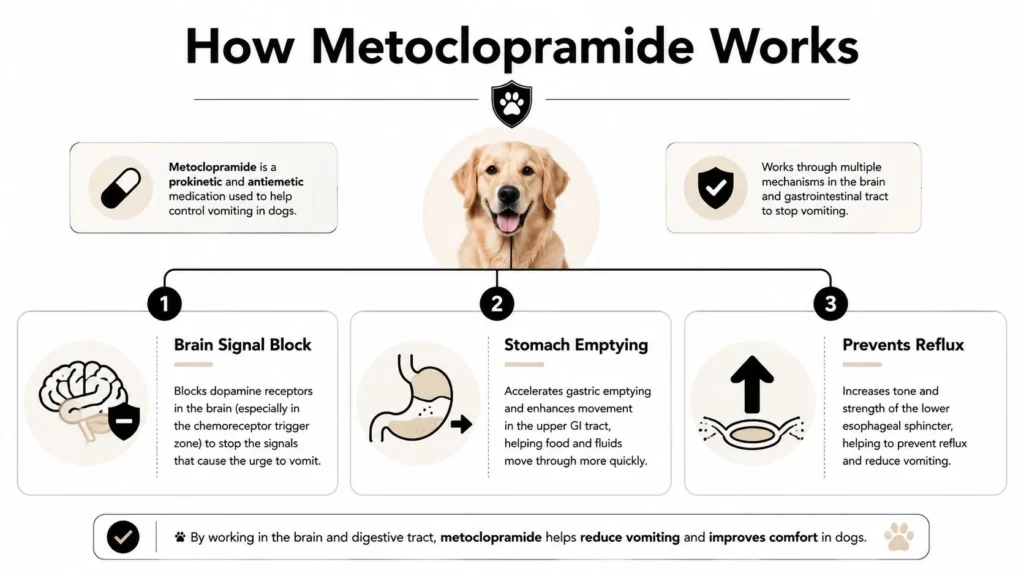
Metoclopramide works in two places at once. That’s why it can be so helpful when a dog seems caught in a cycle of nausea, reflux, and repeated vomiting.
It acts like a traffic controller for the stomach
One part of the drug’s job is prokinetic. That word just means it encourages movement in the upper gastrointestinal tract. If the stomach is sluggish, food and fluid can sit there longer than they should. That delay can feed nausea, increase reflux, and make vomiting more likely.
Metoclopramide helps direct traffic forward. It improves stomach emptying and helps tighten the barrier between the esophagus and stomach. According to Wedgewood’s metoclopramide reference, it can increase lower esophageal sphincter pressure by 20 to 30% and accelerate gastric emptying by 15 to 25%, reducing half-emptying time from 120 minutes to as low as 75 minutes in scintigraphic studies.
That’s the part many owners feel but can’t see. A dog may stop swallowing repeatedly, seem less burpy, and look more comfortable lying down because stomach contents are less likely to wash backward.
It also blocks the brain’s vomit signal
The second part is its antiemetic action. Metoclopramide blocks dopamine D2 receptors in the chemoreceptor trigger zone, often shortened to CTZ, which is one of the brain areas involved in triggering vomiting. Think of it as reducing the volume on a signal that says, “empty the stomach now.”
Some dogs aren’t vomiting only because food is sitting badly. They’re also nauseated. The medication helps on both fronts.
Some drugs mainly quiet vomiting. Metoclopramide can quiet vomiting and help the stomach move along better, which is why vets often use it when nausea and delayed emptying seem linked.
Why timing matters
Because it works on movement as well as nausea, timing affects the result. If your veterinarian tells you to give it before meals, that isn’t arbitrary. The goal is to have the medication active when food enters the stomach, so movement is supported right when it’s needed.
This dual action also explains why metoclopramide isn’t the right fit for every vomiting dog. If a dog might have a blockage, “speeding traffic up” is not what you want. In that situation, pushing the gut to move harder can make a dangerous problem worse.
Common Veterinary Uses for Metoclopramide
When owners ask, “Why this medication and not something else?” the answer usually comes back to the pattern of the dog’s symptoms. Metoclopramide is most useful when vomiting is tied to the upper digestive tract not moving normally.

Situations where vets commonly use it
A veterinarian may prescribe metoclopramide for dogs in cases such as:
- Acute gastritis or stomach irritation: when nausea and repeated vomiting leave the dog unable to settle.
- Post-operative nausea: especially when the stomach seems slow to “wake back up” after anesthesia.
- Reflux or esophagitis support: because improving forward movement and strengthening the lower esophageal sphincter can reduce backflow.
- Delayed gastric emptying: when food lingers in the stomach and contributes to discomfort.
- Vomiting associated with kidney-related illness: when the treatment goal is symptom control while the underlying disease is being managed.
- Hospital care for persistent vomiting: where an injectable or continuous infusion approach may be more useful than home dosing.
Why one dog gets it and another dog doesn’t
Two dogs can both be vomiting and still need different medications. One may need metoclopramide because the stomach is acting “stalled.” Another may need a different anti-nausea drug because the main issue is motion sickness, pancreatitis, or a condition where gut stimulation isn’t desirable.
That distinction is also why home internet guesses can get people in trouble. For example, if a dog vomited after getting into food or garbage, the story matters more than the symptom alone. And if you’re trying to sort out whether a diet issue might be part of the problem, this guide on whether dogs can eat raw chicken is the kind of question worth discussing with your vet before assuming a medication alone will fix things.
A special note on nursing dogs
Metoclopramide also has a more specialized use in some lactating dogs because it can support milk let-down. That’s not a routine use for every dog, and it should only be done under veterinary guidance, but it’s one reason the same medication may appear in very different clinical situations.
A prescription only makes sense when it matches the problem your veterinarian is treating. If you’re unsure why your dog got metoclopramide, ask that question directly. It’s one of the most useful follow-up questions you can ask.
Dosing Metoclopramide by Weight and Route
The most important rule is simple. Your veterinarian’s dose is the right dose for your dog. Weight, age, kidney function, hydration status, and the reason for prescribing all affect the final instructions.
Still, it helps to know what a typical prescription is trying to do. For general antiemetic use, PetPlace’s metoclopramide dosing guide lists 0.1 to 0.2 mg/lb (0.2 to 0.5 mg/kg) every 6 to 8 hours, with practical home dosing examples of 2.5 mg for dogs under 10 lbs, 5 mg for dogs 11 to 40 lbs, and 10 mg for dogs over 40 lbs, typically given 30 to 45 minutes before meals.
Typical dosage table
| Dog Weight | Typical Oral Dose (PO) | Frequency |
|---|---|---|
| Under 10 lbs | 2.5 mg/dose | Every 6 to 8 hours |
| 11 to 40 lbs | 5 mg/dose | Every 6 to 8 hours |
| Over 40 lbs | 10 mg/dose | Every 6 to 8 hours |
These are broad examples, not substitute instructions. A very small dog with another illness may need a more customized plan, and a large dog may not always receive the “standard” practical dose if the veterinarian is calculating by exact body weight.
Routes you may see
Metoclopramide can be given in several ways, and each route has a reason.
Oral dosing at home
Tablets or liquid by mouth are the most common home options. They’re often used for dogs who are stable enough to go home, can keep some medication down, and need support for a few days.
Giving the dose before meals usually helps because the medication is already working when food reaches the stomach.
Injection under the skin or by vein
Some dogs start with injectable treatment in the clinic. This is useful if vomiting has been frequent enough that an oral medication may not stay down.
Injectable forms can also be more practical during a hospital stay when staff need tighter control over timing and response.
Continuous rate infusion in hospital
For more stubborn cases, veterinarians sometimes use a constant rate infusion, often shortened to CRI. This is a steady IV delivery used in a supervised setting, not something owners do at home.
Practical tips that prevent common mistakes
- Give it on schedule: Don’t bunch doses together because a previous one was late.
- Use the measuring device provided: Especially with liquid medication.
- Ask before combining with other stomach remedies: Even over-the-counter products can matter.
- Clarify missed-dose instructions: Don’t guess.
If your dog takes other common medications at home, owners often ask about combinations with allergy products. If that’s part of your situation, this overview of Benadryl dosing for dogs is a good reminder that “common” doesn’t mean “automatically safe to combine.”
Understanding Potential Side Effects and Risks
You give the first dose, your dog finally keeps water down, and a few hours later something feels off. Maybe your Labrador seems unusually sleepy and hard to rouse for dinner. Maybe your Pug is not vomiting anymore, but now he cannot settle, keeps swallowing, and makes a sharper, more urgent noise than his usual snuffling. That kind of change is exactly what owners should watch for with metoclopramide.

Metoclopramide often helps dogs feel better, but it can also affect the brain and gut in ways owners notice at home. The easiest way to understand the risk is to separate expected, milder effects from the uncommon reactions that need a same-day call.
What owners may notice first
The more routine side effects veterinarians watch for include drowsiness, restlessness, constipation, increased urination, and muscle spasms. Some dogs act tired. Others look keyed up, pace, or seem unable to get comfortable.
Watch the whole dog, not just the vomiting.
If the stomach seems calmer but your dog’s behavior suddenly changes, that still counts as a medication response. Owners sometimes miss this because they are focused on whether food stays down. A dog can improve in one area and still be having a side effect in another.
Rare but serious reactions
The uncommon reactions are usually neurologic, which is why they can look dramatic. Signs can include:
- Agitation
- Tremors
- Ataxia or wobbliness
- Aggression or unusual reactivity
- Marked disorientation
- Pacing that will not stop
These signs deserve prompt veterinary attention. Do not wait overnight to see whether a dog with tremors, severe restlessness, or sudden behavior changes settles on their own.
When metoclopramide should not be used
Veterinarians generally avoid metoclopramide if there is concern for:
- Gastrointestinal obstruction
- Perforation
- A previous allergic reaction or known hypersensitivity to the drug
The reason is practical. Metoclopramide helps move stomach contents forward. If the intestine is blocked, increasing that pushing motion can increase pressure behind the blockage, like squeezing more water into a kinked hose.
Breed sensitivity and brachycephalic dogs
Flat-faced breeds need more specific monitoring than they usually get in online medication guides. Pugs, French Bulldogs, Boston Terriers, Bulldogs, and similar dogs often start with noisy breathing, frequent swallowing, mild reflux, or trouble settling in certain positions. Those baseline quirks can blur the line between normal-for-the-breed and a side effect.
That means “watch closely” is not enough. You need a few concrete checkpoints.
In a Labrador, unusual agitation may look like repeated getting up and lying down, pacing room to room, staring, or acting too restless to nap. In a Pug or French Bulldog, the same problem may show up as frantic circling in the crate, repeated upright sitting instead of resting on the chest, a high-pitched whine layered on top of usual snorting, or sudden refusal to lie in the position they normally choose for sleep.
The same goes for comfort at rest. A Labrador with a medication problem may seem shaky or unable to settle. A brachycephalic dog may extend the neck, keep swallowing, sleep in short bursts, or pop awake repeatedly as if they cannot get comfortable enough to breathe and relax at the same time.
For owners of brachycephalic dogs, these steps help:
- Check the first few doses when you can observe your dog directly, not right before you leave the house
- Note your dog’s normal breathing and resting posture before starting the medication
- Watch for repeated swallowing, frantic repositioning, new vocalization, or pacing
- Call your vet if your dog seems more distressed, more reactive, or less able to rest comfortably than usual
Do not dismiss these changes as “just being a Frenchie” or “normal pug fussiness.” Breed habits can hide early warning signs.
Some reactions are mild and pass after the medication is adjusted or stopped. Others need faster reassessment. Careful observation, especially in brachycephalic dogs, helps your veterinarian decide which is which.
Drug Interactions and Monitoring at Home
A good prescription review doesn’t stop at the label. It includes everything else your dog gets, even products that feel harmless because you bought them without a prescription.
The interaction owners miss most often
CBD oil is the biggest blind spot I hear about. Many owners mention it only after I ask directly, because they think of it as a supplement, not a medication interaction risk.
According to VCA’s metoclopramide information, CBD is used by 30% of U.S. dog owners, and emerging 2025 to 2026 data described there indicates that combining it with metoclopramide can lead to serotonin syndrome in 8% of cases at doses above 0.3 mg/kg. That’s why this combination deserves real caution and a veterinary conversation before you give both.
Other combinations worth flagging
You should also tell your vet if your dog receives:
- Acepromazine or other sedating medications
- Barbiturates
- Selegiline
- Over-the-counter antihistamines
- Tramadol
- Any calming supplement or sleep aid
Some combinations can increase sedation. Others can increase constipation or make behavior changes harder to interpret. Even when an interaction doesn’t make the pair forbidden, it may change what your veterinarian wants you to monitor.
A simple home monitoring checklist
During treatment, keep your observations basic and concrete. You don’t need a spreadsheet. You need a few reliable notes.
- Vomiting pattern: Is it stopping, decreasing, or unchanged?
- Appetite: Will your dog eat small meals, or do they still turn away?
- Behavior: Calm, sleepy, restless, shaky, confused?
- Bowel movements: Normal, absent, or harder than usual?
- Water intake and urination: Especially if your dog seems drowsy or dehydrated.
If you have to describe your dog’s behavior with words like “strange,” “not himself,” or “can’t settle,” call your veterinarian. Those descriptions are often more useful than owners realize.
Brachycephalic dogs need closer observation
With brachycephalic breeds, home monitoring matters even more. These dogs may already gag, swallow loudly, snore awake, or act anxious around eating. Those baseline quirks can hide signs that the medication isn’t agreeing with them.
The safest approach is simple. Start exactly as prescribed, don’t stack other supplements on top, and call early if anything looks off.
Emergency Signs and When to Call Your Vet
It is 10 p.m., your dog got a dose of metoclopramide earlier, and now something feels off. Maybe the vomiting has not stopped. Maybe your dog seems unusually agitated, wobbly, or just not like himself. That is the moment owners often hesitate, especially if they were told this medication is commonly used. Common does not mean every reaction is harmless.

The easiest way to judge urgency is to focus on function. Ask yourself: can my dog breathe comfortably, walk normally, settle, and keep water down? If one of those basics suddenly changes after starting the medication, call your veterinarian promptly. If your dog is struggling to breathe, collapses, or has severe neurologic signs, go to an emergency clinic.
Call your vet right away if you see these signs
Metoclopramide can, in rare cases, trigger abnormal neurologic reactions. These can look dramatic and can be frightening to watch.
Seek urgent veterinary advice if your dog develops:
- Uncontrolled tremors or repeated muscle twitching
- Staggering, falling, or trouble standing
- Sudden aggression, panic, or extreme agitation
- Severe disorientation or inability to settle
- Repeated vomiting despite treatment, especially if your dog seems weak or dehydrated
- Facial swelling, hives, pale gums, or trouble breathing
For brachycephalic dogs such as Bulldogs, Pugs, Boston Terriers, and French Bulldogs, use an even lower threshold for calling. These breeds can already make noisy breathing, gagging, and reflux-like sounds part of daily life. That can blur the line between a familiar airway issue and a medication problem. If your flat-faced dog seems more distressed than usual around breathing, swallowing, or retching, do not wait to see if it passes.
Signs that still deserve a same-day call
Some problems are less dramatic but still deserve attention that day.
- Vomiting is unchanged after multiple doses
- Your dog refuses food or water
- Constipation becomes marked or painful
- Restlessness continues or gets worse
- You think an extra dose may have been given
- Your dog seems much sleepier after taking metoclopramide with CBD oil, calming chews, or another supplement
That last point gets missed often. Owners do not always think of CBD oil or over-the-counter calming products as medications, but they can muddy the picture. If your dog becomes unusually sedate, oddly restless, or harder to rouse after combining products, your veterinarian needs to know exactly what was given and when.
If your dog is coughing, retching, or bringing up foam and you cannot tell whether the problem is stomach-related or respiratory, this guide on dog coughing up white foam may help you sort out what you are seeing while you arrange veterinary advice.
Trust a sudden change
Neurologic side effects can look strange. A dog may seem panicked, glassy-eyed, stiff, or unable to get comfortable. Owners often worry they are overreacting because the signs do not look like simple vomiting anymore. That concern is understandable, but it is also exactly why a phone call matters.
You know your dog’s normal better than anyone. If the change is abrupt, unusual, or hard to manage at home, contact your veterinarian. Early calls are easier than late emergencies.
Discover more from Maxi Journal
Subscribe to get the latest posts sent to your email.