In 2024, independent venues, promoters, and festivals contributed $86.2 billion to U.S. GDP, generated $153.1 billion in economic output, and supported 908,000 jobs, according to the NIVA State of Live 2025 report. Those figures challenge the familiar image of underground music as a hobby happening at the margins. Behind the unusual sounds and small rooms sits a working ecosystem of artists, audiences, promoters, venues, record shops, media makers, and local businesses.
Introduction
An underground music scene is more than a genre label and more than a place to find obscure songs. It’s a network that helps people make, share, hear, and pay for music outside the most visible commercial channels. A basement show, a volunteer-run radio program, a regional promoter, and a small club may look unrelated, but together they can create the conditions for artistic development and local economic activity.
This guide follows that network step by step. You’ll learn how the underground music scene developed, how to recognize its shared characteristics across punk, techno, hip-hop, noise, and experimental music, and how local communities grow from informal gatherings into durable institutions. You’ll also see how regional identity shapes scenes, how fans move from discovery to meaningful support, and how artists can use practical DIY methods without treating every task as a race to become a full-time content creator.
The central idea is simple: underground describes a position within a cultural and commercial ecosystem, not an absence of value. Understanding that ecosystem helps listeners find music with more context and helps artists, promoters, and venues make better decisions about survival.
Understanding the Underground Music Scene
The underground music scene is an interconnected community of venues, promoters, artists, fans, media, and small businesses. It may operate outside dominant industry channels, but it still needs infrastructure. Someone books the room, someone designs the flyer, someone runs sound, someone documents the show, and someone buys the ticket that makes the next event possible.
That structure has appeared in different forms across music history. Early jazz clubs and speakeasies created spaces where musicians and audiences could gather around sounds that challenged social and commercial expectations. Punk basements later used cheap equipment, informal venues, and direct communication to build networks without waiting for approval from major institutions. DIY hip-hop, electronic collectives, and experimental communities adapted the same principle to new technologies and spaces.
The style changes, but the process remains recognizable. An underground scene grows when people turn shared taste into repeated activity. A rehearsal space becomes a venue. A flyer becomes a mailing list. A small club becomes a meeting point for artists, promoters, photographers, record sellers, and fans.
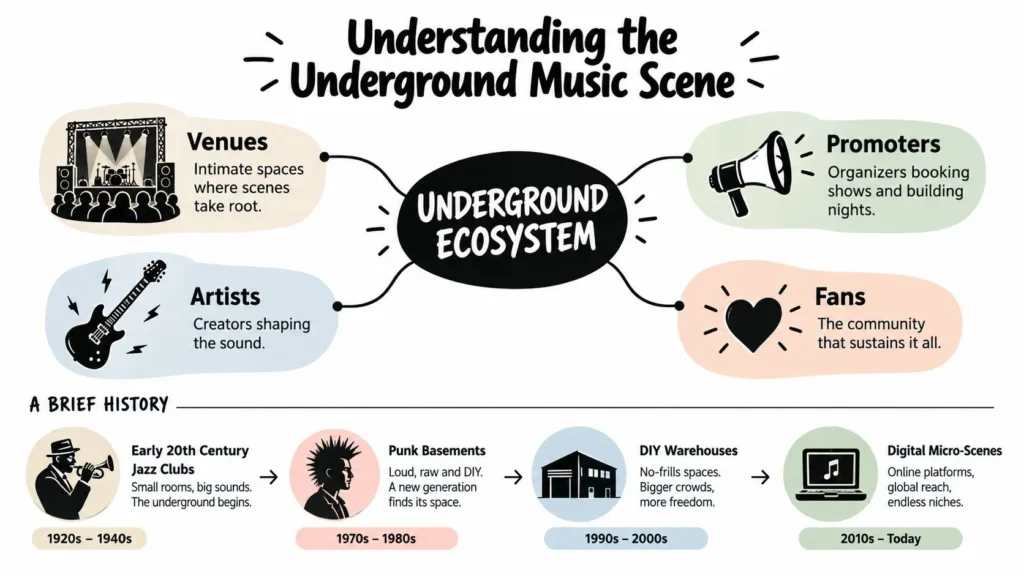
Underground is a position, not a permanent identity
Artists can move between underground and mainstream spaces without abandoning the values that shaped their work. A scene may begin outside dominant commercial systems, then become economically visible once its artists, venues, and audiences create durable institutions. Punk, indie rock, hip-hop, electronic music, and experimental scenes have all followed versions of this path.
The economic role can be substantial. Independent music represented almost 26% of the entire U.S. music industry in 2007, second only to Universal, and an analysis of SXSW estimated that the festival generated $325.3 million for Austin during its one-week run in 2016. These figures appear in research on indie music’s role in small American cities, available through this study of independent music and local economies.
For readers who want to follow how these networks are documented, independent music blogs can provide local context that streaming interfaces often leave out. Reviews, interviews, gig listings, and scene reports explain not only what an artist sounds like, but also where that sound comes from.
Key Characteristics and Genres
Underground scenes vary widely, but several characteristics appear again and again. The first is a DIY ethos, meaning participants solve practical problems themselves instead of waiting for a major label, large promoter, or established media outlet. The second is experimentation. Artists use unusual structures, production methods, languages, instruments, or performance settings because the scene gives them room to test ideas.
A third characteristic is the strength of informal networks. A trusted promoter may connect a new band with a venue. A community radio host may introduce an artist to listeners. A photographer may help create the visual identity that makes a night recognizable. These relationships aren’t always hierarchical, but they still carry responsibilities. Reliability, respectful behavior, and fair communication matter because reputations travel quickly through small communities.
Different genres, shared infrastructure
Punk often centers on direct participation. The distance between performer and audience can be small, and the same person may play in a band, organize a show, print a zine, and help clean the room afterward. Its infrastructure tends to value speed, access, and collective labor.
Indie rock commonly develops through rehearsal spaces, small clubs, independent labels, record shops, and local media. The term covers many sounds, but the scene often rewards distinctive songwriting and a recognizable community identity rather than strict genre purity.
Techno and electronic music frequently rely on DJs, producers, promoters, sound-system operators, and collectives. A Berlin club night, for example, can function as both a performance platform and a social institution, with its identity shaped by curation, space, lighting, sound, and audience conduct.
Underground hip-hop grows through emcees, beatmakers, open mics, cyphers, independent video makers, and direct local promotion. The scene can be intensely place-specific because artists respond to neighborhood language, politics, and daily life.
Noise and experimental electronic music challenge the assumption that music must be immediately accessible. Their communities may form around galleries, warehouses, artist-run spaces, specialist radio, or small festivals. New York’s noise underground illustrates how a scene can use extreme sound as a way to build a shared artistic language.
Practical rule: Judge a scene by how people exchange skills, attention, space, and money, not only by the genre names on a poster.
To identify these traits locally, look beyond playlists. Find the recurring nights, community radio programs, small labels, rehearsal spaces, and people who consistently support unfamiliar artists. The scene is usually visible through its connections before it becomes visible through its reputation.
How Scenes Form and Sustain
A scene usually starts with something small and repeatable. A few people find a room, gather enough gear to make the night work, spread the word, and give others a reason to show up again. The first space might be a garage, loft, rehearsal room, gallery, or borrowed hall. Prestige matters less than trust, basic organization, and a sense that people will be welcomed when they arrive.
That first gathering is like laying the foundation of a building. Nobody sees the whole structure yet, but the support system is already being tested. Can the room handle sound? Can the organizer communicate clearly? Do artists feel respected enough to return? Those early answers shape everything that follows.
Repetition turns an event into infrastructure. A single show can create excitement, but a recurring DIY night creates habits. Artists begin to rely on it as a place to try material and meet collaborators. Fans learn when to come, who to ask, and which friends to bring. Flyers, zines, community radio, independent blogs, and word-of-mouth then carry the scene beyond the people who were in the room on night one.
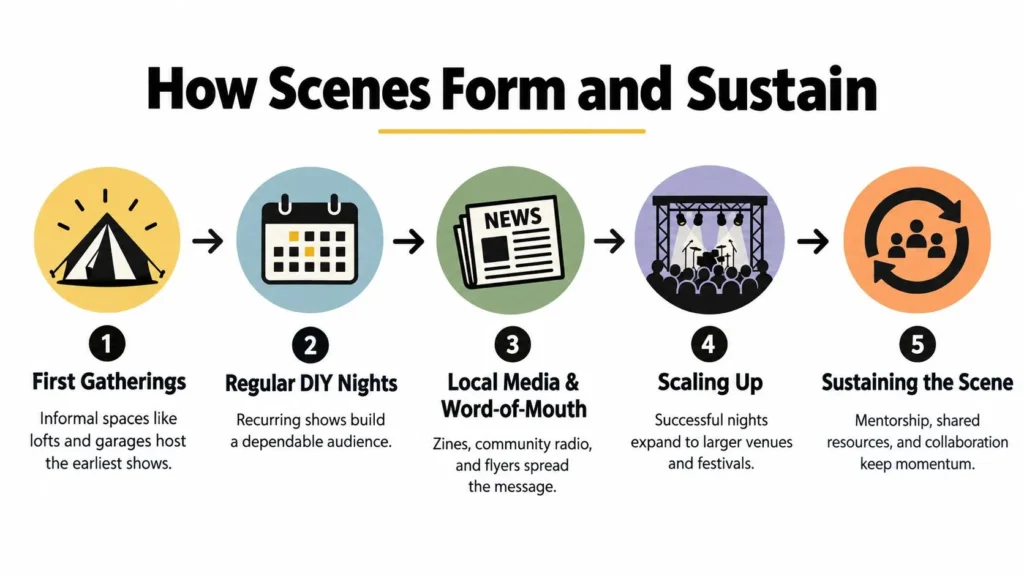
The five-stage lifecycle
First gatherings: Informal spaces lower the cost of experimenting. People can test lineups, formats, and audience fit before committing to a permanent venue.
Regular nights: Recurring events create routine. Promoters improve scheduling, ticketing, sound, and safety, while artists get steady chances to perform.
Local communication: Flyers and personal recommendations still matter because they add context. A trusted local source can explain why an unfamiliar act belongs on a bill.
Scaling up: Successful nights may move into larger rooms, festivals, or permanent venues. Growth can increase income and visibility, but it can also change the social character that made the night meaningful.
Sustaining the network: Mentorship, equipment sharing, fair booking, accessible policies, and collaboration help the scene last beyond its founders.
Scenes survive because they are cultural systems and economic systems at the same time. The room on show night is only the visible part. Behind it are renters, engineers, door staff, designers, printers, rehearsal spaces, small labels, food spots, and regular attendees whose spending keeps activity circulating through the local music economy. Analysts in a national independent live-music analysis found that 91% of these businesses operated year-round, which helps explain why even small events depend on continuous infrastructure.
That continuity does not make a scene financially safe. Promoters still have to weigh artist guarantees, staffing, production, insurance, taxes, and facility costs against realistic ticket sales and secondary revenue. At this stage, two measures matter especially: the guarantee-to-net-revenue ratio and the share of bills reserved for local artists.
Healthy scenes treat those choices as connected. Higher-margin nights can support riskier programming. Memberships, grants, bar revenue, or tourism-linked events can help cover less commercial shows. Without that balancing act, a venue may become well known while the community around it grows more fragile.
Regional Scenes and Notable Examples
A city shapes an underground scene the way a room shapes a sound. Ceiling height, neighborhood traffic, rent pressure, local history, transit, language, and nightlife policy all change what is possible. That is why regional scenes matter. They show the economic and community infrastructure behind the music, not just a style or a stereotype.
The examples below are starting points, not fixed definitions. Every city contains overlapping networks, and no single venue or artist can stand in for an entire place.
| City | Genre Focus | Notable Venue | Pioneering Artist |
|---|---|---|---|
| Detroit | Techno | The Old Miami | Juan Atkins |
| Bristol | Trip-hop and electronic music | Thekla | Tricky |
| Mexico City | Punk and alternative music | Multiforo Alicia | Rodrigo González (Los Lagartos) |
| Seoul | Experimental and electronic music | Cakeshop Seoul | Park Hye Jin (DJ and producer) |
| São Paulo | Indie rock | Áudio Rebel | Boogarins |
These artists are illustrative figures associated with each city’s scene. They are not presented as founders of the listed venues.
Detroit techno shows how place can become sound. Industrial decline, Black musical innovation, and a working club network helped produce music that felt local first and global later. The lesson for artists is practical. Use the tools, rooms, and social realities you have, because scenes grow from constraints as much as from ambition.
Bristol offers a different pattern. Its trip-hop history grew through DJ culture, sound-system traditions, visual art, and audiences comfortable with hybrid forms. In that kind of environment, collaboration matters more than neat genre labels. The shared atmosphere helps rappers, singers, producers, and instrumentalists build a common language.
Mexico City and Seoul reveal another side of underground infrastructure. Mexico City’s punk networks show what independent rooms and direct community organizing can do when formal support is limited. Seoul’s experimental and electronic communities work inside a dense, connected urban culture, yet still protect smaller spaces for unusual formats and riskier sets. São Paulo adds another useful example. Its indie circles show how local labels, clubs, art spaces, and touring routes can keep guitar-based music distinct even in a large and crowded market.
Regional scenes also matter beyond the venue door. As noted earlier, audience travel generated $10.62 billion in off-site spending in 2024. That helps explain why a modest show can still affect restaurants, transit providers, hotels, and record shops nearby. The underground is not separate from the local economy. It feeds it, and depends on it in return.
If you want to explore a scene outside your own city, start with local media, promoters, and community organizers. Learn which spaces people trust. Pay for events when you can. Follow house rules. That approach helps you understand how a scene works, and it supports the people keeping it alive.
How Fans Discover and Support Underground Acts
Discovery often begins with a small signal. A friend sends a track. A community radio host plays an unfamiliar artist. A local blog reviews a release, or a flyer leads someone to a room they’ve never entered. Streaming platforms can help, but they can’t provide all the social information that tells a listener why an artist matters to a particular community.
The scale of digital supply makes attention difficult. More than 106,000 tracks are uploaded daily to streaming platforms, and 88% receive fewer than 1,000 annual streams, according to this analysis of the discovery crisis facing independent artists. The problem isn’t just distribution. Artists can release music worldwide, but listeners still have limited time and often need trusted context before they commit attention.
The path from listener to participant
A first listen has little financial meaning by itself. Sustainable support usually develops through a sequence:
- Attention: The listener hears a song through radio, a friend, a blog, a playlist, or a live set.
- Recognition: The artist becomes associated with a sound, place, message, or memorable performance.
- Participation: The listener follows the artist, joins a mailing list, attends a show, or shares the music with someone else.
- Support: The fan buys a ticket, record, shirt, download, membership, or direct-to-fan release.
- Continuity: The artist earns a repeat attendee or customer rather than a single isolated stream.
Merchandise can make that connection tangible. Fans who want to support a band beyond streaming can use a practical T-Shirt Envy band merchandise guide to understand how apparel and other products can reinforce an artist’s visual identity. For artists, merchandise works best when it’s treated as part of the story of a release, not as random branding placed on a blank shirt.
Access needs equal attention. Age restrictions, late-night transport, ticket prices, disability access, unclear conduct policies, and insider social networks can exclude people before they hear the music. A welcoming venue should publish practical information, explain safety expectations, identify accessible routes and facilities where possible, and avoid assuming that newcomers already know the unwritten rules.
Fans can also support inclusion by introducing people outside their existing circle, sharing useful event information, respecting space boundaries, and paying artists or venues whenever they can. A broader approach to discovering new music combines digital exploration with local participation, because scenes become durable when listeners move from passive consumption to repeated presence.
DIY Strategies for Independent Artists
A DIY career isn’t a promise that one person can perform every industry role forever. It’s a method for building enough knowledge and direct relationships to make informed choices. Artists can outsource tasks later, but they’ll negotiate more safely if they understand how booking, promotion, money, and audience development fit together.
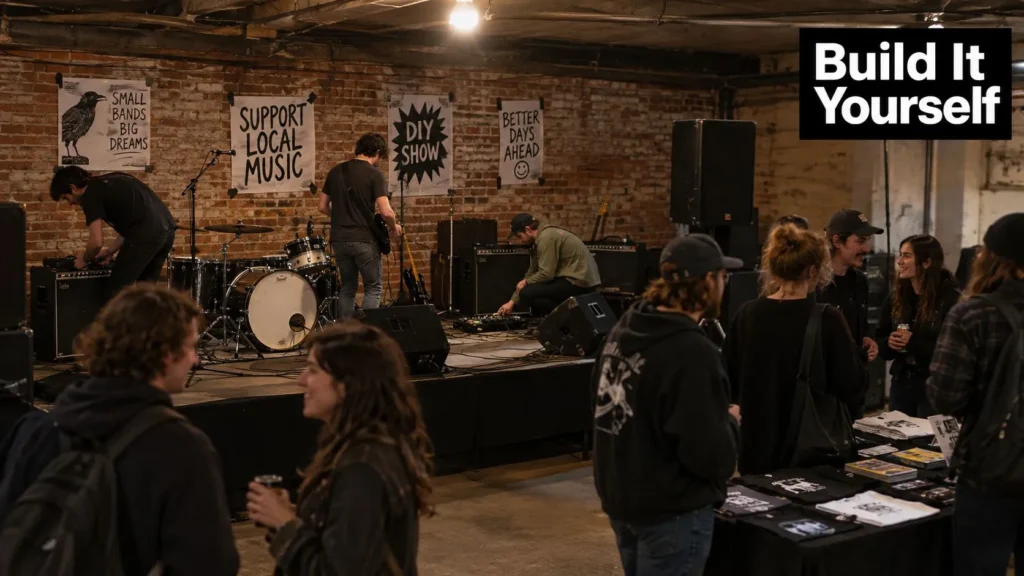
Start with a reliable live proposition
Before contacting venues, prepare a concise press folder. Include a short biography, live photographs, music links, a performance video, technical requirements, contact details, and a clear description of the audience or scene you serve. A venue needs to know what you sound like, what your setup requires, and why its audience might care.
Build a route rather than sending random requests. Identify rooms that already book related artists, then study their calendars and policies. Contact the appropriate person with a specific proposal, possible dates, lineup information, and an honest statement about your draw. Don’t exaggerate past attendance. Promoters remember artists who communicate accurately.
The negotiation should clarify:
- Payment: Is the arrangement a guarantee, a percentage, or a door split?
- Costs: Who covers sound, backline, travel, accommodation, hospitality, and ticketing fees?
- Timing: What are the load-in, soundcheck, doors, set, and settlement times?
- Promotion: Which assets does the venue need, and who publishes them?
- Cancellation: What happens if the show is postponed or canceled?
One industry analysis found that only 36% of independent venues, promoters, and festivals were profitable in 2024, despite the sector’s substantial overall economic activity. The figure, reported in this analysis of independent venue economics, explains why a full room can still produce a weak result. Artists who understand the venue’s cost structure are more likely to propose workable bills and avoid demands that damage future relationships.
Promote with several small signals
A single post rarely carries an event. Build a sequence that reaches people in different ways:
- Create one clear event page with the date, time, location, ticket information, accessibility details, and lineup.
- Give the venue, support acts, and local media correctly sized images and copy.
- Ask each collaborator to communicate with its own audience rather than relying on one central account.
- Contact niche blogs, campus radio, community radio, record shops, and local newsletters with a specific story angle.
- Use physical flyers where the scene gathers, and remove outdated posters when the event has passed.
Your message should explain the reason to attend. A description such as “live music tonight” gives a listener no decision-making information. Mention the unusual pairing, local connection, new release, performance format, or community cause that makes the event distinctive.
For practical research and discovery tools, artists can find indie music tools at Isolate Audio. Tools matter less than consistency, but the right directory or planning resource can reduce time spent searching for contacts and opportunities.
Own the direct relationship
Social platforms are useful for reaching people, but an email list gives artists a more dependable channel. Invite listeners to join after shows, offer a clear reason to subscribe, and send messages that contain actual value, such as tour announcements, demos, rehearsal notes, ticket access, or local recommendations.
A mailing list should not become a broadcast of constant demands. Segment people by city when possible, so a London announcement doesn’t distract listeners elsewhere. Keep a simple record of who attended, who bought merchandise, and which messages produced replies or ticket sales.
A fan club can remain informal. It might include a private listening session, a small printed release, a community chat, or early access to tickets. The purpose is not to manufacture artificial exclusivity. It’s to give committed listeners a way to participate in the artist’s ongoing work.
Measure the money that keeps the project alive
Artists don’t need a complicated dashboard, but they do need basic event accounting. Track income and costs for every show, then compare the result against the time and travel involved.
Important measures include:
- Break-even attendance: The number of paid attendees required to cover guarantees and event costs.
- Guarantee-to-net-revenue ratio: Whether the artist payment leaves enough room for the promoter after direct expenses.
- Labor cost per attendee: A useful signal when setup, security, hospitality, or stage management expands.
- Production cost per show: The cost of sound, lighting, equipment rental, and technical support.
- Secondary spend: Money generated through merchandise, food, drinks, or other purchases around the event.
- Local artist allocation: The share of a bill that invests in developing musicians from the surrounding community.
A sold-out room is evidence of demand, not proof of a healthy settlement.
Review the numbers with collaborators after each show. If a venue consistently loses money on your bill, adjust the lineup, ticket structure, production plan, or room size. If audiences respond strongly but don’t buy tickets, test clearer communication about the experience and remove avoidable access barriers.
Artists can also form partnerships that lower risk. A residency with a small venue creates continuity. A collaboration with a visual artist can provide distinctive promotional material. A split release with a compatible label or band can combine audiences. A local journalist or independent platform such as independent music artists coverage on Maxi Journal may offer another way to explain the project beyond a short social post.
Use the following video as a prompt for reviewing stage preparation, equipment flow, and communication among performers:
The strongest DIY practice is sustainable division of labor. Share booking, design, accounting, filming, and communication where possible. A scene built on one exhausted person may look energetic for a while, but a scene built on shared skills has a better chance of lasting.
Conclusion and Resources
The underground music scene is best understood as an ecosystem rather than a mysterious category of obscure artists. Its history includes jazz clubs, punk basements, independent record shops, electronic collectives, hip-hop gatherings, experimental spaces, community radio, and small festivals. The genres differ, but the underlying work is similar: people create spaces, circulate information, develop artists, and turn attention into continued participation.
Scenes form through repetition. Informal gatherings become regular nights, regular nights create local knowledge, and local knowledge can support venues, festivals, touring routes, and creative careers. Their economic role is real, but their finances remain fragile. Fans, artists, promoters, and venues need to understand contribution margins, accessibility, communication, and shared responsibility if they want cultural energy to become durable infrastructure.
A practical learning path looks like this:
- Listen locally: Find small venues, community radio, independent blogs, record shops, and recurring nights.
- Attend with context: Read the event information, respect the space, and pay for tickets when you can.
- Support directly: Buy music or merchandise, join mailing lists, recommend artists thoughtfully, and return to future shows.
- Build carefully: Artists should prepare a clear press folder, track event economics, communicate transparently, and develop direct audience relationships.
- Document the network: Keep notes on venues, promoters, collaborators, access information, and reliable media contacts.
For deeper work, combine local knowledge with practical resources. Scene mapping can begin with a spreadsheet of venues, artists, promoters, radio programs, blogs, rehearsal spaces, and community organizations. Promoter directories and grant databases can help identify opportunities, but artists should verify eligibility and current terms before applying. A small archive of flyers, interviews, set lists, and recordings can preserve the history that commercial platforms rarely capture.
The most useful next action is concrete. Attend an event by an artist you don’t know, introduce yourself respectfully, and ask how the scene works. If you’re an artist, contact one suitable venue with a precise proposal, then create a mailing-list form before the next show. If you’re a promoter, publish access information and a fair settlement plan before announcing the bill.
Maxi Journal publishes approachable writing across music, arts, education, entertainment, and other subjects, giving independent creators a place to explain their work and reach interested readers. Visit maxijournal.com to explore its coverage and consider how a thoughtful article could help document your scene or introduce an upcoming release.
Discover more from Maxi Journal
Subscribe to get the latest posts sent to your email.