A byline is the credit line beneath a headline (or at the end of a story) that names the journalist or team responsible for writing it.
But if a name appears above an article, does that mean its owner reported every fact, wrote every sentence, and checked every claim? Not necessarily. Understanding what is a byline in journalism means learning to read it as an assignment of responsibility, not just a name attached to a page.
What a Byline Is and How It Became Standard
Say you open a magazine article about a new medical treatment. Beneath the headline, you see a writer’s name and a science correspondent title. Before reading the opening paragraph, you already know whom the publication credits and what kind of reporting role that person holds.
A byline does several jobs. It separates the writer’s work from the publication’s institutional voice, gives readers someone to hold accountable, and lets journalists build reputations that travel between outlets. It resembles a signature on a contract, although it isn’t a legal guarantee that every statement is correct.
What the name line tells you
The name is the core element, but editors can add useful context. A role indicates a reporting specialty; a team label tells readers that the publication is presenting collective work rather than an individual article.
Byline elements and what each one tells the reader
| Element | Example | What it tells the reader |
|---|---|---|
| Writer name | By Maria Lopez | Who is accountable for the text |
| Role or beat | By Maria Lopez, Science Correspondent | The writer’s expertise and area |
| Location | By Maria Lopez, Lisbon | Where the reporting took place, when that is what the publication’s convention means |
| Team credit | By the Data Desk | Collaborative work with several contributors |
| Pseudonym | By Publius | Identity withheld or shared; the real authors are not named |
Don’t read more into these elements than they promise. A science correspondent title doesn’t establish a medical qualification, and a recognizable name doesn’t remove the editor’s responsibility to check the work.
Reading the attribution alongside the article helps you separate the writer’s role from the publisher’s decisions.

From anonymity to identifiable reporters
Routine newspaper reporting was once often anonymous, but signatures and assumed names existed before modern bylines. Britannica’s account of the byline includes the Federalist Papers: 85 essays published between October 1787 and April 1788 under the shared pseudonym Publius, written by Alexander Hamilton, James Madison, and John Jay.
That example matters because attribution and disclosure of a real name aren’t the same thing. Readers could recognize a continuing authorial identity without knowing which person had written a particular essay.
Reuters’ history of the byline traces important turning points: Union General Joseph Hooker’s General Order No. 48 in 1863 required war correspondents to sign reports at least with initials; bylines spread in the late nineteenth century; the Associated Press published its first known bylined wire-service story in 1925; and the word appeared in Ernest Hemingway’s The Sun Also Rises in 1926.
Hooker’s requirement followed objections to reporting that disclosed sensitive military information. Naming correspondents helped authorities identify responsibility for errors or security violations, while newspapers later used reporters’ reputations to signal authority and exclusivity.
A byline isn’t only recognition for the writer. It’s a way for readers and editors to identify who stands behind the reporting.
On a web magazine, that principle becomes practical: readers should be able to distinguish staff writing, outside contributions, and collaborative work without guessing from the article’s tone.
Common Byline Formats With Real Examples
The most familiar format is a name preceded by By. It works well when the same journalist carries out the reporting and writes the article, but newsroom work doesn’t always divide so neatly.
The sample names below illustrate standard formats rather than identifying published articles. Choose the format that accurately describes the work, not the one that looks most impressive.
Match the format to the work
Common byline formats, sample lines and best use
| Format | Sample line | Best used when |
|---|---|---|
| Single author | By Anna Reyes | One writer reported and wrote the piece |
| Co-byline | By Anna Reyes and Tom Hale | Two writers share reporting and drafting |
| Reported and written by | Reported and written by Anna Reyes | The writer also did the original reporting |
| Staff byline | By Our Staff Reporter | No single writer should be named, such as a standards piece |
| Team byline | By the Investigations Team | A large project with many contributors |
| Guest contributor | By Tom Hale, guest writer | An outside author; the label separates them from staff |
| Wire service | By Jane Doe, AP | An agency reporter’s story run by another outlet |
| Pseudonym | By Publius | The author’s identity is withheld, and the publication knows the real name |
A single-author byline doesn’t mean the writer received no editorial help. A co-byline, however, should reflect shared substantive work, not just a colleague suggesting a useful contact. Some outlets place the lead contributor first; others use a different ordering convention, so name order alone isn’t reliable evidence of workload.
Reported and written by makes combined responsibility explicit. When different people perform those tasks, separate the credits: Reporting by Anna Reyes. Written by Tom Hale.
A staff label can suit an institutional standards notice, but it shouldn’t obscure the author of original reporting. Similarly, a team label works best when readers can find the project’s contributors and their roles elsewhere on the page.
Labels that need extra care
A guest label identifies the writer’s relationship to the outlet, not whether editors checked the article. A wire-service credit should preserve both the originating reporter’s attribution and the agency identity; the editor republishing it doesn’t become its author.
A pseudonym requires an editorial reason, such as a credible safety concern. Editors should know the writer’s identity and explain the withheld name without exposing sensitive details. Unlike an invented credential, an openly explained pseudonym doesn’t ask readers to believe a false professional history.
Byline, Dateline and Credit Line Compared
A byline names a person or team. A dateline names a place associated with the story’s basic information, typically at the beginning of the text. A city beside an author’s biography, by contrast, might describe where the writer lives rather than where they reported.
Under the Associated Press News Values and Principles, a byline on a datelined text story is generally reserved for a journalist physically present in that location; AP also permits bylines for photographers, broadcast reporters, and video journalists whose contributions were indispensable. For undatelined stories, the principal writer receives the byline, while substantial reporting assistance can receive a separate tag line.
Keep authorship, place and asset credits separate
Byline compared with dateline, credit line and notes
| Line | What it identifies | Where it appears | Example |
|---|---|---|---|
| Byline | The journalist or journalists who wrote the story | Beneath the headline | By Ana Ruiz |
| Dateline | The place the basic information came from | Opening words of the text | LISBON, followed by a dash |
| Credit line | The source of a photo, graphic or video | Beside the image or caption | Photo: Reuters |
| Contributor note | Narrower help, such as research or translation | End of the article | Additional reporting by Tom Hale |
| Editor’s note | Context, corrections or AI disclosure | Top or end of the article | Note: This story was translated with AI and reviewed by a human editor |
Say a reporter interviews Lisbon residents by telephone from another country. Those interviews don’t, by themselves, justify an attribution that implies the journalist visited Lisbon. Editors need to distinguish the location being discussed from the location where reporting occurred.
A photo credit answers a different question: who supplied or created this image? It doesn’t establish who wrote the accompanying article, even when the photographer and writer happen to be the same person.
Placement check: Keep each credit beside the work it describes. Don’t make readers infer authorship from a caption or reporting location from an author profile.
Contributor notes also help avoid inflating authorship. They recognize meaningful assistance without implying that every helper took responsibility for the complete text.
Confidential sources create another distinction. AP recommends a reporter’s byline on stories relying on anonymous sources: protecting a source’s identity shouldn’t remove visible accountability for publishing the claims.
Who Earns a Byline and Who Does Not
Give a byline to someone who made a material intellectual contribution and can take responsibility for that contribution. Reporting, interviewing, substantive drafting, and analysis that shapes the article are stronger grounds than seniority, friendship, or routine production work.
The International Committee of Medical Journal Editors’ authorship guidance treats the byline as identifying people directly responsible for a manuscript. That’s a useful accountability principle for journalism, though scholarly authorship criteria aren’t automatically newsroom rules.
Contribution type and the credit it earns
| Contribution | Byline treatment | Where to record it |
|---|---|---|
| Original reporting or interviews | Full byline for a material contribution | Byline and role at submission |
| Substantive drafting of the story | Full byline | Byline, with the writer’s role recorded |
| Analysis that shapes the claims | Byline if the writer owns the claims, otherwise acknowledged | Byline or contributor note |
| Research leads or background support | Contributor note or acknowledgment | Contributor line |
| Copy editing, headline or layout | No authorship byline for these tasks alone | Editor credit line |
| Translation | Preserve the author’s byline and add translator credit | Translator note |
| Fact-checking or legal review | Acknowledgment for review alone | Editor’s note |
Decide from the contribution, not the job title
Suppose a researcher finds a public report and sends it to the writer. A contributor note may be appropriate. If that researcher instead analyzes the underlying records and develops the article’s central finding, consider a co-byline and define responsibility for the analysis.
Translation needs similar care. Credit the translator explicitly, but don’t imply that translating an article automatically makes someone its original reporter.
Honorary bylines reward people who didn’t do the work. Omitting a major contributor causes the opposite problem, while attaching someone’s name without consent can falsely imply verification they never performed.
Make the decision traceable
Record roles at submission, obtain consent from named contributors, and preserve attribution through revisions unless responsibility materially changes. The policy should also address shared names, guest labels, pseudonyms, and corrections.
These standards apply to outside participants too, including people practicing citizen journalism. Contribution matters more than employment status.
Protecting contributors also means protecting their communications. Ciphar’s guidance on how to reduce metadata risks when contacting sources is a useful companion to attribution decisions involving sensitive reporting.
AI Use and What the Byline Should Disclose
An AI tool shouldn’t be presented as an accountable human author. A named person must remain responsible for verification, sourcing, fairness, and corrections, rather than treating generated text as someone else’s responsibility.
Editorial review includes checking what the software changed, not merely reading the final copy for fluency.
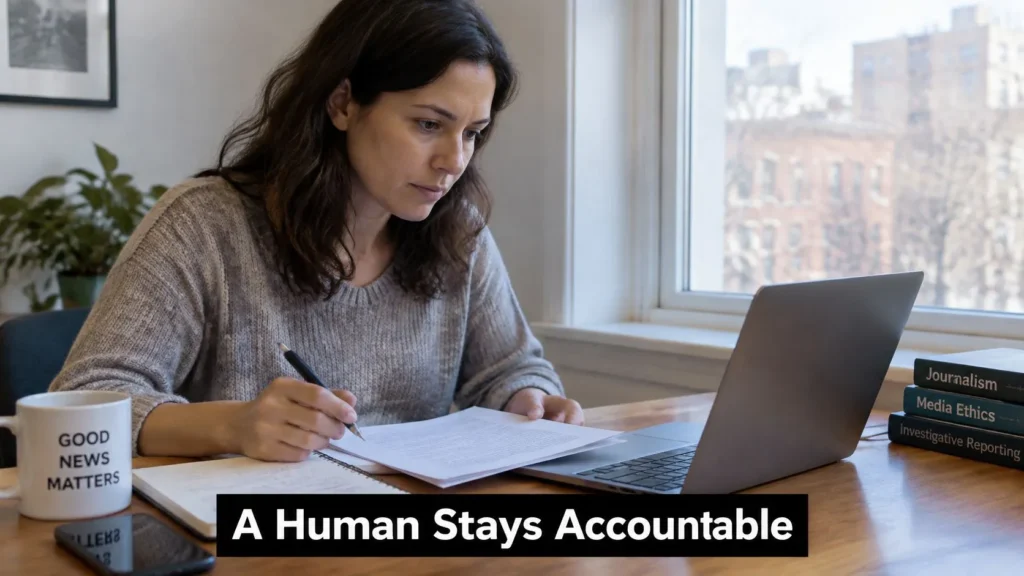
The Impress best-practice note on artificial intelligence recommends human editorial review and clear labeling when AI generates or materially supports news content. A conventional human name can otherwise leave readers assuming the writer personally produced reporting or language that software supplied.
Scale the disclosure to the use
The following treatments offer a practical house-policy model. They distinguish routine assistance from work that changes what readers are being asked to trust.
AI use level, byline treatment and disclosure
| AI use | Byline treatment | Disclosure |
|---|---|---|
| Spelling and grammar checks | Human byline | Usually none, unless house policy requires it |
| AI translation of human-reported copy | Human byline with translator credit | Name the tool and state that a human checked the translation |
| AI summary of human-reported text | Human byline with approval for this version | Label the summary as AI-assisted |
| AI-drafted passages reviewed by a human | Human byline | Prominent note or an AI-assisted reporter byline |
| Automated copy with no human reporting | No human reporter byline | Label as automated and name the responsible editor |
Don’t automatically transfer a reporter’s byline to a generated summary. The reporter should review that version and agree to the attribution, because compression can remove qualifications or distort a finding.
Disclosure describes how the article was made. It doesn’t excuse unsupported claims or missing attribution.
Originality needs a separate check. Contesimal’s discussion of ChatGPT plagiarism risks in 2026 offers a related resource for considering copied phrasing and attribution; an AI label doesn’t replace credit to an original author.
Use the video as a prompt for an editorial discussion about these choices.
A workable policy specifies eligible tools, required human checks, disclosure wording, and circumstances where a reporter’s byline isn’t appropriate. Connect those decisions to broader AI ethics and governance, including confidential material and permission to process source documents.
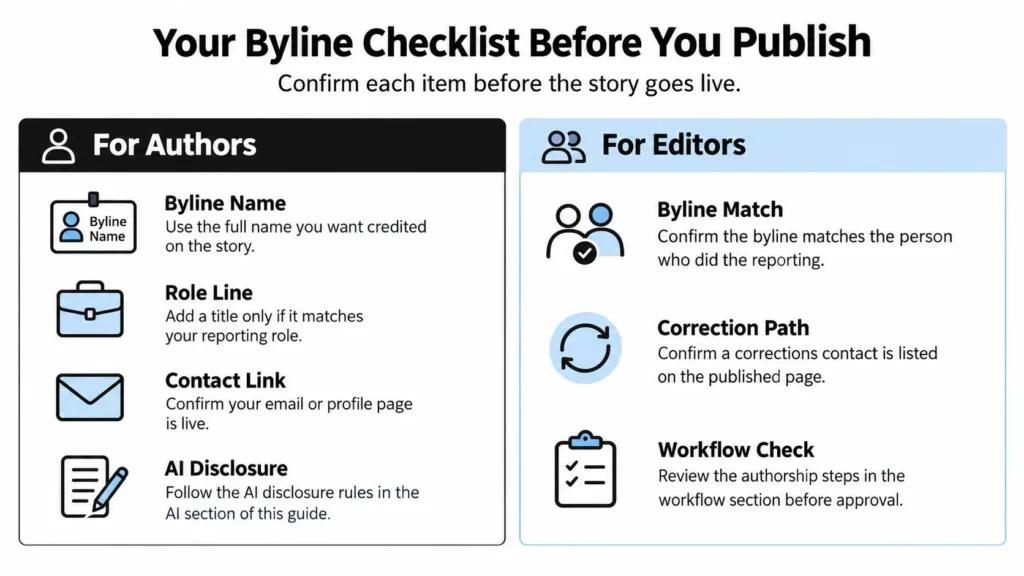
Your Byline Checklist Before You Publish
Use separate author and editor checks so nobody assumes the other person has approved the attribution. Resolve disagreements before publication, while roles and consent are still easy to confirm.
For authors
- Confirm eligibility. Apply the contribution test, rather than choosing credit by status.
- Check your identity. Verify name spelling, role, and any author-profile or contact link.
- Choose the format. Agree on single-author, shared, or guest attribution.
- Declare assistance. Submit material AI-use details with the article.
For editors
- Close the workflow. Confirm recorded roles and consent from everyone named.
- Check location. Apply the relevant physical-presence rule to datelined bylines.
- Inspect asset credits. Account for every photo, graphic, and video.
- Match the disclosure. Confirm that the AI note accurately describes the use.
Pair attribution checks with source verification. Unflag’s guide to a verification workflow for editorial teams can help editors organize that separate review.
When correcting a published story, keep the byline with the people who reported it and explain the change in a correction note. Don’t silently replace attribution to distance the publication from an error.
Before pitching a guest article, check the publication’s author guidelines for byline and biography requirements.
As one option for prospective contributors, maxijournal.com publishes independent writing across science, technology, health, arts, and other subjects, with author attribution for guest contributions. Visit to explore its articles and review its contributor guidance before preparing a pitch with a clear reporting plan and accurate author credit.
Discover more from Maxi Journal
Subscribe to get the latest posts sent to your email.