Elephants are obligate herbivores that eat only plant material, including grasses, leaves, bark, roots, twigs, and fruit. Their diet can include 40 to 80 kilograms of plant dry matter per day in African elephants, depending on habitat, season, and local food availability.
But does calling an elephant a herbivore tell the whole story? Not quite. An elephant isn’t a large grass eater wandering from one pasture to the next. It is a flexible plant-feeder that may graze on grasses, browse through tree branches, strip bark, dig for roots, or seek fruit as conditions change. Its unusual digestive system also explains why it spends so much time feeding and why a plant-based diet can sometimes bring elephants into conflict with farmers.
A Quick Answer to the Herbivore Question
So, is an elephant a herbivore? Yes. Elephants eat plant material, not animal prey, and their feeding includes grasses, leaves, twigs, bark, roots, fruit, and other vegetation. As noted by the San Diego Zoo Wildlife Alliance’s elephant overview, their diet is built around plants, even though the exact mix shifts with habitat, rainfall, and season.
The more precise term is obligate herbivore. That means an elephant’s feeding biology is built for plant food from the ground up. Its teeth, trunk, digestive tract, and feeding behaviour are all suited to finding, handling, and processing fibrous vegetation.
That simple answer opens the door to better questions. Does an elephant eat only grass? Why does it strip bark or dig for roots? How can such a huge animal live on leaves and stems that are hard to break down? And why do elephants sometimes move into farms and damage crops?
The short answer is that herbivory is a strategy, not a single menu. Elephants are not meat-eaters with the occasional plant snack. They are large plant-eaters with a digestive system that works differently from cattle, and that difference shapes how much they must eat and how they move through the day.
Their feeding style also helps explain why they can live in forests, savannas, and other changing habitats. The same flexibility can bring them into conflict with people when wild forage becomes scarce or less accessible.
What It Means to Be a Herbivore
A herbivore is an animal whose diet consists entirely of plant material. That can mean grass, leaves, seeds, fruit, bark, roots, algae, or other parts of plants. The category describes the animal’s main food source, not whether the menu is simple.
A lion is a carnivore because it obtains food by eating other animals. A deer is a herbivore because it feeds on vegetation. A bear is often described as an omnivore because its feeding pattern can include both plant and animal foods. Elephants fit firmly on the herbivore side of this spectrum.
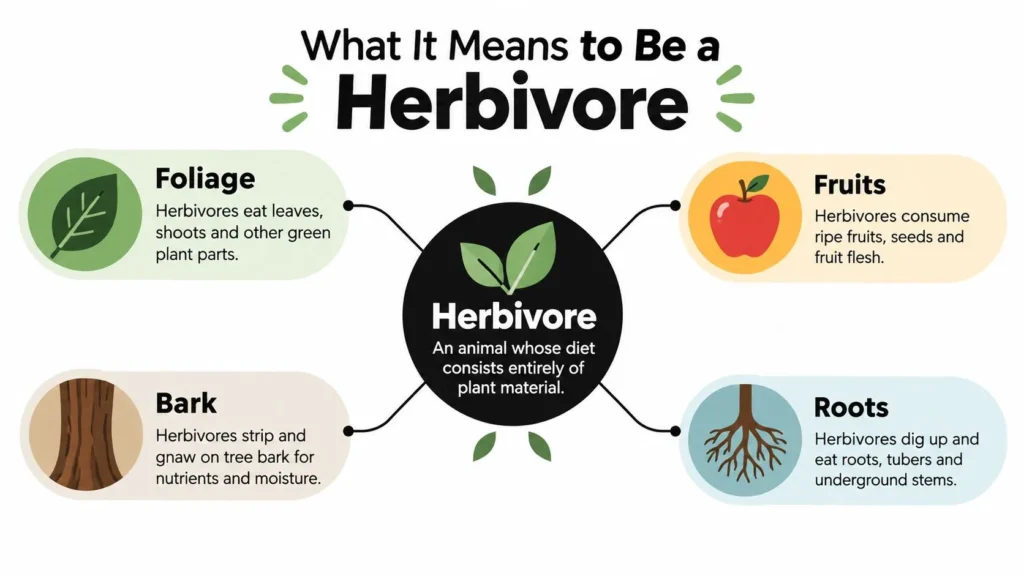
Herbivores can have very different menus
Not every herbivore eats the same way. Some species focus on a limited group of plants or plant parts. Others are generalist feeders, meaning they can use many kinds of vegetation and change their choices when conditions shift.
Elephants are generalists. Their plant foods include:
- Grasses and sedges, which they pull, gather, and chew.
- Leaves and twigs, taken from shrubs and trees.
- Bark, especially when softer forage is limited.
- Roots and other underground plant parts, reached by digging.
- Fruit, when seasonal supplies become available.
This variety matters because habitat changes from place to place. A forest elephant has access to a different plant community from an African savanna elephant. An Asian elephant in a seasonal environment also faces different choices from one living in denser forest.
Plant-only doesn’t mean low-impact
Herbivory can look gentle when described as eating leaves, but large herbivores can dramatically change their surroundings. An elephant pulls down branches, opens pathways, removes bark, breaks vegetation, and spreads plant material through its movements and waste. Its feeding can alter which plants remain available for other animals.
The key distinction is between what an animal eats and how narrowly it feeds. Elephants eat plants, but they don’t depend on a single plant type. That broad menu gives them resilience when one food becomes scarce, while also requiring them to travel, select, and process a large amount of vegetation.
What Elephants Actually Eat in the Wild
What ends up in an elephant’s mouth depends on where it lives and what the habitat offers at that moment. Their diet is a mix of grazing and browsing. Grazing means feeding on grasses and other low-growing plants. Browsing means taking leaves, twigs, bark, and similar material from shrubs and trees.
African elephants can eat a very large amount of plant dry matter each day, as noted in the FAO account of elephant feeding ecology. That amount is not a fixed menu. Rainfall, plant quality, habitat structure, and season all shape what they choose.
| Elephant type | Main foods | Daily intake | Notable behaviour |
|---|---|---|---|
| African savanna elephant | Grasses, leaves, twigs, bark, roots, and fruit | Approximately 40 to 80 kilograms of plant dry matter daily | Switches between grazing and browsing as conditions change |
| African forest elephant | Leaves, fruit, bark, roots, and other forest vegetation | Varies with habitat and seasonal availability | Has been documented eating more than 350 plant species linked study on forest elephant diet |
| Asian elephant | Grasses, browse, bark, roots, fruit, and local vegetation | Varies with habitat and forage quality | Adjusts feeding choices across forests, grasslands, and human-dominated edges |
Grazing is only part of the picture
Savanna elephants often take advantage of fresh grass when rainfall improves its quality and availability. When conditions dry out, they shift toward woody plants, bark, roots, and other foods that remain reachable after grasses decline.
Forest elephants face a different menu. Their habitat provides abundant woody vegetation and seasonal fruit, so they may feed on many tree and shrub species. The record of more than 350 plant species in forest elephant diets shows how wide that menu can be, and it also shows that herbivory is more varied than a simple leaf-eating image suggests.
Asian elephants are flexible in the same way. Their feeding depends on the plant community around them, whether that is dense forest, open grassland, or land cut by farms and roads. That flexibility helps them survive in changing habitats, but it also means they may turn to cultivated plants when those foods are close by.
Readers comparing safe wild plants with potentially harmful garden species should also treat plant identification carefully. A resource on whether lantana is poisonous helps show why common plant names are not enough to judge safety.
The key point is simple. An elephant’s diet is broad, seasonal, and selective. It does not eat every plant it meets. It chooses among plant parts based on access, quality, and nutritional need.
How Elephant Digestion Actually Works
Why does an animal that eats only plants need to spend so much of its life feeding? The answer lies in how an elephant’s gut handles fibre.
Elephants are unusual herbivores because they are hindgut fermenters. Cattle do most of their fibre processing before food leaves the stomach. Elephants do it later, in the caecum and large intestine, where microbes break down tough plant material after it has already passed through the stomach and small intestine.
Those microbes, including bacteria and protozoa, ferment cellulose and other fibrous compounds. In the process, they produce volatile fatty acids that the elephant can absorb for energy. So the system works well enough to support a very large body, but it extracts less from each mouthful than the digestive system of a ruminant.
According to the University of Zurich elephant-feeding handout, an elephant typically digests only about 44 percent of ingested food, compared with roughly 60 percent for cattle and water buffalo. Reported total gut transit time is approximately 11 to 46 hours, while dry-matter digestibility commonly falls around 40 to 60 percent.
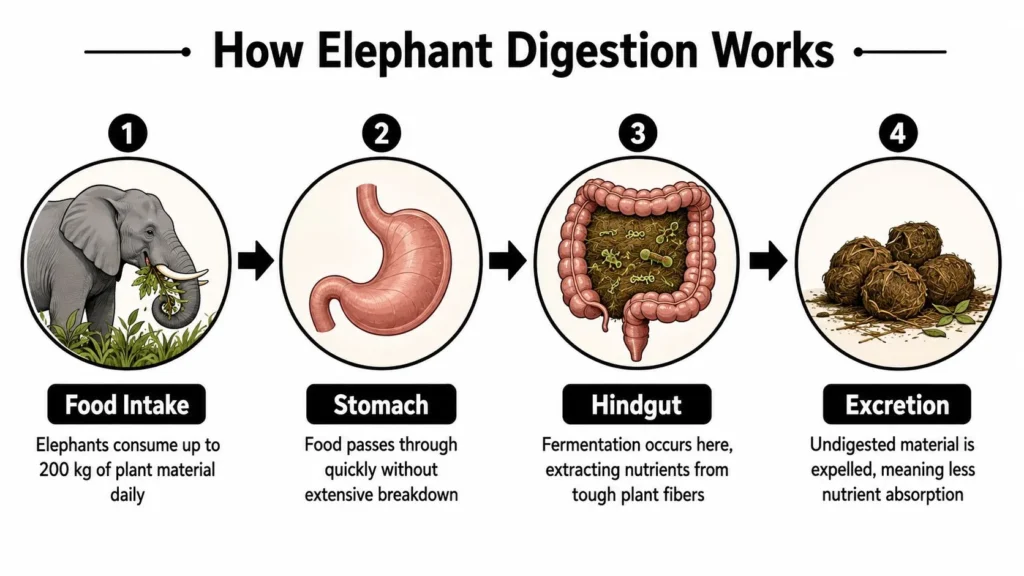
Why low efficiency changes behaviour
This lower extraction rate helps explain elephant behaviour in the field. If each kilogram of food yields only part of its possible energy, the animal has to keep intake high. That means long feeding periods, large daily volumes of vegetation, and constant movement between patches that can meet those needs.
It also explains elephant dung. Much of what goes in comes out still visibly fibrous, because the gut moves material through relatively quickly and does not strip every bit of value from each bite. That trait is one reason elephants can reshape vegetation so strongly. They are not just selecting plants. They are processing huge amounts of them.
The contrast with cattle is useful here. A cow gets more from a smaller amount of forage by fermenting it earlier and longer. An elephant follows a different strategy. It keeps food moving and makes up for lower efficiency with throughput.
The same broad principle appears in other large herbivores, even when their digestive anatomy differs. In practical terms, heavy plant use by big herbivores can alter habitats, crop edges, and woody growth. Readers interested in how plant-eating animals can affect managed environments can see a parallel in beaver damage prevention.
Elephant digestion does more than answer a biology question. It helps explain why elephants need abundant forage, why they travel so widely, and why being a herbivore does not make them gentle on the plants around them.
The Grass Eater Myth and the Omnivore Rumour
Calling an elephant a grass eater is convenient, but it leaves out too much. Elephants graze on grass, yet they also browse on leaves, twigs, bark, roots, and other woody plant material. Their diet changes as rainfall, plant quality, and local vegetation change.
Research from Kruger National Park found that grass made up an average of about 35 percent of African elephant diets. In the dry season, northern elephants consumed about 40 percent grass while southern elephants consumed about 10 percent. In the wet season, both regions approached roughly 50 percent grass, according to the Journal of Mammalogy study of African elephant feeding.
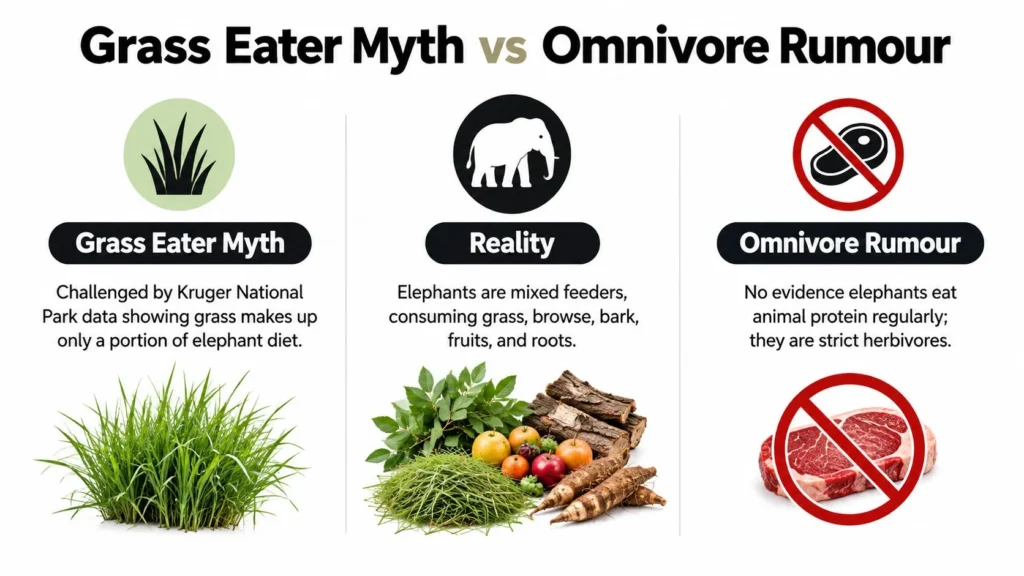
Why the menu shifts
Rain affects more than the amount of grass available. It can also influence grass quality, the growth of other plants, and the accessibility of different feeding sites. An elephant may respond by changing the balance between grazing and browsing rather than following one permanent diet.
This is why two elephant populations in the same broad region can eat different proportions of grass. Local plant communities, geography, season, and the condition of individual plants all matter. A mixed feeder doesn’t alternate between two fixed menus. It makes choices within a changing environment.
What about bones and other non-plant material?
Occasional reports of elephants chewing bones, eating charcoal, or consuming mineral-rich soil can create confusion. Such behaviour doesn’t turn an elephant into an omnivore. Omnivory refers to a regular dietary strategy that includes both plant and animal foods. Seeking minerals or other supplements is different from hunting prey or relying on animal tissue.
An elephant may also ingest small animals accidentally while feeding, just as many herbivores can swallow insects or other organisms attached to plants. Accidental intake doesn’t alter the animal’s classification.
The most accurate description is therefore a flexible, mixed-feeding herbivore. It can eat many plant parts, select different foods in different seasons, and seek non-food materials for specific needs without becoming an animal that regularly eats meat.
Why Herbivory Leads Elephants into Conflict with People
A plant-based diet doesn’t keep elephants away from farms. Elephants need abundant forage, and they may enter cultivated areas when crops offer concentrated or more accessible nutrients than the surrounding wild vegetation.
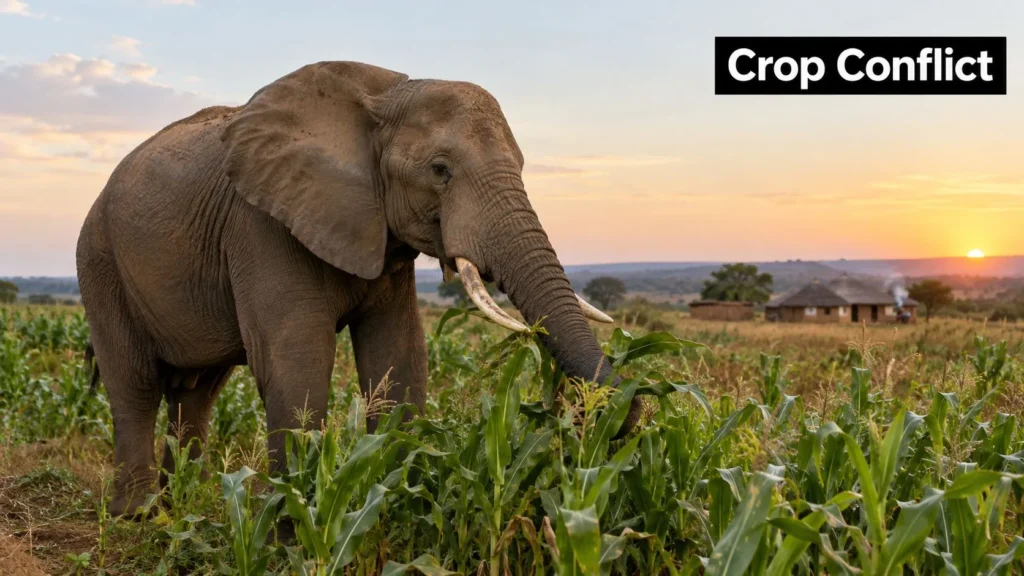
Research from Botswana’s Okavango Delta found that elephant diets contained insufficient sodium year-round and insufficient phosphorus from February through July. The same research reported that crop consumption increased as wild forage quality declined, as described in the study of seasonal dietary switching in savanna elephants.
That doesn’t mean every crop raid has one simple nutritional cause. Farms can be located along movement routes, and cultivated plants may be dense, easy to reach, or available when natural vegetation is less useful. But nutritional pressure helps explain why elephants may accept the risks of approaching people.
Browse isn’t automatically better
It also helps to avoid another oversimplification: the idea that woody browse is always more nutritious than grass. Research on Asian elephants analysed 102 faecal samples and 141 consumed plant species and found similar forage quality between diets with high browsing and those with low browsing. Woody browse didn’t consistently provide more protein than grasses.
That finding reinforces a broader lesson. Elephants don’t choose food according to a universal rule such as “browse is good” or “grass is bad.” They respond to the combination of plant quality, availability, minerals, season, and access.
Human-elephant conflict is also shaped by broader environmental change. Readers looking for a plain-language foundation on what climate change is can usefully connect changing rainfall and forage conditions with the pressures that affect both wildlife and farming communities.
A crop raid can damage a family’s livelihood, so empathy for elephant biology shouldn’t erase human costs. Effective coexistence requires understanding the feeding incentives while protecting farms and maintaining routes to suitable natural forage.
The video below provides another way to observe elephant feeding behaviour and the close relationship between food, movement, and habitat.
A 60-Million-Year Legacy of Plant Eating
Elephant herbivory is not a recent response to modern habitats. Proboscideans, the broader group that includes living elephants and their extinct relatives, first appeared in Africa approximately 60 million years ago as a diverse group of plant-eating mammals, according to the Natural History Museum’s account of elephant evolution.
Their feeding history also shows that herbivory can change over evolutionary time. Carbon-isotope evidence indicates that many early elephant species in East Africa shifted from diets dominated mainly by soft woodland leaves toward grass-dominated diets around 8 million years ago. Dental adaptations suited specifically to processing grasses began evolving later, around 4 million years ago.
That sequence matters. Dietary change came before some of the major tooth adaptations associated with grass feeding. It suggests that elephant ancestors could respond to environmental opportunities first, while anatomy gradually followed the demands of new foods.
Flexibility is the inherited advantage
Modern elephants retain that broad ecological flexibility. Different species and populations can browse, graze, or combine both strategies. They can shift between grasses, leaves, bark, roots, and fruit as plant communities and seasons change.
This flexibility helps explain why elephants are often described as ecosystem engineers. Their feeding doesn’t just remove vegetation. It opens spaces, changes plant structure, moves seeds, and redistributes nutrients. Their influence comes from the scale and variety of their plant use.
The fossil record provides evidence of these long transitions, but it is never a complete film of the past. For a useful explanation of why the fossil record is incomplete, consider how uneven preservation and discovery can affect what scientists know about ancient diets and habitats.
The answer to “is an elephant a herbivore” is therefore both straightforward and surprisingly rich. Elephants are obligate herbivores, but their plant-based lives include specialised digestion, broad dietary choice, seasonal decision-making, and major effects on terrain. Understanding that complexity makes their conservation more practical, because protecting elephants also means protecting the plant communities and migration routes that sustain them.
Maxijournal.com offers approachable writing on science, education, health, technology, travel, and many other subjects, including clear answers to everyday questions like this one. Visit maxijournal.com to discover fresh independent articles and practical explanations that make complex topics easier to understand.
Discover more from Maxi Journal
Subscribe to get the latest posts sent to your email.