You’re standing in front of a shelf covered with peptide serums, eye creams, moisturizers, and even makeup primers. One label promises collagen support, another mentions copper peptides, and a third suggests a Botox-like smoothing effect. They all sound persuasive, but peptides aren’t one ingredient with one guaranteed result. They’re a broad family of short amino-acid chains, and their value depends on the specific peptide, the formula carrying it, and how consistently you use the product.
Peptide skincare products can support gradual improvements in the look of fine lines, texture, firmness, and overall skin quality. They aren’t instant resurfacing treatments, and they don’t replace procedures. To shop intelligently, you need to separate a peptide’s proposed job from the strength of its human evidence, then examine whether the product gives that ingredient a realistic chance to remain stable and reach the skin.
Introduction to Peptide Skincare Products
Peptides have been part of skincare for much longer than the current trend suggests. A beauty-industry history of the ingredient traces peptides back to products “floating around” in skincare since the 1970s, while consumer awareness grew sharply after an Olay campaign in 2006 brought pentapeptides into mainstream anti-aging marketing. You can read more about that evolution in this expert guide to collagen, which places peptide conversations within the wider story of collagen-focused skincare.
That history helps explain the confusion. The word peptide now appears across formulas designed for different purposes. One product might use a signal peptide intended to support collagen-related activity. Another might use a carrier peptide, such as a copper peptide, while a third uses a neurotransmitter-inhibiting peptide aimed at the appearance of expression lines. Treating those products as interchangeable is like treating every medicine as a painkiller because it comes in a tablet.
The category itself has expanded considerably. One industry forecast estimates that the global peptide skincare market could reach US$3.9 billion in 2026 and grow to US$7.5 billion by 2033, at a projected 9.8% CAGR, according to Persistence Market Research’s peptide skincare market analysis. A separate estimate in the same market overview places the broader peptide cosmetics market at about US$2.6 billion in 2025, with projections exceeding US$6.5 billion by 2033.
The useful question isn’t “Do peptides work?” It’s “Which peptide, in which formula, for which goal?”
This guide follows that question from basic skin biology to label reading. You’ll learn what peptides can plausibly signal, how the main peptide families differ, what human studies show, and why packaging and formulation may matter more than a large number printed on the front of a bottle.
How Peptides Work in Your Skin
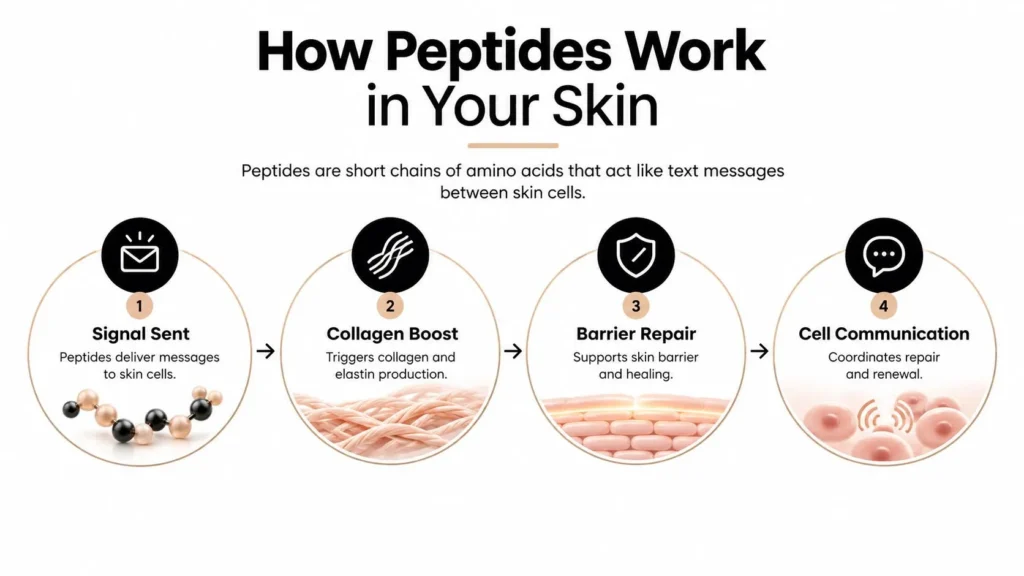
A peptide is a short chain of amino acids. Amino acids are the small units used to make larger proteins, including collagen and elastin. A finished protein resembles a completed building, while a peptide is more like a short instruction or component that can participate in a biological process.
Skin cells exchange chemical signals about repair, inflammation, and the surrounding structure. A topical peptide may act like a brief message, encouraging a response such as collagen-related activity or repair support. It does not construct new skin by itself. Instead, it may prompt the skin to use biological processes it already has.
The sequence matters. One peptide may be designed to support the appearance of firmness, while another binds or carries trace elements, affects enzyme activity, or influences the appearance of expression lines. The named ingredient therefore tells you more than the word peptide printed on the front of a package.
Why the skin barrier changes the outcome
The outer skin barrier is built to keep unwanted substances out. That protects the body, but it also creates a delivery challenge for cosmetic peptides. A peptide can show interesting activity in laboratory testing and still have limited value in a leave-on product if it breaks down or fails to reach the relevant surface layers.
A recent safety framework summarizing Cosmetic Ingredient Review data reports minimal, if any, skin penetration for cosmetic peptides, with no systemic toxicity or genotoxicity in the reviewed material and irritation ranging from none to slight. It also explains that manufacturers may use small peptide size, optimized vehicles, and repeated application to improve local availability. Large, well-designed randomized trials remain limited. These findings appear in the 2026 review of cosmetic peptide safety and delivery.
Formulation can therefore matter more than a prominent concentration claim. Water content, pH, preservatives, humectants, encapsulation, and packaging all affect whether a peptide stays intact and feels comfortable on skin. A stable, well-designed formula may be more useful than one with a larger advertised amount but weak delivery.
Hydration can support the overall formula experience. This explanation of why hyaluronic acid peptides work examines how peptides are paired with a water-binding ingredient. If barrier comfort is the priority, this guide to beta-glucan for skin explains why soothing and water-binding ingredients can complement a peptide product.
Types of Peptides Found in Skincare
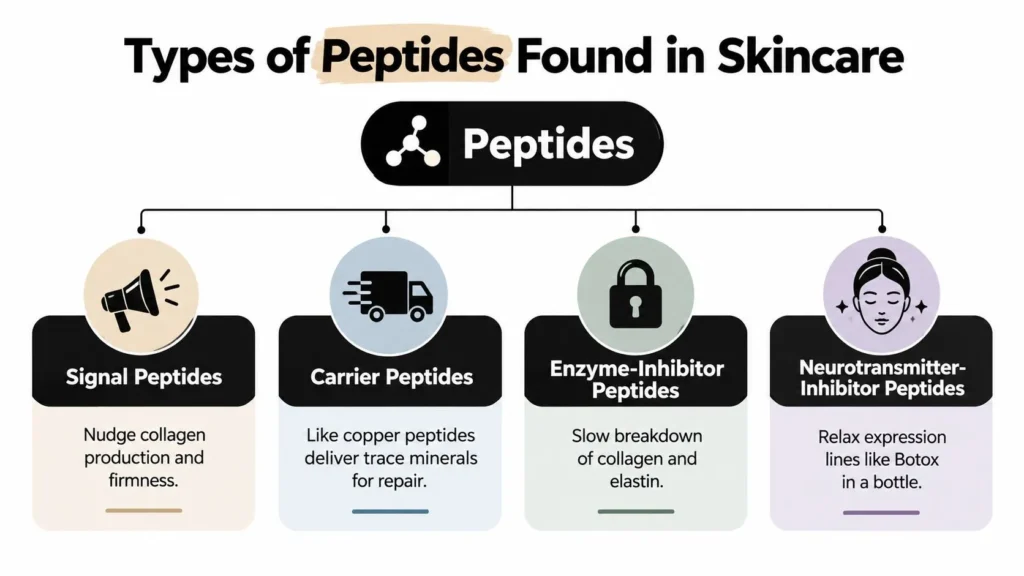
The easiest way to understand peptide skincare is to classify products by function, not by marketing mood. Cosmetic formulators commonly group peptides into signal, carrier, neurotransmitter-inhibiting, and enzyme-inhibitor families. These categories describe a proposed job, but they don’t guarantee that every ingredient in a family has equally strong human evidence.
| Peptide Family | Proposed Action | Example Names on Labels | Best For |
|---|---|---|---|
| Signal peptides | Encourage skin-signaling activity associated with collagen or elastin support | Palmitoyl Pentapeptide-4, Palmitoyl Oligopeptide | Fine lines, loss of visible firmness |
| Carrier peptides | Bind or transport trace elements that may support repair-related processes | Copper Tripeptide-1, Copper PCA | Products focused on repair, resilience, or firmness |
| Enzyme-inhibitor peptides | Inhibit selected enzymes involved in the breakdown of structural or pigment-related components | Oligopeptide-24 and other supplier-specific complexes | Preservation-focused anti-aging formulas |
| Neurotransmitter-inhibiting peptides | Modulate signals associated with facial muscle contraction and expression lines | Acetyl Hexapeptide-8 | Early expression lines and smoothing claims |
Signal peptides
Signal peptides are the most familiar category in anti-aging formulas. They’re intended to act like prompts that encourage collagen-related activity, which is why you’ll often find them in serums, creams, and eye products marketed for firmness or fine lines. Palmitoyl Pentapeptide-4 and Palmitoyl Oligopeptide are examples readers may encounter on ingredient lists.
The key limitation is that a label name doesn’t tell you how well the final product performs. The peptide needs a compatible vehicle, adequate stability, and regular contact with the skin. A useful peptide guide from Peptide Warehouse USA can help you become familiar with common names, but ingredient familiarity shouldn’t be confused with independent clinical proof.
Carrier peptides
Carrier peptides are designed to bind or transport trace elements. Copper Tripeptide-1 is the most recognizable example. These products often appeal to people interested in repair, firmness, and a more resilient-looking complexion.
Copper peptides deserve careful label reading because copper chemistry can create formulation challenges. Oxidation and compatibility with the rest of a water-based formula may affect stability, so the product’s packaging and manufacturer instructions matter.
Neurotransmitter-inhibiting and enzyme-inhibitor peptides
Neurotransmitter-inhibiting peptides are marketed around expression lines. Acetyl Hexapeptide-8, commonly associated with Argireline branding, is an example. The “Botox in a bottle” comparison is catchy, but it overstates what a topical cosmetic can generally achieve. A topical product may soften the appearance of lines gradually, but it doesn’t reproduce an injectable procedure.
Enzyme-inhibitor peptides take a preservation-oriented approach. Instead of primarily encouraging new structural activity, they’re designed to slow selected breakdown processes. Their proposed role can make sense within a long-term routine, but the specific evidence varies by peptide and formula.
What Clinical Evidence Actually Shows
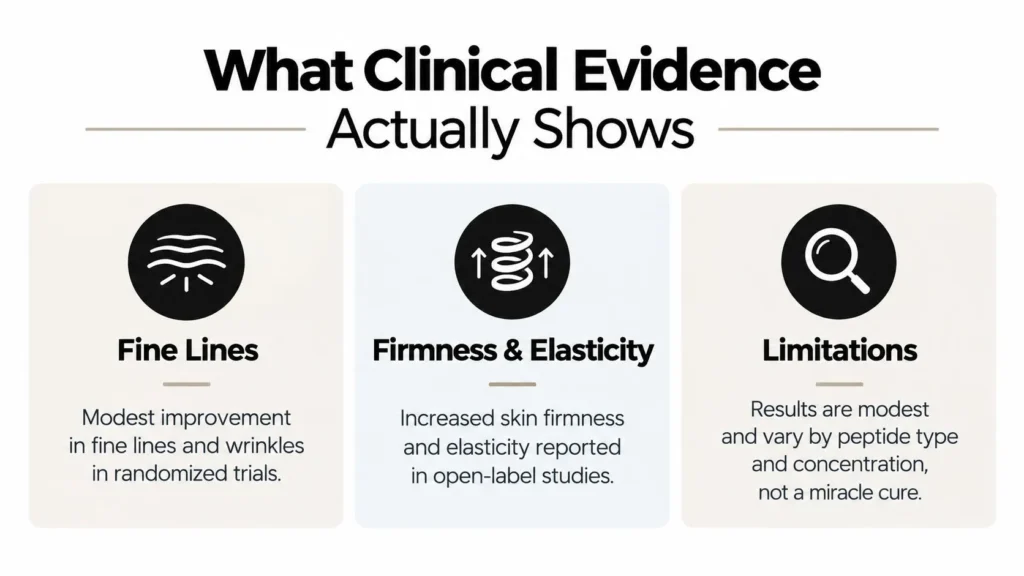
Human evidence supports a measured view of peptide skincare. A randomized, double-blind, placebo-controlled study found that applying a water-based peptide treatment twice daily for 12 weeks significantly improved expression fine lines, wrinkles, and overall skin health compared with the study’s control, as reported in the peer-reviewed clinical study available through PubMed Central.
An open-label study of a peptide serum reported statistically significant improvements after 14 weeks in facial lines, eye lines, wrinkle appearance, smoothness, softness, firmness, radiance, and luminosity. The study reported no adverse events. Those findings are encouraging, but they describe gradual changes measured over sustained use, not a dramatic overnight transformation.
What the studies don’t prove
A positive study for one peptide treatment doesn’t prove that every product containing every peptide will produce the same result. Formulas differ in peptide sequence, supporting ingredients, vehicle, concentration, stability, application schedule, and measurement method. If a brand cites a clinical result, check whether the study tested the finished product or only an isolated ingredient.
The broader evidence base also has important weaknesses. Recent review material describes peptide research as uneven, concentrated in industry-sponsored studies, and lacking independent replication for several major peptide classes. Peptides remain biologically plausible, but the field has mostly small trials rather than a Cochrane-level synthesis, and the evidence is less established than for retinoids. This assessment appears in the recent review of cosmetic peptides and their clinical evidence.
That gap between plausibility and proof explains why marketing can move faster than science. A claim such as “supports collagen” may reflect a reasonable proposed mechanism, while “rebuilds your skin” suggests a much stronger outcome than the available evidence supports.
A realistic interpretation
The strongest practical expectation is incremental improvement in fine lines, texture, softness, firmness, or radiance after consistent use. Peptides make more sense as supportive actives within a routine than as substitutes for sunscreen, moisturization, retinoids, or professional treatments.
A clinical result is a clue about a specific formula, not a blank check for the entire peptide category.
How to Read Labels and Build a Peptide Routine
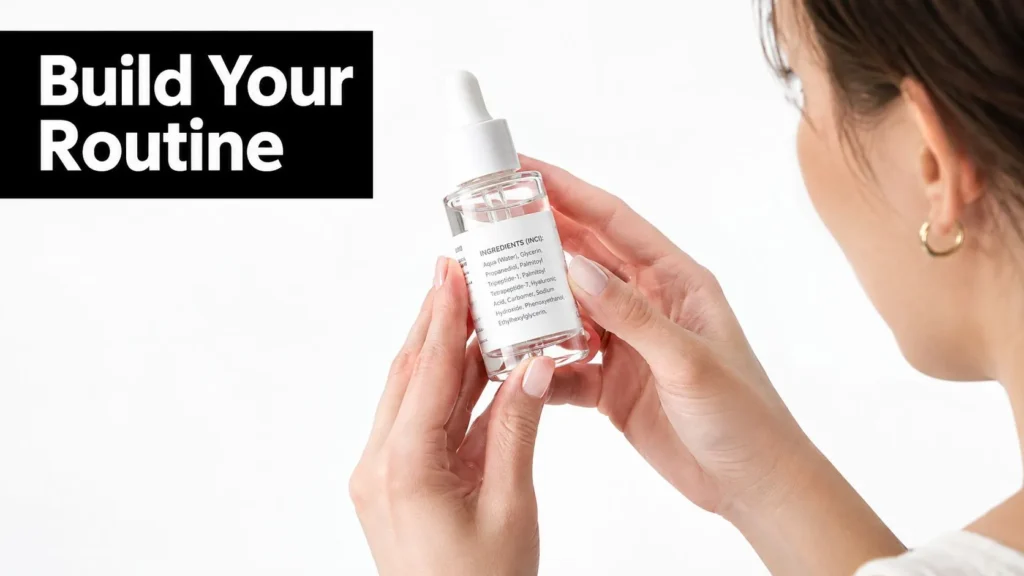
A peptide label can look scientific while telling you very little about performance. Start with the full INCI list, not the largest text on the box. Look for a named peptide, such as Palmitoyl Pentapeptide-4, Palmitoyl Oligopeptide, Acetyl Hexapeptide-8, or Copper Tripeptide-1, then check whether the brand explains the product’s testing, packaging, storage, and intended use.
Ingredient order can offer a rough clue, but it isn’t a precise concentration meter. Many cosmetic ingredients work at low levels, and proprietary complexes may appear under a blend name. Be cautious with products that highlight a dramatic percentage without identifying the actual peptide, explaining the testing, or addressing stability.
Build the routine around your skin’s priority
For fine lines, choose a leave-on serum or moisturizer with a clearly named signal or neurotransmitter-inhibiting peptide. Apply it to clean skin according to the product directions, then follow with moisturizer. In the morning, finish with broad-spectrum sunscreen, because UV exposure can undermine the appearance-focused goals of an anti-aging routine.
For dryness or sensitivity, select a simpler peptide formula with humectants and barrier-supportive ingredients. Avoid introducing several strong actives at once. A peptide product is easier to evaluate when you aren’t also starting a retinoid, exfoliating acid, and new fragrance-heavy cream during the same trial.
For a targeted eye-area routine, you can compare peptide-containing products with broader guidance on choosing an anti-aging eye cream. The same principles apply, use a formula suited to the delicate area, introduce it gradually, and keep expectations modest.
Pairing and timing
Peptides generally fit well into a routine with moisturizer and hydrating ingredients. Retinoids and vitamin C can also have a place, but your skin may tolerate a simpler schedule better. If a combination causes stinging, dryness, or peeling, separate the products by time of day or alternate nights rather than assuming more actives will produce faster results.
Use the product consistently for the period suggested by its testing or directions. The human studies discussed above observed changes over 12 and 14 weeks, so judging a peptide serum after only a few applications won’t tell you much. Take baseline photographs in consistent lighting, then reassess texture and fine lines after sustained use.
Common Myths and Safety Considerations
Myth: Peptides replace Botox. Neurotransmitter-inhibiting peptides may soften the look of expression lines through topical signaling, but a serum does not equal an injectable treatment. Expect gradual, surface-level changes rather than the same mechanism or immediacy as a procedure. The label can suggest a biological target, not guarantee a procedure-like result.
Myth: More peptide types guarantee better results. A long peptide list may represent several proposed functions, yet each added ingredient can make compatibility and stability harder to manage. Formula design matters more than counting peptides. The vehicle, testing, packaging, and fit with your skin all influence whether an ingredient remains stable and reaches the surface in a useful form.
Myth: Natural peptides are automatically safer. “Natural” describes an ingredient’s origin, not its full safety profile. Any ingredient can irritate an individual, and a natural material can still be unstable, contaminated, or poorly suited to a finished formula. Patch testing makes sense for reactive skin, especially around the eyes or with a copper-containing product.
Copper peptides and newer delivery methods
Topical copper peptides have a longer cosmetic history than injectable experimentation, so the two uses should remain separate. Recent reporting describes copper peptides appearing in injections, but published human evidence does not establish that practice as safe or effective. A topical ingredient label cannot validate an injectable procedure.
A reviewed cosmetic safety framework found no systemic toxicity or genotoxicity in its summarized data. It described skin and eye irritation as none to slight, along with good tolerability in clinical studies lasting from 30 days to seven months, according to the safety review in PubMed Central. Those findings apply to the reviewed cosmetic context, not to every delivery system or product.
Handle copper peptide products like light-sensitive ingredients. Follow the storage directions, limit heat and light exposure, and check for changes in color, smell, or texture. Stop using the product if persistent burning, swelling, rash, or worsening irritation develops, and consult a dermatologist. If you also use exfoliating acids, this guide to glycolic acid offers practical context for introducing another active without overloading your routine.
Smart Shopping Tips for Peptide Skincare Products
A sensible purchase starts with the goal, not the trend. Decide whether you want to address visible fine lines, dryness, texture, or general barrier support, then choose a product whose named peptide and supporting formula match that goal.
Use this checklist before buying:
- Identify the peptide: Look for a specific INCI name rather than relying on the word peptide alone.
- Check the format: Prefer a leave-on serum or moisturizer when you want prolonged skin contact.
- Inspect the packaging: An airtight pump or similarly protective container may help limit exposure to air and light.
- Look for testing details: Give more weight to finished-product clinical testing than to broad ingredient promises.
- Keep the routine manageable: Add one new active at a time so you can identify irritation or benefit.
- Set a fair trial: Expect gradual changes over weeks, not an instant procedure-like result.
- Protect the basics: Moisturizer and daily sunscreen remain central to maintaining healthier-looking skin.
Price alone doesn’t establish quality. A modestly priced formula with a clearly identified peptide, stable packaging, and a comfortable base may be a smarter choice than an expensive product built around vague claims. Track your response with consistent photographs and notes, then keep the product only if it provides a benefit you can observe.
Peptide skincare products work best as supportive, evidence-aware additions, not as miracle solutions. For more approachable coverage of skincare, health, science, and related everyday questions, visit maxijournal.com, where you can explore practical articles and clear explanations designed for curious readers. Use it as a starting point when you’re comparing ingredients, building routines, and deciding which beauty claims deserve a closer look.
Discover more from Maxi Journal
Subscribe to get the latest posts sent to your email.