Dogs can eat eggs when they’re fully cooked and served plain, in small portions as an occasional addition to their regular food. For egg dishes, the food-safety target is 160°F (71.1°C), not just a white that looks cooked.
The counterintuitive part is that a clean, unbroken shell doesn’t prove an egg is free of bacteria. Preparation matters more than appearance, and a breakfast egg made for a person isn’t automatically suitable for a dog.
Yes, When Eggs Are Fully Cooked and Plain
Plain, fully cooked eggs are generally suitable for healthy dogs. The main avoidable problems are undercooking and adding ingredients that don’t belong in your dog’s bowl.
The USDA’s shell-egg safety guidance states that even clean, unbroken eggs may contain Salmonella Enteritidis, and recommends cooking egg dishes to 160°F (71.1°C), measured with a food thermometer, with firm whites and yolks. Lightly cooked whites and yolks have both been associated with Salmonella outbreaks, so a set white surrounding a liquid yolk isn’t the standard to aim for.
Egg Preparations That Are Safe for Dogs
| Preparation | Safe for dogs? | Why |
|---|---|---|
| Hard-boiled, plain | Yes | White and yolk are fully firm, with no added fat |
| Scrambled dry, no oil or butter | Yes | Suitable when cooked until no liquid remains |
| Poached or boiled until firm | Yes | Thorough cooking, not the method’s name, establishes safety |
| Baked plain until firm | Yes | Fully cooked throughout, without liquid pockets |
| Runny or soft-cooked yolk | No | Lightly cooked eggs have been linked to Salmonella outbreaks |
| Raw or cracked, unknown origin | No | Bacterial risk, uncertain handling, and potential avian flu concerns |
| Seasoned with salt, butter, onion or garlic | No | Unnecessary sodium or fat, and onion and garlic are toxic to dogs |
“Scrambled” doesn’t automatically mean safe, just as “poached” doesn’t automatically mean undercooked. What matters is the finished egg and everything added to it.
Practical rule: Set aside your dog’s portion before you season your own food.
Eggs belong alongside a complete and balanced diet, not in place of it. A healthy dog that eats a small amount of plain, properly cooked egg and remains comfortable generally gives you no reason for concern. Deliberately feeding raw egg creates an avoidable risk instead.
How Much Egg Is Safe Each Week
| Dog size | Typical weight | Frequency | Portion |
|---|---|---|---|
| Small | Small-bodied dogs, such as a Chihuahua | Occasional, not an automatic weekly schedule | A small taste, with the amount fitted to the dog’s calorie needs |
| Medium | Medium-bodied dogs, such as a Beagle | Occasional, allowing for other treats | A modest portion agreed within the dog’s feeding plan |
| Large | Large-bodied dogs, such as a Labrador | Occasional, not an extra meal | A treat-sized portion, not automatically a whole egg |
| Obesity, pancreatitis, hyperlipidemia, food allergy or prescribed diet | Any size | Ask a veterinarian first | None until cleared |
There isn’t a universal egg-per-week allowance that’s safe for every dog. Body size helps you think about portions, but it doesn’t tell you the dog’s activity level, body condition, medical restrictions, or how many other extras they already eat.
The distinction between a taste and a substantial treat matters. The USDA egg-products guide provides background on egg nutrition and processing; eggs contribute protein and fat, so they shouldn’t be treated as a calorie-free garnish. Egg size and preparation also affect what goes into the bowl.
Apply the Portion to the Whole Day
Say your Chihuahua already receives training treats and a dental chew. Adding egg without adjusting those extras may be less sensible than using a little cooked egg instead of another treat.
A Labrador’s larger body doesn’t automatically justify a whole egg either. A sedentary dog trying to lose weight may have less room for extras than an active dog with a feeding plan designed to maintain weight.
Think of egg as part of the treat budget, not a bonus outside the budget.
Dogs with obesity, pancreatitis, hyperlipidemia, food allergies, or prescribed diets need individual advice before you experiment. A suitable portion for a healthy dog can be inappropriate for a dog whose treatment depends on controlled fat intake or strict ingredient exclusion.
If your dog begins gaining weight, remove the optional egg and review all extras. Don’t repeatedly reduce complete food to make room for treats without checking that the overall feeding plan remains balanced.
How to Cook Eggs Safely for Your Dog
A saucepan, a dry non-stick pan, and a clean food thermometer are enough. You don’t need a special recipe, cooking spray, or pet-food supplement.
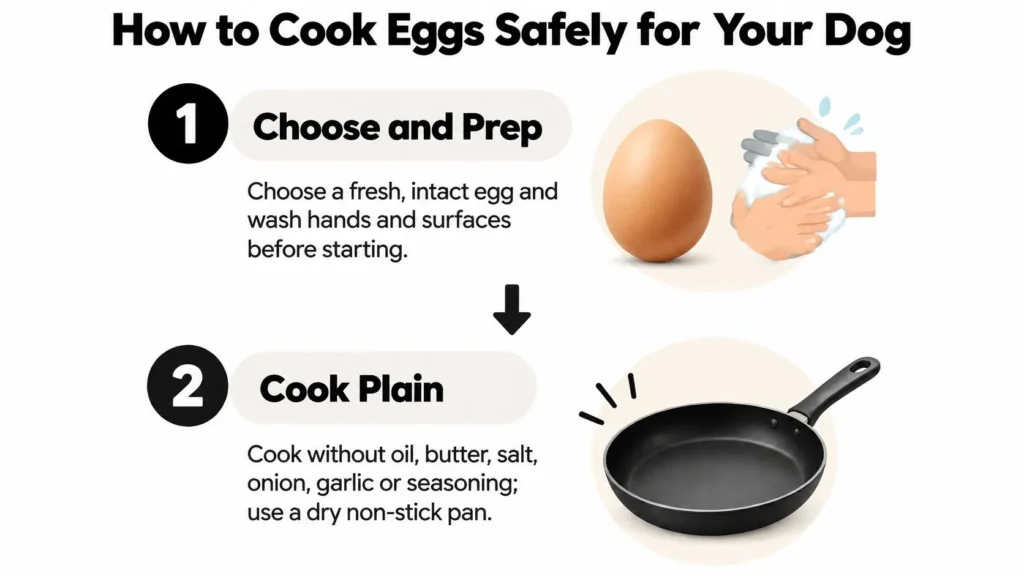
Choose and prepare the egg. Start with a fresh, intact egg from a source you trust, and wash your hands and preparation surface. Don’t use a damaged or questionable egg because you intend to give it to a pet.
Use plain boiling or a dry non-stick pan, without oil, butter, salt, onion, garlic, or seasoning. Keeping the ingredient list to egg alone avoids unnecessary fat and makes it easier to identify what your dog has eaten if they develop symptoms.
Cook through completely. For scrambled or baked egg, check the center with a food thermometer rather than judging only the browned edges. For boiled or poached egg, make sure both the white and yolk are firm, with no liquid center.
Let the egg cool, then peel and chop or mash it into pieces your dog can comfortably manage. Don’t hand over a hot, slippery whole egg, particularly to a small dog or one that gulps food.
Serve the selected portion in your dog’s bowl. Offer it alone as a treat or mix it into their normal meal without turning it into a meal replacement. Using the dog’s own bowl also helps keep pet feeding separate from human serving dishes.
Clean up after serving. Discard uneaten egg from the feeding bowl, wash the bowl and preparation utensils, and clean surfaces that touched raw egg. Wash your hands again so you don’t transfer residue to handles, counters, or other food.
Check the Finished Portion
The egg should look firm and evenly cooked throughout, without runny centers or glossy patches of uncooked egg. It should also be free from shell fragments and added toppings.
Don’t assume that a preparation suitable for one food applies to everything you share. If you’re considering another kitchen staple, check the separate guidance on whether dogs can eat potatoes before adding it to the same bowl.
What Eggs Add to Your Dog’s Diet
Eggs provide digestible animal protein, fat, and micronutrients. That makes them a useful optional food, but it doesn’t mean a dog eating a complete diet needs an egg to correct a nutritional gap.
The benefit and the limitation come together: an egg supplies nutrients, but also extra energy and fat. For an overweight dog or one with a diet-sensitive condition, a nutritious extra can still be an unsuitable extra.
Keep the Main Diet in Charge
A complete food should remain the nutritional foundation. If you’re reviewing that foundation, the guide to dog food brands recommended by vets can help you frame questions for your veterinarian rather than trying to improve an unsuitable diet with toppings.
Introduce egg in a small amount and watch for vomiting, diarrhea, itching, or other changes. Stop offering it and contact your veterinarian if significant symptoms develop, rather than continuing to test whether your dog will adjust.
A symptom after a new food is a reason to pause, not proof of a food allergy.
For example, a dog that vomits after trying egg may need assessment for other causes. Note what they ate and how they behaved, and let the veterinarian interpret that history.
Leave Shells Out of Casual Feeding
Shell fragments can irritate the digestive tract, while homemade shell powder can upset mineral balance unless a veterinarian has formulated the diet. Eggshell membrane is a separate topic from feeding broken shells; Pure Paw Labs’ discussion of evidence on natural joint support for dogs offers context for that distinction, not a reason to add kitchen shells.
Household safety matters too. The FDA’s guidance on raw pet-food risks explains that pets can spread pathogens even when they don’t appear sick.
Why Raw Eggs and Avian Flu Change the Risk
Fully cooked household eggs and raw ingredients in pet diets are not equivalent exposures. The labels below describe practical relative risk, not measured probabilities or a guarantee that any food is risk-free.
| Egg type | Risk level | Main concern |
|---|---|---|
| Fully cooked household egg | Low | Cooking controls bacteria |
| Cooked pasteurized liquid egg | Low | Pasteurization reduces bacteria, with cooking still advised |
| Raw household egg | High | Salmonella and avidin binding biotin |
| Raw egg in a raw pet diet | High | Salmonella and potential avian flu exposure |
| Backyard, farm or cracked egg, uncooked | Uncertain | Origin and handling may be unknown; uncertainty isn’t reassurance |
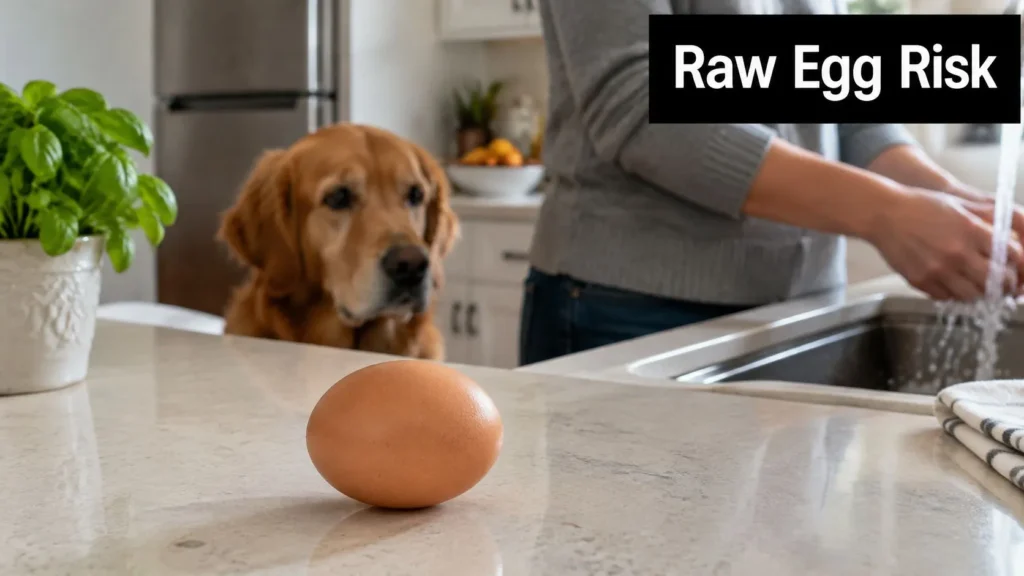
Separate Bacterial Risk From Biotin Concerns
Raw egg raises distinct questions. Bacteria can cause infection or make a dog a carrier, while avidin, a protein in raw egg white, binds biotin and can reduce its absorption.
The WebVet explanation of eggs in canine diets describes cooking as the intervention that controls foodborne bacteria and denatures avidin. Biotin deficiency is primarily a concern with repeated raw-white feeding, not an isolated small accident.
A dog that looks well after eating raw egg hasn’t necessarily escaped exposure. Dogs may carry Salmonella without obvious illness and shed it in saliva or feces, which makes careful handling especially important around children, older adults, pregnant people, and immunocompromised household members.
What the Avian Flu Question Changes
For readers weighing this issue in 2026, the relevant documented regulatory action dates to January 2025, when the FDA required covered pet-food manufacturers using uncooked or unpasteurized poultry- or cattle-derived ingredients, including unpasteurized eggs, to reassess H5N1 controls, according to the SBA Office of Advocacy’s notice about the FDA requirement. That requirement concerns manufacturers and their food-safety plans; it isn’t evidence that every household egg contains the virus.
Dogs and cats can contract H5N1 from infected, unprocessed products. Cooking, pasteurization, or canning can inactivate the virus, which strengthens the case against offering raw, unpasteurized ingredients.
Pasteurized doesn’t mean cooked. It describes a processing step that reduces pathogen risk, not permission to ignore cooking or hygiene.
For broader context, Setterfrens LLC’s guide to raw diet benefits and risks discusses the wider feeding choice. Keep the practical distinction clear: choosing raw ingredients introduces handling and exposure questions that a plain, thoroughly cooked egg avoids.
Respond Calmly to an Accidental Exposure
If your dog eats raw egg, remove the remaining food and clean the bowl, utensils, and contaminated surfaces. Monitor your dog and contact your veterinarian if symptoms develop, if your dog has medical vulnerabilities, or if the egg came from a potentially affected flock.
Backyard or farm-fresh eggs aren’t automatically safer because they’re local. During an outbreak, ask your veterinarian or public-health agency about local advice rather than relying on an egg’s appearance or the absence of symptoms.
Decide Whether Eggs Fit Your Dog’s Diet
The useful question isn’t only “Can dogs eat eggs?” It’s whether this preparation and portion suit this dog.
For a healthy adult dog, plain cooked egg can be an optional treat when it fits the existing feeding plan. For puppies, dogs with ongoing illness, or dogs on restricted diets, get advice matched to their nutritional and medical needs instead of borrowing another dog’s portion.
Make the Decision Before Cooking
- Check the dog. Review body condition, previous food reactions, and any veterinary diet restrictions.
- Check the ingredients. Keep the egg separate from seasoned table food and discard questionable eggs.
- Check the feeding plan. Decide which other extras the egg will replace rather than adding it automatically.
- Check the response. Stop if your dog develops digestive upset or itching, and seek veterinary advice for significant or persistent symptoms.
Don’t combine several new foods in the same meal. If you’re also considering dairy, check whether dogs can drink milk separately so you can make each decision on its own merits.
Before offering egg, note your dog’s current weight and medical limits, then choose a small introductory amount. If you’re unsure how it fits, ask your veterinarian to include egg in a specific treat allowance rather than guessing from breed size.
For approachable explanations of everyday pet-care questions, visit maxijournal.com. Its pet articles and wider health and science coverage help you examine topics such as food safety and feeding choices with clearer questions and practical next steps.
Discover more from Maxi Journal
Subscribe to get the latest posts sent to your email.